








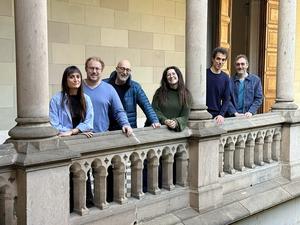


































New research from an international team led by the University of Barcelona has affirmed that the notion of artificial intelligence (AI) possessing genuine creativity is unfounded. The study, published in the journal Advanced Science, concludes that while generative AI models may exhibit characteristics of creative agents, their imaginative processes are fundamentally lacking. This research, which focused on visual creativity and imagination, began during a workshop in 2024 organized by the Fundació Èpica – La Fura dels Baus, aimed at fostering interdisciplinary collaboration across science, technology, and art.
The researchers devised a novel methodology to evaluate creativity through visual-creative tasks based on abstract stimuli. They compared the creative output of an image-generation AI model—assessed both with and without human guidance—against two groups of human participants: professional visual artists and the general public. The AI model was trained using the creative works of the human participants, receiving varying levels of prompts based on the guidance provided during assessments.
The findings were striking, revealing unanimous agreement among evaluators that human creations were more creative than those produced by AI. Evaluators assessed the drawings based on five criteria: liking, vividness, originality, aesthetics, and curiosity. The results showed that professional artists scored the highest in creativity, followed by non-artists, the human-guided AI, and significantly lower scores for the unguided AI model.
Xim Cerdá-Company, a researcher at the Institute for Biomedical Research (IDIBELL) and co-leader of the study, noted that even when trained with human creative outputs, the AI model performed poorly in generating creative images. “In fact, it did even worse when it was deprived of human assistance,” he remarked. This highlights a critical aspect of the research: without human guidance, the AI’s creativity diminished significantly.
The study underscores the need to approach creativity as a multifaceted process rather than merely evaluating outcomes. Cerdá-Company emphasized that current measures of AI creativity often focus exclusively on verbal tasks, presenting a skewed view of AI as a creative agent. “By directly assessing the imaginative process from ideation to execution, we have shown that this is not true,” he explained. The researchers advocate for a more comprehensive evaluation of creativity that encompasses various dimensions of the creative process.
Professor Antoni Rodríguez-Fornells, another co-leader of the study and head of the Cognition and Brain Plasticity research group, echoed this sentiment. He stated that current generative AI models are “still far from replicating independent creative processes,” affirming the essential role of human intervention in multiple stages of the AI creative workflow—from training to idea generation.
Rodríguez-Fornells further clarified that the technical abilities of image-generation AI cannot be assessed in isolation. “The creative process must be explored in its multiple components. In doing so, it becomes clear that AI depends directly on our intervention,” he concluded.
Professor Dan Dediu from the Faculty of Philology and Communication and the Institute of Complex Systems at the University of Barcelona also contributed to the study, which raises significant implications for the future of AI creativity. As the field continues to evolve, understanding the limitations of AI in creative domains will be crucial for integrating this technology into collaborative artistic and scientific endeavors.
See also AI Study Reveals Generated Faces Indistinguishable from Real Photos, Erodes Trust in Visual Media
 Gen AI Revolutionizes Market Research, Transforming $140B Industry Dynamics
 Researchers Unlock Light-Based AI Operations for Significant Energy Efficiency Gains
 Tempus AI Reports $334M Earnings Surge, Unveils Lymphoma Research Partnership
 Iaroslav Argunov Reveals Big Data Methodology Boosting Construction Profits by Billions






