






































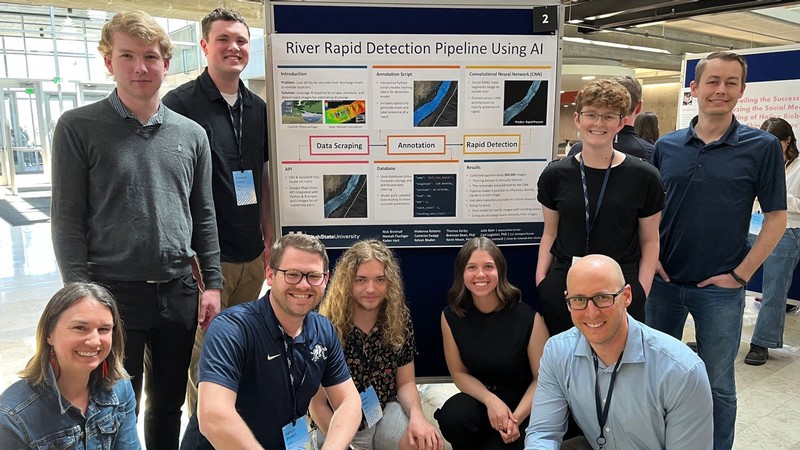
A chance encounter at a seminar hosted by the Utah State University (USU) Ecology Center has led to a significant research collaboration, resulting in a year-long artificial intelligence (AI) project aimed at identifying river rapids through satellite imagery. This initiative produced a publicly available river image dataset, a peer-reviewed paper published in the journal Remote Sensing, and plans for a presentation at the 2026 Spring Runoff Conference scheduled for March 24-25.
USU statistician Brennan Bean recounted that discussions with researchers from the National Park Service (NPS) and the U.S. Geological Survey (USGS) sparked the idea for a real-world challenge to present to a group of undergraduate students enrolled in an applied research course focused on machine learning and AI. “The challenge was to determine whether AI tools could identify certain kinds of rapids in satellite images of rivers,” Bean explained. The significance of this task lies in its potential utility for water managers, allowing them to infer river flow in areas where physical streamgages are absent.
The initial class project aimed to collect approximately 3,000 images to construct machine learning models. However, it evolved into a sophisticated endeavor that culminated in a dataset containing over 280,000 images spanning the continental U.S. and Alaska. “I never dreamed it would develop into a sophisticated, year-long machine learning project that could be shared with river managers and the scientific community,” Bean stated.
Leading the project alongside Bean were Christy Leonard Stegman, adjunct assistant professor at USU’s Department of Watershed Sciences; Julie Bahr from the NPS; and USGS hydrologist Carl Legleiter. The research team also included Kevin Moon, director of the USU Data Science and AI Center. Importantly, it was the students who propelled the project forward, with undergraduate researcher Nicholas Brimhall serving as the lead author on the published paper.
The collaborative effort saw students employing AI techniques to train neural networks capable of isolating rivers in satellite imagery and predicting the presence of rapids. “The class refined an image segmentation model that could isolate rivers in an image, along with a neural network to identify rapids in those images with fairly high accuracy,” Bean noted. The dataset created provides a framework for future hydrologic applications, including discharge estimation and habitat assessment.
Moon emphasized the scale of this dataset, stating, “To the team’s knowledge, no one has developed a river image dataset of this scale. This is one of the first to specifically look at rapids.” He highlighted that the project transformed into a valuable experiential learning opportunity for both undergraduate and graduate students, allowing them to tackle real-world challenges.
Bean remarked on the organic nature of the learning process, stating, “I thought the students did a great job of adapting to the realities of a real data analysis. When something didn’t turn out as expected, they would ask themselves, ‘What’s not working and what do we do?’” This approach fostered an environment that was less scripted and more exploratory.
Statistics doctoral student Kelvyn Bladen will present the findings at the upcoming conference, where the research is expected to spark further dialogue on the intersection of AI and hydrology. The project not only showcases the capabilities of machine learning in environmental science but also underscores the potential for academic collaborations to address pressing ecological issues.
See also AI Study Reveals Generative AI Boosts Productivity in 650 Indian IT Firms, Not Mass Layoffs
 ASEAN Foundation Reveals AI Readiness Gap: 95% of Students Use AI, Only 46% of Educators Do
 AI Models Revolutionize Data Analysis in Neuroscience and Materials Science
 US Department of Energy Launches Genesis Mission to Accelerate Scientific Discovery with AI
 AI’s Rapid Evolution: OpenAI and Anthropic Launch Major Models, Reshape Workforce Dynamics






