

























In a significant development within the global artificial intelligence (AI) landscape, the Chinese startup DeepSeek is reportedly circumventing U.S. export restrictions to acquire advanced AI hardware. Utilizing Nvidia‘s cutting-edge Blackwell chips, which are banned from sale in China, DeepSeek is allegedly training its next-generation AI models amid rising geopolitical tensions. This revelation, highlighted in a report by Yahoo Finance, underscores the lengths to which companies are willing to go to secure vital technology.
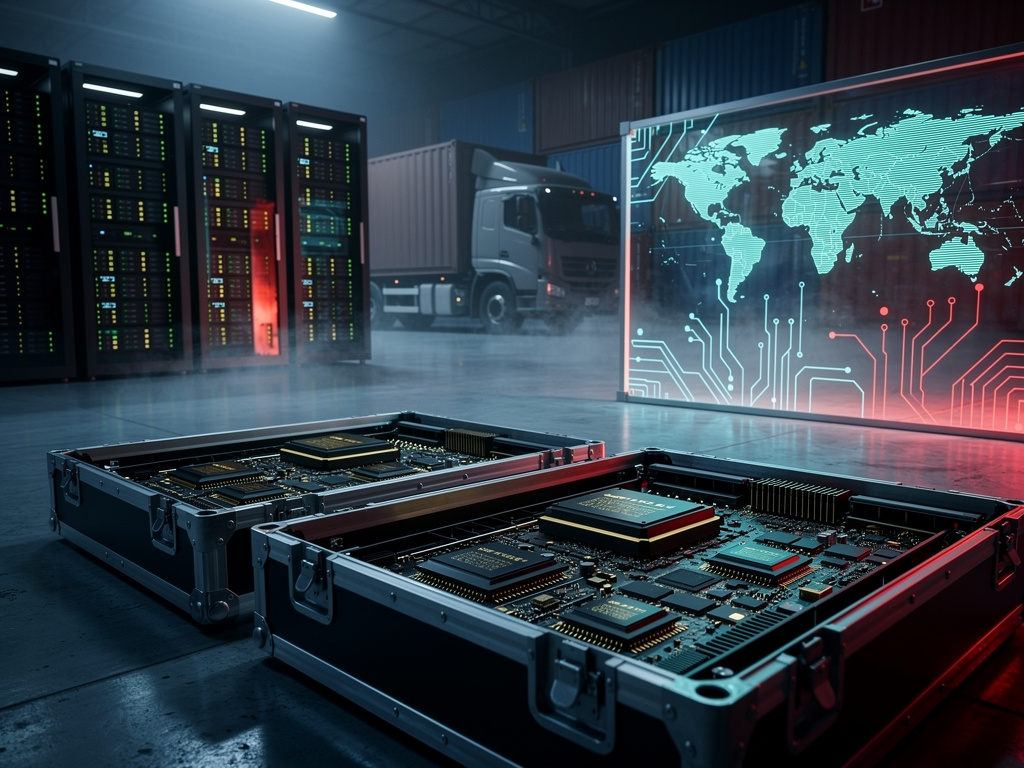
The smuggling operation involved the installation of Blackwell chips in data centers located in countries where their sale is permitted. After being dismantled and inspected by server equipment developers to ensure compliance with export rules, these components were covertly shipped to China. This strategy allows Chinese firms to access hardware deemed too sensitive for export by the U.S. government, which fears it could enhance military or surveillance capabilities. DeepSeek’s actions come at a time when China’s ambitions in AI are increasingly viewed as a national priority, with significant government investment in domestic alternatives to Western technology.
Nvidia, a key player in AI chip manufacturing, has been at the center of these restrictions since they were imposed in 2022 and expanded under the Biden administration to include the latest Blackwell series. In response to the allegations, Nvidia issued a statement to CNBC, denying any knowledge of its chips being used in such a manner and reaffirming its commitment to comply with export controls while pursuing violations aggressively. However, these events raise questions about the effectiveness of U.S. restrictions in curbing China’s advancements.
Industry experts indicate that the smuggling of advanced chips is not a new practice, but the scale and sophistication of this operation are particularly noteworthy. Sources cited by Bloomberg reveal that DeepSeek has leveraged several thousand Blackwell chips, which are highly sought after for their performance in training large language models. This scenario is indicative of a broader trend in which Chinese AI developers are increasingly utilizing black-market channels or overseas data centers to bypass restrictions. Growing discussions on social media platform X reflect a sentiment among tech observers that such workarounds are becoming inevitable.
The rationale behind the U.S. bans is largely rooted in national security concerns. Officials express worries that chips like Nvidia’s Blackwell could enhance China’s capabilities in areas such as autonomous weapons and advanced surveillance systems. However, critics argue that these measures might inadvertently promote China’s self-reliance. Reports from The Information detail how DeepSeek’s strategy not only involves smuggling but also the integration of these chips into secretive development pipelines, potentially enabling the company to release competitive AI models more swiftly than anticipated.
Nvidia’s position in the market adds another layer of complexity. Once dominating China’s AI chip market with a share of 95%, the company’s market presence has reportedly diminished to near zero due to the bans. This shift has compelled Chinese firms like DeepSeek to explore alternatives, including Huawei‘s Ascend chips and other domestically produced solutions. Nevertheless, the allure of Nvidia’s ecosystem, particularly its CUDA software platform, persists, making the acquisition of smuggled hardware an enticing shortcut.
DeepSeek’s rapid rise in a competitive sector highlights its efficiency amid hardware constraints. Founded as part of China’s strategy to rival Western AI giants like OpenAI, the startup garnered attention for training a model on a modest budget of under $6 million, significantly less than its U.S. counterparts. This efficiency is attributed not only to innovative training techniques but also to access to high-end chips like Blackwell, which could enhance the complexity of neural networks and speed up iteration cycles.
The smuggling report has ignited a debate over enforcement measures. Nvidia reiterated through The Times of India that it possesses no evidence of DeepSeek using its chips and pledged to investigate any leads. This denial contrasts with unnamed sources from the initial reporting, creating uncertainty around the situation. Analysts contend that tracking smuggled chips is notoriously challenging due to the global nature of supply chains and the involvement of third-party intermediaries.
Meanwhile, this development coincides with shifts in U.S. policy, as recent reports from The Guardian suggest the incoming Trump administration may consider relaxing some restrictions, potentially allowing sales of specific Nvidia chips like the H200 to China. For now, however, companies like DeepSeek seem willing to navigate gray areas to maintain their competitive edge.
The ramifications for the AI sector extend beyond individual companies. With hardware shortages, Chinese firms are increasingly investing in domestic semiconductor production. Posts on X have circulated rumors indicating that DeepSeek may pivot entirely to China-made GPUs to lessen reliance on Nvidia’s CUDA. Such a shift could democratize AI development by lowering costs and barriers, though it may also fragment the global tech ecosystem into competing silos.
Critics argue that U.S. bans may backfire, as restricting access to advanced chips could accelerate China’s innovation in areas like chip design and alternative architectures. The reported use of smuggled Blackwell chips by DeepSeek exemplifies resilience and adaptability. If confirmed, it may embolden other Chinese startups to pursue similar paths, undermining the intended technological lead.
Nvidia’s stock has experienced volatility in the wake of these claims. While the company has dismissed allegations through various channels, market reactions have been mixed, with premarket dips noted on social media. Investors are weighing risks related to enforcement actions against the backdrop of possible policy changes under new U.S. leadership, which could reopen lucrative markets.
As DeepSeek’s alleged tactics illustrate, the future of AI advancement may hinge on supply chain creativity as much as on raw innovation. If its next model, trained on these contentious chips, meets performance expectations, it could pose a challenge to Western dominance and spark a race toward the development of more efficient, sanction-proof systems.
In conclusion, as stakeholders from Silicon Valley to Shenzhen adapt to these developments, DeepSeek’s approach, if validated, may set precedents for evading sanctions, prompting stronger international cooperation on enforcement. The unfolding situation signals the beginning of a new era where access to advanced technology becomes a battleground for global supremacy in the AI landscape.
See also Autonomous AI Agents Set to Transform Platform Engineering with Self-Governance by 2026
 LG Launches AI Cabin Platform at CES 2026, Redefining In-Vehicle Experiences with Generative AI
 White House Announces Approval for Nvidia’s H200 AI Chips Export to China with 25% Fee
 NED University Achieves Milestone with Pakistan’s First AI-Powered Driverless Car Test
 Broadcom Projects $19.1B Q1 Revenue but Warns of Margin Drop Amid AI Surge