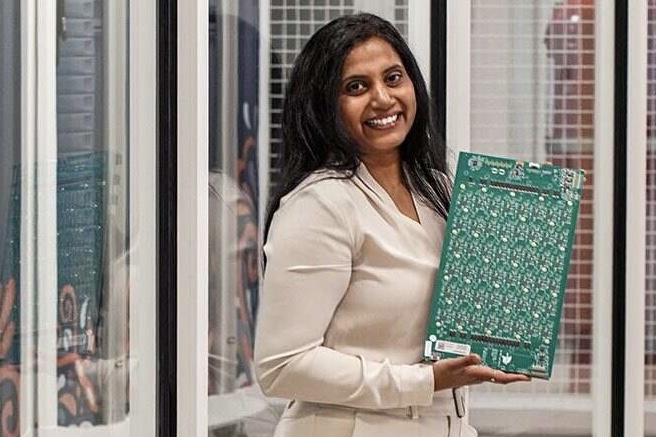
Indian American computer scientist Dhireesha Kudithipudi is spearheading a transformative shift in the American technological landscape by transitioning artificial intelligence away from traditional, power-intensive data centers and toward a more biological blueprint. As the founding director of the MATRIX AI Consortium at the University of Texas at San Antonio (UTSA), she is the driving force behind the launch of THOR: The Neuromorphic Commons, the first open-access hub of its kind in the United States.
Funded by the National Science Foundation, the THOR project aims to democratize access to neuromorphic computing, a field that emulates the human brain’s architecture to process information. Unlike conventional silicon chips that consume vast amounts of electricity regardless of the task, neuromorphic systems are “event-based,” activating only when new data is detected. “THOR is the U.S. national hub for neuromorphic computing,” said Kudithipudi, who also holds the title of Robert F. McDermott Chair in Engineering. “We are democratizing the technology, expanding industry-academia partnerships, and serving as a catalyst for bringing neuromorphic computing closer to real-world applications.”
Historically, such advanced hardware was limited to elite corporate laboratories or well-funded academic institutions. In contrast, UTSA’s initiative functions much like a public library, enabling researchers and students nationwide to apply for free access to conduct experiments, thereby lowering the barrier to entry for future engineers. At the core of this hub is the SpiNNaker2 system, a sophisticated platform comprising approximately 400,000 processing elements. Developed with SpiNNcloud, this hardware utilizes energy-efficient ARM-based cores, akin to those found in smartphones, to simulate the pulsing signals of biological neurons and synapses.
The practical implications of this efficiency are significant. According to the research team, neuromorphic chips could potentially revolutionize medical devices, including pacemakers that adapt in real-time to a patient’s physical distress or hearing aids that intelligently filter background noise without rapidly draining their batteries. Beyond energy savings, Kudithipudi and her team are addressing the issue of “catastrophic forgetting,” a common flaw in AI where machines lose previous knowledge when learning new information. By emulating the brain’s “lifelong learning” capabilities, THOR could pave the way for AI that evolves continuously.
This initiative involves a nationwide collaboration with experts from institutions including UT Knoxville, UC San Diego, and Harvard University. The official launch is slated for February 23, marking a pivotal milestone for the university’s newly established College of AI, Cyber, and Computing. For Kudithipudi, the goal is clear: to ensure that the future of computing is not only more powerful but also more accessible and sustainable for all.
See also AI Sovereignty Requires Interoperability Standards to Avoid Vendor Lock-In, Experts Warn
 Intel, AMD, NVIDIA, and Arm Reveal Strategies to Optimize Silicon for Edge AI Performance
 Department of Education Spotlights Alpha School’s AI-Driven Learning Model, Serving 250 Students
 UC Berkeley Researchers Reveal CATTS Technique, Boosts AI Performance by 9.1% with 2.3x Less Compute
 Meta Expands Nvidia Partnership, Commits to Millions of AI Chips Over Coming Years