




















































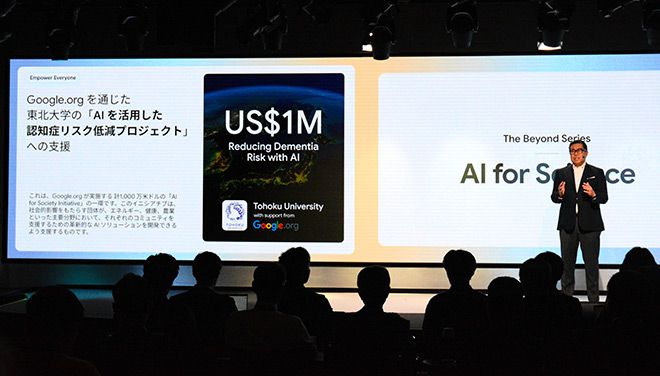
Google LLC is accelerating its commitment to scientific and medical research through partnerships with Japanese universities, leveraging advanced artificial intelligence (AI) technologies along with financial contributions. The tech giant announced a donation of $1 million (approximately 150 million yen) to a research initiative at Tohoku University focused on reducing dementia risk by employing AI.
This announcement coincided with Google’s ongoing collaboration with Kyoto University’s Center for iPS Cell Research and Application (CiRA), which was highlighted during an event in Tokyo. On November 17, Google and the CiRA revealed that they are conducting a joint verification test on an AI-driven system designed to autonomously generate scientific hypotheses.
The partnerships are part of Google’s broader strategy to enhance investment in the field of “AI for Science.” The company has been increasingly channeling resources into scientific initiatives, a move that was underscored by recent accolades received by its researchers. Notably, Google’s team was recognized with both the 2024 Nobel Prize in Chemistry and the 2025 Nobel Prize in Physics, reflecting their contributions to AI-driven research and quantum computing.
One of Google’s flagship AI models, known as AlphaFold, is currently utilized by over 3 million scientists globally, including approximately 150,000 in Japan. This model significantly advances the understanding of protein structures that were once difficult to analyze or predict, marking a substantial contribution to the scientific community.
Pushmeet Kohli, a representative from Google DeepMind focused on scientific AI development, emphasized the potential of non-human intelligence to accelerate scientific progress, suggesting it could lead humanity into a new era. Kohli noted that discoveries facilitated by AI are expected to have commercial implications in the future.
On the same day the funding was announced, Shinji Okuyama, president of Google Japan, outlined a series of initiatives aimed at supporting university and laboratory projects, aiming to further expedite advancements in the field.
The Tohoku University project will employ AI technology to recreate historical views of towns and cities using images, videos, and archival records. This approach aims to investigate whether stimulating cognitive functions through these AI-generated materials can help mitigate the risk of dementia.
In collaboration with Kyoto University’s CiRA, Google began a validation trial in September for the “AI co-scientist” system. This innovative technology analyzes data from various sources and can reportedly suggest appropriate hypotheses for diverse research objectives, including new methods for efficiently producing induced pluripotent stem (iPS) cells.
Hirohide Saito, a biological professor at Kyoto University, praised Google’s technology during the presentation held in Tokyo’s Shibuya Ward. He remarked, “Teaming with the system makes me feel as if I have an additional, exceptionally skilled scientist in my lab. I am seeing firsthand how powerful it is, just as I did at the advent of AlphaFold.” Saito further stated, “The use of AI will become an essential part of science from here on out.”
As Google continues to solidify its role in the scientific domain, its partnerships with leading academic institutions in Japan highlight the growing integration of AI in research. This trend not only aims to enhance academic inquiry but also positions AI as a cornerstone of future scientific advancements and commercial applications.
See also Top 5 AI Stocks for 2026: AMD, Alphabet, and Broadcom Lead Investment Insights
 Google Unveils Budget Tracker and BATS Framework to Enhance AI Tool Efficiency by 31%
 $400B AI Chip Investment Faces Scrutiny as Lifespan Estimates Shorten to 2-3 Years
 FunkyMEDIA Launches AI-Driven SEO Suite to Enhance Brand Visibility and Performance
 Fed Cuts Rates to 3.50%, Verizon Launches Price War Amid Telecom Turmoil