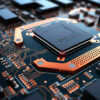














































NUREMBERG, Germany, March 10, 2026, 22:44 CET — Intel unveiled its Core Series 2 processors designed for industrial applications on Monday, while also providing an early glimpse of its Health & Life Sciences Edge AI suite at the Embedded World conference in Nuremberg. This initiative marks a strategic pivot for the company, emphasizing the importance of bringing processing capabilities closer to machines and sensors rather than relying solely on cloud computing. The focus areas include factories, robotics, and patient monitoring systems.
The timing of this launch is particularly critical as Intel, led by Chief Executive Lip-Bu Tan, faces mounting pressure to showcase growth beyond its traditional strengths in the AI data-center market. In January, the company projected first-quarter revenues between $11.7 billion and $12.7 billion, with adjusted earnings expected to hover around break-even—figures that fell short of Wall Street expectations. Intel also acknowledged its struggles to meet demand for server CPUs that are typically paired with Nvidia‘s leading AI chips.
Intel’s new processors are aimed at applications that require reliable and timely responses, referred to as deterministic performance. Each chip can incorporate up to 12 performance cores (P-cores). For the healthcare sector, Intel’s toolkit aims to facilitate the development of AI-driven technologies such as heart rhythm analysis, touch-free vital sign monitoring, and 3D tracking of patients while ensuring privacy.
“The next wave of AI is coming to the edge,” said Michael Masci, Intel’s vice president of product management, during a press briefing. According to analyst Stephen Sopko of HyperFrame Research, Intel’s strategy involves a “two-chip story,” where the Core Series 2 chips are designated for control tasks, while the Core Ultra Series 3 chips handle AI inference operations.
In the competitive landscape, Intel is positioning itself against AMD in embedded processors and targeting Nvidia‘s edge AI hardware. Reports from Tom’s Hardware indicate that Intel has aligned its new chips against AMD’s Ryzen 7 9700X and has spotlighted the Core Ultra Series 3 for robotics, positioning it as a challenger to Nvidia‘s Jetson AGX Orin.
Following the announcement, Intel’s stock rose by 2.6%, trading at $46.78 as of 21:28 UTC on Tuesday, up from a session start of $45.42. The company’s shares experienced an impressive 84% surge in 2025, driven by investor confidence in Tan’s restructuring efforts and a series of external investments.
Tan is actively reshaping the company, as highlighted by a March 4 report indicating that Intel is reconsidering its decision to reserve the 18A manufacturing process primarily for in-house use, now contemplating opening it up to external clients. Concurrently, the company announced that board chair Frank Yeary would resign in May, with chip industry veteran Craig Barratt set to take over.
However, the excitement surrounding the product launch does not alleviate pressing concerns. Michael Schulman, chief investment officer at Running Point Capital, remarked in January that Intel’s recovery remains “supply-constrained rather than demand-constrained.” This comes in light of the company’s decision to withdraw from certain server-chip sales. Additionally, UBS has flagged increasing memory prices as a potential headwind for PC demand this year.
Intel is also encountering new political challenges. Recently, a bipartisan group of U.S. lawmakers, including Elizabeth Warren and Tom Cotton, raised national-security concerns regarding Intel’s use of ACM Research tools, which have connections to China and are currently under scrutiny. Intel contends that ACM’s tools are not utilized in its production processes and asserts compliance with U.S. law.
The Core Series 2 and Core Ultra Series 3 systems are already available, with the Health & Life Sciences suite expected for wider rollout in the second quarter. This launch is part of a broader initiative for 2026, aimed at recapturing market share from AMD in the PC sector and from Taiwan Semiconductor Manufacturing Co. in manufacturing capabilities.
See also Tesseract Launches Site Manager and PRISM Vision Badge for Job Site Clarity
 Affordable Android Smartwatches That Offer Great Value and Features
 Russia”s AIDOL Robot Stumbles During Debut in Moscow
 AI Technology Revolutionizes Meat Processing at Cargill Slaughterhouse
 Seagate Unveils Exos 4U100: 3.2PB AI-Ready Storage with Advanced HAMR Tech