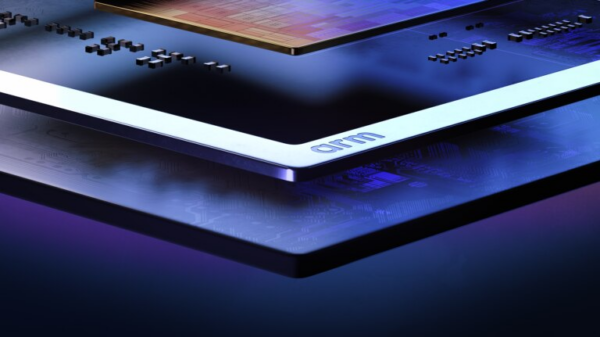
























































Rivian unveiled its third generation in-house autonomy hardware platform, marking a significant advancement in the realm of autonomous vehicles, during its Autonomy and AI Day held today. This platform, known as the Rivian Gen 3 Autonomy Computer, is built around a new custom chip called the Rivian Autonomy Processor (RAP1), which has been developed through a close collaboration with Arm.
At the core of this platform is the Arm compute platform, which utilizes the latest generation Armv9 architecture. This architecture is pivotal for Rivian’s ambitious plans to enhance autonomous capabilities in its future vehicles, enabling them to interpret complex environments and make real-time decisions with precision and safety.
The initiative reflects the growing trend of integrating AI into the physical world, which encompasses vehicles, robotics, and various autonomous systems. This integration requires robust computing power that is not only efficient but also capable of long-term reliability in dynamic settings. The potential market for such physical AI technologies is projected to be worth trillions of dollars, a fact that underscores the importance of the innovations brought forth by Rivian and Arm.
With the launch of the Gen 3 autonomy platform, Rivian highlights its commitment to becoming a leader in AI-driven automotive technology. The RAP1 chip plays a foundational role, leveraging the advanced capabilities of the Arm Cortex-A720AE CPU to enhance the vehicle’s ability to perceive its surroundings, forecast potential scenarios, and execute safe, reliable actions almost instantaneously.
Safety is an integral aspect of this compute platform, woven throughout its design. Rivian has incorporated Arm processors specifically dedicated to executing real-time safety functions. This attention to safety is critical, especially in applications where autonomous systems are responsible for making decisions on roads or in other unpredictable environments.
The collaboration between Rivian and Arm emphasizes the need for high performance at lower power consumption levels. This efficiency allows Rivian to pursue advanced autonomy without sacrificing vehicle range or operational efficiency, an essential factor as AI technologies evolve closer to the edge in both automotive and other autonomous applications. This strategic move positions Rivian not only for current capabilities but also for future scalability across various vehicle generations and applications of physical AI.
Rivian’s third generation autonomy platform serves as a clear illustration of how AI is transforming vehicles and machines. The integration of intelligence, safety, and efficient computing forms the backbone of physical AI applications in real-world settings. Arm’s compute platform, built on the cutting-edge Armv9 architecture, plays a vital role in driving this transformation, facilitating the perception, planning, and control capabilities necessary for the next generation of autonomous systems.
As the world increasingly gravitates towards a multi-trillion-dollar physical AI economy—encompassing mobility, robotics, logistics, and industrial automation—Arm, through its partnership with Rivian, is positioning itself at the forefront of the technological shift. By providing the intelligent, efficient, and safety-capable compute foundation, Arm aims to empower innovators globally to develop the autonomous machines that will define the future.
See also Accenture Launches Anthropic Business Group with 30,000 Trained Engineers to Scale AI Adoption
 Elon Musk Warns AI War Ignites with Nvidia’s Blackwell Chip Transition by 2026
 Tiiny AI Launches Pocket-Sized Supercomputer, Verified as World’s Smallest by Guinness
 Google Invests $1M in AI Research to Combat Dementia with Tohoku University Partnership
 Top 5 AI Stocks for 2026: AMD, Alphabet, and Broadcom Lead Investment Insights