























































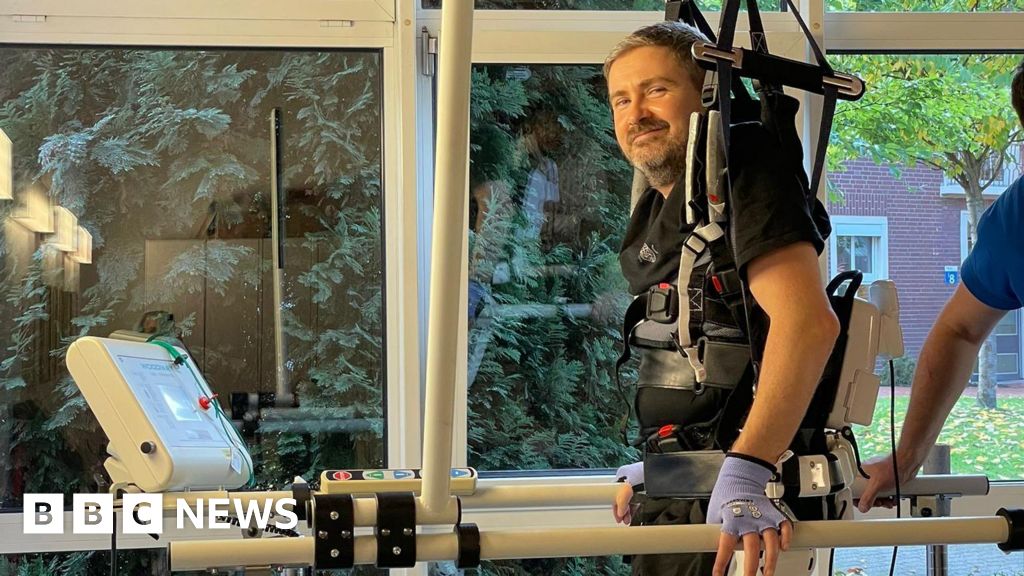
After a New Year’s Eve swim in 2023, Dan Richards’ life changed dramatically following a freak accident at Langland Bay in Swansea. While celebrating the new year with his partner Anna, Richards suffered a severe neck injury after being flipped by a wave and striking the sandy bottom. “I knew instantly that I was paralysed,” the 37-year-old stated, recalling the moment everything changed. “I couldn’t move anything.”
Initially, doctors warned him he would likely be confined to a bed for life. However, two years later, Richards uses a wheelchair, has regained movement in his arms and fingers, and has even walked with the assistance of advanced artificial intelligence technologies in both Wales and Germany. The couple had been enjoying a cold water dip when the incident occurred, a moment Anna vividly remembers. “I just remember looking over and just seeing Dan’s head coming up and then going back under,” she recounted. “We dragged him out. But he was just dead weight.”
As emergency services arrived, Anna recalls her desperate plea to join Dan in the helicopter. After being rushed to a hospital in Bristol, they received life-altering news: Richards was paralysed from the neck down. “How do you phone someone’s mum and say that their son is paralysed?” Anna reflected on the painful phone calls she had to make to family.
As the days turned into weeks, the couple faced new challenges daily, which Anna described as their new reality. “Until you’re in this situation… you don’t realise just how much you have lost,” she said. However, even the slightest movement in Dan’s toes brought a glimmer of hope. “Luckily I’m quite stubborn,” he remarked, eager to begin physiotherapy as soon as possible. “I wanted to work. I didn’t accept what they were saying.”
Richards’ determination paid off; he gradually regained feeling in his legs and core strength, previously thought lost. He emphasized his proud progress: “The feeling in my toes then translated into full feeling through my legs and feet, some movement in my right leg, and being able to hold things.” His private physiotherapy included innovative treatments at a specialist clinic in south Wales, where he utilized a world-first combined system to assist him in walking.
Jakko Brouwers, a neurophysiotherapist from the Morello clinic in Newport, described Dan as “an immensely motivated guy.” The pioneering technology he employed involved a robot designed to replicate normal human gait alongside a stimulation suit equipped with sensors and electrodes to activate muscle activity at precise times. “Through a little bit of algorithm – and dare I say AI – it will start developing a walking pattern,” Brouwers explained.
Richards described the experience as “surreal” but “the best feeling,” motivating him to pursue further research into advanced treatments. Yet, the costs of private physiotherapy and innovative therapies have required support from family and friends, who organized fundraisers, including ultramarathons and charity events. These efforts enabled Dan and Anna to travel to Germany for a trial in October.
In Bochum, Germany, Dan underwent simultaneous treatments: a stem cell procedure directly into his spinal cord and the use of a Hybrid Assistive Limb (HAL) suit, which operates on brain waves. “It’s one of the first times it’s ever been done,” he noted. The suit translates brain signals into movement, gradually allowing him to walk independently. “The more you do it, the stronger the signals get,” he explained, highlighting his optimism about the future.
With six weeks of treatment remaining, Richards faces the challenge of applying for an EU Medical Visa to continue his care. Despite the uncertainties ahead, he remains resolute. “Technology is advancing so fast; things aren’t where they were 10 years ago,” he said, expressing his belief in the limitless potential of modern science. “The more progress I can make now, the better our future will be.”
See also Amazon Enhances AI Workflows with GenAI Learning Systems for Global Enterprises
 ByteDance Plans $14B Nvidia AI Chip Purchase to Boost Computing Power by 2026
 AI Workshop Reveals Effective Strategies for Implementing AI in AEC Projects
 US Army Launches AI Officer Corps to Transform Military into Data-Centric Force
 AI Chip Demand Surges to $400 Billion in 2025, Projected to Reach $800 Billion by 2026