





















































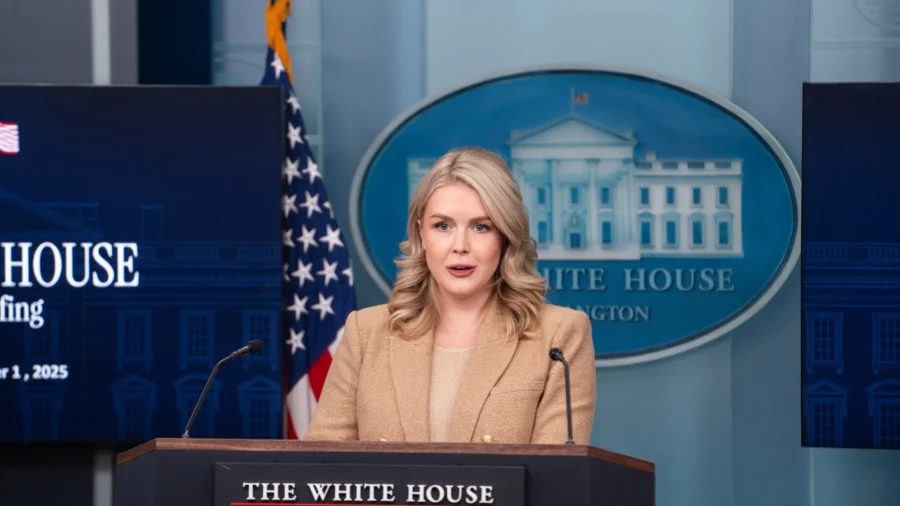
Plans to sell Nvidia’s H200 chips to Chinese customers align with national security policy and export controls, according to White House press secretary Karoline Leavitt during a December 11 briefing. Leavitt emphasized that the Biden administration maintains a strict export control regime, ensuring that advanced technologies, including the H200 chips, undergo security inspections in the United States prior to any shipment to China.
On December 8, former President Donald Trump announced via Truth Social his intention to approve sales of Nvidia’s H200 artificial intelligence (AI) chips to “approved customers” in China. He claimed to have spoken with Chinese Communist Party leader Xi Jinping, who responded positively to the decision. This marks the first occasion in which non-modified versions of Nvidia’s Hopper line of AI chips will be permitted for export to China.
Previously, Nvidia had developed the H800 and H20 chips specifically for the Chinese market, which were downgraded versions of the H100 and H200 chips, as mandated by U.S. export controls. Trump criticized this policy on social media, arguing that it forced American companies to produce inferior products for foreign markets.
Nvidia’s Blackwell line represents its latest generation of AI chips. The company plans to introduce the more advanced Rubin AI chip next year; however, neither of these chips will be approved for export to China. As it stands, Chinese firms predominantly rely on the Nvidia H20 chip, which the Trump administration contemplated banning in April before ultimately reversing that decision. Trump had also suggested that 15 percent of H20 sales should be remitted to the United States, though this policy did not come to fruition.
Following Trump’s reversal on H20 chips, Chinese officials called upon Nvidia representatives in Beijing to allay concerns regarding potential security vulnerabilities in its products. Concurrently, trade organizations in China have urged companies to reduce their reliance on American chips and to seek out domestic alternatives. Despite the policy reversal, Nvidia CEO Jensen Huang stated that the company had not received any orders for H20 chips from China.
Trump’s announcement regarding the H200 sales included a stipulation of a 25 percent fee, and other American chip manufacturers will also have similar allowances. However, these companies must still apply for export licenses and secure approval from relevant agencies before selling to Chinese customers. This move has drawn criticism from lawmakers advocating for stricter chip export controls to China, particularly as competition in the AI sector intensifies between the two nations.
The implications of these developments extend beyond immediate market dynamics, reflecting the ongoing geopolitical tension and competition in technology between the United States and China. As both countries vie for supremacy in AI, how this policy evolves could significantly impact the landscape of international technology trade and collaboration.
See also NED University Achieves Milestone with Pakistan’s First AI-Powered Driverless Car Test
 Broadcom Projects $19.1B Q1 Revenue but Warns of Margin Drop Amid AI Surge
 Chindata and HEC Launch Gigawatt AI Compute Projects in Shaoguan and Ulanqab
 Cambricon Targets 500,000 AI Chips by 2026 Amid Supply Challenges and Rising Demand
 CYBRET AI Launches Autonomous Cyber Defence Systems Backed by Leading Nordic VCs