














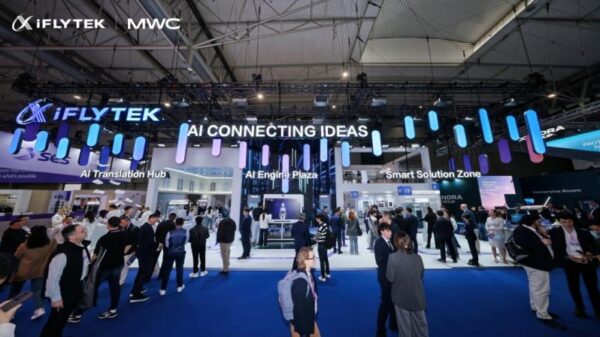
































China is asserting its position as a global leader in artificial intelligence (AI), with notable advancements in various applications, according to Pan Jiaofeng, a deputy to the National People’s Congress and president of the Institutes of Science and Development at the Chinese Academy of Sciences. In an exclusive interview with China Perspective, Pan expressed confidence that China has become a frontrunner in AI development, particularly through its focus on application-driven innovation.
During the discussion, Pan emphasized that China’s achievements in AI are built on a foundation of robust scientific and technological capabilities. He noted that the country’s vast domestic market and the richest variety of application scenarios create a fertile environment for AI deployment. “China’s success in AI is based on its existing scientific and technological capabilities,” Pan stated, highlighting how these elements contribute to the nation’s technological edge.
Pan pointed to the extensive use of AI large models as a critical measure of progress, asserting that China has surpassed the United States in this regard, nearly doubling the usage levels seen in the U.S. “This shows that in application-driven development, China is ahead in this regard,” he remarked, underscoring the significance of these figures for the global AI landscape.
Despite acknowledging existing gaps in high-end chips and foundational model architectures, Pan expressed optimism about China’s trajectory in AI. He believes that continued innovation driven by practical applications will eventually lead to breakthroughs in upstream technologies. “The development of AI has now entered a critical stage of large-scale implementation and application,” he elaborated, suggesting that China is poised to sustain its competitive edge.
As the Spring Festival Gala recently demonstrated, the advancements in application-driven AI development are becoming increasingly visible to the public. Pan noted that the event illustrated the milestones achieved thus far and set clearer expectations for future technological progress in China. “In applications, we are on par with the United States, and perhaps even slightly ahead,” he added, while acknowledging that original innovation remains an area where there is still work to be done.
This perspective aligns with broader trends in the global AI space, where the race for dominance is intensifying. As nations increase their investment in AI technologies, the implications for economic competitiveness and technological leadership are significant. The emphasis on application-driven innovation reflects a strategic choice by China to leverage its unique market conditions and existing capabilities to foster growth in this critical sector.
Looking ahead, the implications of China’s advancements in AI extend beyond national borders. As countries worldwide grapple with the challenges and opportunities presented by AI, China’s approach may serve as a model for others aiming to leverage technology for economic and social progress. Pan’s insights underscore the importance of balancing application-driven efforts with foundational research to ensure long-term sustainability and innovation in the rapidly evolving landscape of artificial intelligence.
See also AI Transforms Health Care Workflows, Elevating Patient Care and Outcomes
 Tamil Nadu’s Anbil Mahesh Seeks Exemption for In-Service Teachers from TET Requirements
 Top AI Note-Taking Apps of 2026: Boost Productivity with 95% Accurate Transcriptions
 Machine Learning Tools Transform Materials Discovery, Enhancing Semiconductor Efficiency