











































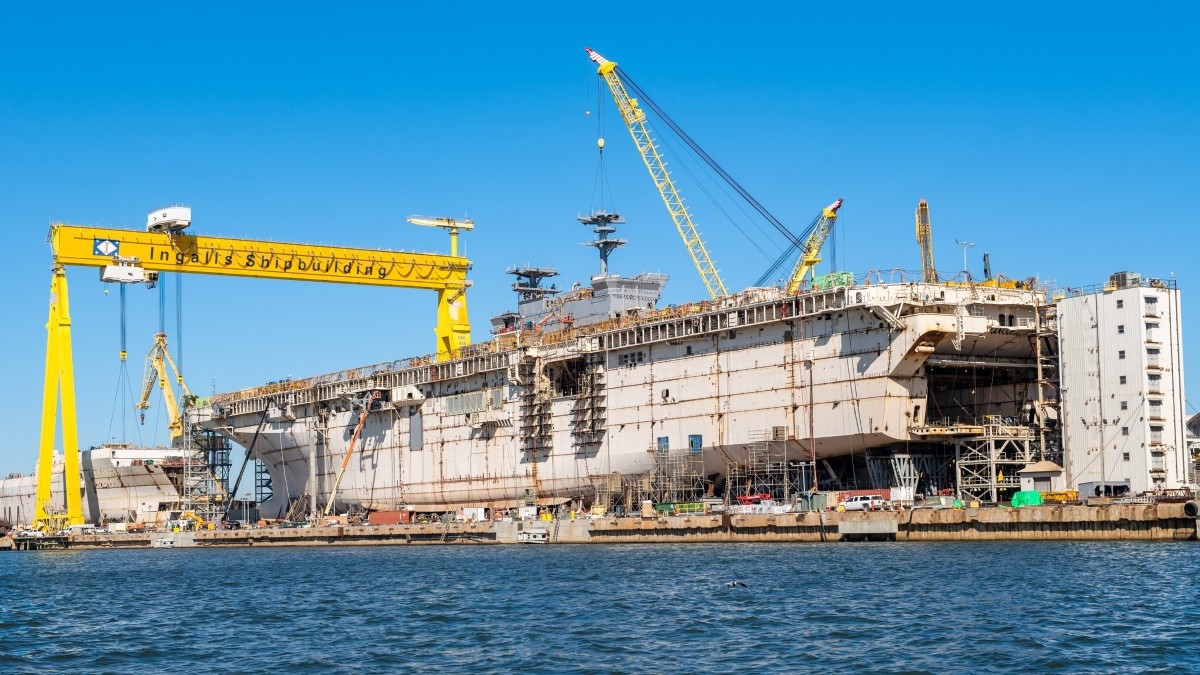
In an exclusive interview, Eric Chewning, executive vice president of maritime systems and corporate strategy at HII, discussed the challenges and innovations facing America’s largest military shipbuilder. With shipbuilding historically slow to adopt advanced technologies like AI, Chewning shared insights on cultural shifts, collaboration with startups, and the strategic importance of revitalizing the industrial base.
Chewning acknowledged that while HII has employed advanced automation for years, shipbuilding’s unique requirements have limited AI’s initial applications. “In shipbuilding, you need ten thousand tasks done once,” he explained, contrasting it with other manufacturing sectors that benefit from repeated tasks. He emphasized that successful AI adoption hinges on demonstrating value to experienced shipbuilders, many of whom have decades of expertise in traditional methods.
To facilitate this transition, HII is focused on change management, promoting pilot projects and cultivating internal champions. Collaborations with firms like C3 AI have yielded promising results, particularly in machine shop planning, where a pilot program showed significant scheduling improvements. “We’re building a culture where shipbuilders see AI as a tool that amplifies their expertise rather than replaces it,” Chewning noted.
Despite HII’s advanced AI environments through its mission technologies division, Chewning highlighted the challenges in translating these capabilities to shipyards. The fragmented data systems and the unique production data in naval shipbuilding complicate AI integration. “In naval shipbuilding, we might produce 10 units of a class, each with significant design evolutions,” he said, explaining the difficulty in leveraging learnings across builds.
In addressing these data challenges, Chewning pointed to HII’s initiative to create a digital thread that connects disparate systems, ultimately allowing AI to optimize production scheduling effectively. This integrated approach is expected to yield benefits not only in shipbuilding but across various manufacturing environments, including unmanned vehicles.
Chewning’s experience as deputy assistant secretary of defense for industrial policy provides him with a unique perspective on the industrial base challenges identified in the Executive Order 13806 report. He noted that HII has significantly increased throughput in its shipyards, achieving a 14 percent increase last year and targeting a further 15 percent increase by 2026, driven by strategic investments and a five-part strategy.
This strategy includes expanding capacity through acquisitions, investing in Industry 4.0 technologies, and outsourcing work to smaller shipyards, thereby creating jobs while improving efficiency. Notably, HII plans to increase its workforce significantly, hiring 6,600 new shipbuilders in 2025 and 2026, in response to the growing demand for skilled labor.
On the topic of new entrants in the shipbuilding market, Chewning emphasized HII’s proactive approach to collaborating with startups, particularly in unmanned vehicles and digital tooling. Partnerships with companies like Path Robotics aim to integrate advanced welding technologies into operations, enhancing overall efficiency and capabilities.
Chewning also underscored the vital role of state and local governments in supporting shipbuilding reindustrialization. He suggested that governments should focus on developing workforce pipelines, improving infrastructure and permitting processes, and ensuring tax and land-use stability. “Shipyards are capital-intensive and waterfront dependent,” he explained, highlighting the need for predictable regulatory environments to attract investment.
Reflecting on his experiences, Chewning expressed a newfound understanding of America’s workforce development challenges. He noted that HII is addressing these issues through a robust apprenticeship program, rooted in a long-standing tradition of cultivating talent in shipbuilding. “The Apprentice School at Newport News Shipbuilding was founded in 1919 and is the preeminent apprenticeship program in the nation,” he remarked, emphasizing the importance of skilled trades for future growth.
As HII continues to innovate and adapt to the changing landscape of defense and shipbuilding, Chewning’s insights reveal the importance of combining traditional expertise with modern technology to ensure the industry’s future resilience and competitiveness.
See also AI Transforms Health Care Workflows, Elevating Patient Care and Outcomes
 Tamil Nadu’s Anbil Mahesh Seeks Exemption for In-Service Teachers from TET Requirements
 Top AI Note-Taking Apps of 2026: Boost Productivity with 95% Accurate Transcriptions
 Machine Learning Tools Transform Materials Discovery, Enhancing Semiconductor Efficiency