



















































In a significant advance for quantum computing, researchers including Yuri Alexeev, Marwa H. Farag, Taylor L. Patti, Mark E. Wolf, and Alán Aspuru-Guzik have published findings in Nature Communications on December 2, 2025, exploring the integration of artificial intelligence (AI) with quantum computing (QC). The study addresses critical challenges in scaling quantum systems, proposing that a robust blend of fault-tolerant quantum hardware and accelerated supercomputers could yield quantum supercomputers capable of solving previously intractable problems. This transition from noisy intermediate-scale quantum (NISQ) devices to fault-tolerant quantum computing (FTQC) presents substantial hurdles, underscoring the necessity of leveraging AI’s data-driven capabilities.
The integration of AI into quantum computing is seen as a pivotal strategy for tackling scaling difficulties. AI’s adeptness at navigating complex, high-dimensional mathematics aligns well with the intricacies of quantum systems. This synergy seeks to expedite advancements across the entire QC workflow, from hardware design to optimizing algorithms, thereby facilitating the development of more powerful quantum computers.
One key area where AI is making an impact is in the development of more effective quantum error correction (QEC) codes and faster decoding algorithms. Current qubit modalities face challenges with hardware noise, which hampers fault-tolerant computations. AI techniques could mitigate these constraints by enhancing the design of QEC codes and accelerating algorithm development, thus shortening the timeline to practical quantum applications.
Despite promising developments, the research highlights significant limitations of AI in quantum settings. As a classical paradigm, AI struggles to efficiently simulate quantum systems, primarily due to exponential scaling constraints. Tools like GroverGPT-2 illustrate this challenge, demonstrating that while AI can alleviate some classical resource bottlenecks in simulating quantum circuits, it cannot entirely replace the need for quantum hardware. In essence, AI functions as a complementary tool, aiding in the development and operation of quantum computers.
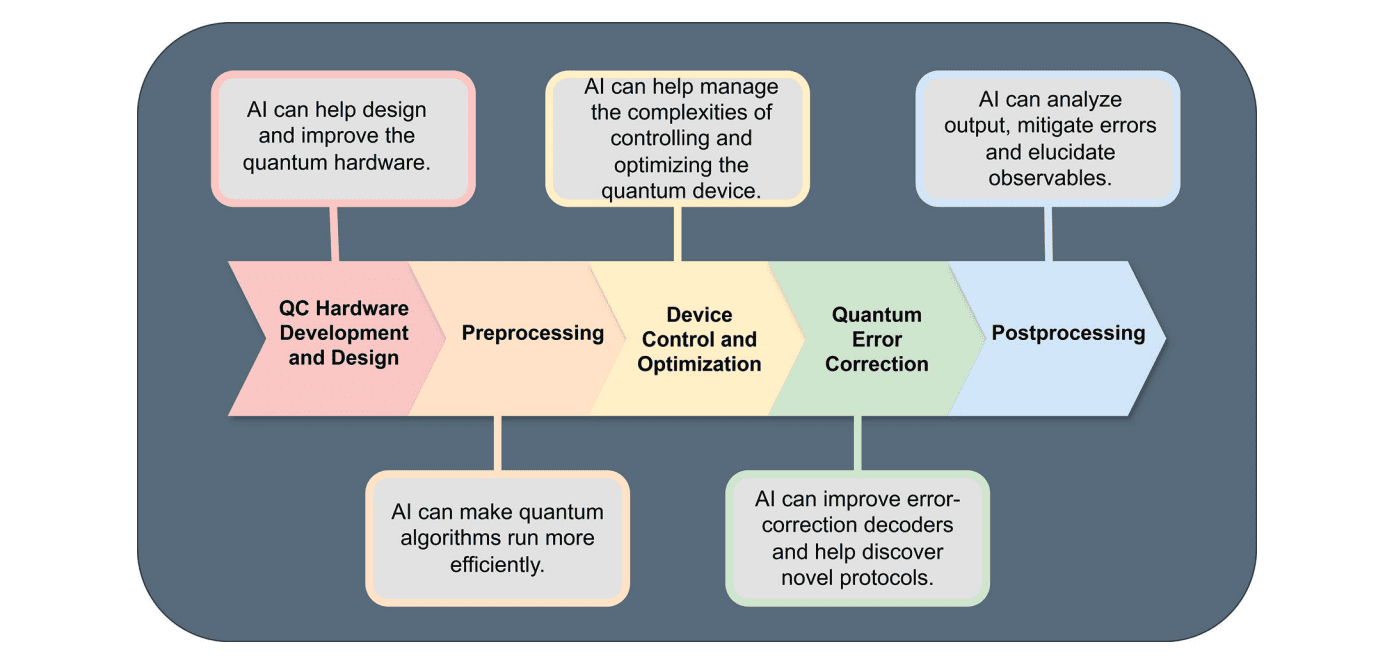
The review underscores AI’s potential to address scaling challenges in quantum computing, indicating that breakthroughs in AI could lead to substantial advancements in quantum hardware. The complexity of quantum mechanical systems plays to AI’s strengths in pattern recognition and scalability, which may drive significant progress in the field. AI’s role spans the entire QC workflow, encompassing preprocessing, device control, optimization, and quantum error correction, thereby enhancing each stage of quantum computation.
AI’s utility also extends to algorithm development, where foundational models like transformer architectures, notably those popularized by OpenAI, are emerging as effective tools in quantum research. These models are being leveraged across various applications, from biomedical engineering to materials science, and are now finding utility in quantum hardware research and algorithm development.
Nonetheless, the limitations of AI in simulating quantum systems remain pronounced. The review indicates that classical simulations encounter exponential growth in computational requirements and memory constraints, thereby limiting the size of quantum systems that can be effectively modeled. For instance, while GroverGPT-2 utilizes large language models to simulate Grover’s algorithm, it faces practical limitations in handling larger circuits due to maximum context length restrictions.
As researchers work to transition from NISQ to FTQC, the collaboration between AI and quantum computing is increasingly viewed as a vital pathway to overcoming critical obstacles. The focus is on integrating AI techniques throughout the quantum computing workflow, emphasizing that while AI will not replace quantum hardware, it will serve to enhance the capabilities and functionalities of quantum systems.
Ultimately, as advancements in AI continue to unfold, the potential for creating accelerated quantum supercomputers capable of solving complex scientific and industrial challenges appears more tangible. By harnessing AI’s strengths, researchers aim to unlock the full power of quantum computing, with implications that could resonate across various sectors, from materials science to optimization problems in chemistry.
See also Morgan Lewis Advises Nebius on $3B AI Infrastructure Deal with Meta
 C-Suite Executives Report Critical Gaps in AI Preparedness Amid Rising Costs, HFMA Finds
 AI Revolutionizes Global Health: 400M Women to Be Screened, Tackling Cervical Cancer and Parasites
 NVIDIA’s GB200 NVL72 Achieves 10x Speed Boost for Mixture-of-Experts AI Models
 Europe’s AI Data Centers Face Urgent Sovereignty, Energy, and Environmental Struggles