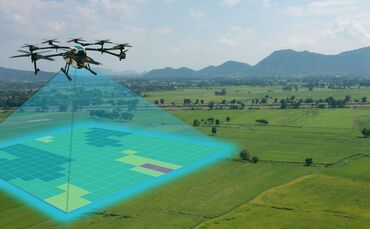























































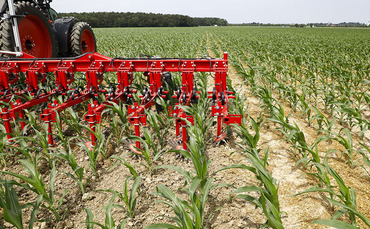
Artificial Intelligence (AI) is poised to enhance agricultural sustainability, but experts at the Institution of Agricultural Engineers (IAgrE) AI conference warned that the technology also entails a notable carbon and water footprint. Fernando Auat Cheein, a robotics expert from Harper Adams University, emphasized the energy demands associated with training and operating AI systems, asserting that sustainable practices are crucial for the benefits of AI to be realized in the agricultural sector. He referenced a report from the Royal Academy of Engineering that underscores these escalating concerns.
Despite these challenges, speakers at the conference highlighted AI’s potential to minimize the environmental impact of agriculture. Professor Simon Pearson from Lincoln University, who received the IAgrE Award of Merit, pointed to advancements in nitrogen use efficiency as a significant example, where AI-driven precision could cut costs and reduce carbon emissions. Kieran Fitzgerald, vice president of digital services at DeLaval, outlined how early disease detection in dairy herds can mitigate production losses, thereby lessening the environmental costs associated with milk production.
The conference also delved into AI’s role in supporting regenerative farming practices. Jonathan Henry, managing director of Garford Farm Machinery, stressed the symbiotic relationship between AI and detailed soil health analysis, which is essential for successful regenerative approaches. Professor Pearson noted that AI can help navigate the uncertainties inherent in regenerative farming, accelerating improvements and providing traceability that consumers and regulators increasingly demand.
One delegate reminded attendees that “AI is a machine, not a being,” framing the technology as a tool that must justify its environmental costs through demonstrable advancements in agricultural efficiency and sustainability.
The reliance on cloud-based AI systems brought another crucial issue to light during the conference. Fitzgerald revealed that a recent hack related to AWS (Amazon Web Services) disrupted DeLaval’s entire system, illustrating the vulnerabilities faced by farms dependent on cloud computing. “If you have business-critical services in the cloud, you will fail at some point,” he warned delegates, highlighting the risks associated with relying entirely on cloud-based AI for daily operations, including automated milking systems and decision-support platforms.
Morten Bilde, managing director at AGCO, discussed the significant challenges posed by the dependence on cloud computing, particularly in rural areas where connectivity may be limited. The speakers suggested that edge computing—processing data locally on farming equipment—could provide a solution to these challenges. However, implementing edge computing presents its own set of difficulties, as systems must remain reliable in harsh environments characterized by dust, moisture, and temperature extremes.
Allan Kildeby, head of camera sensors at CLAAS, noted that hardware accelerators and localized processing capabilities are becoming essential components of agricultural AI systems. AGCO’s mixed fleet strategy, which favors the integration of various machines and systems rather than creating closed ecosystems reliant on a single provider, was highlighted as a strategy to mitigate the risk of total system failure. Their forest harvester solution, developed as an aftermarket kit, exemplifies this approach.
Henry underscored the necessity of rigorous testing and verification to ensure that AI systems remain trustworthy in real-world farming conditions, where consistent internet connectivity is not always assured.
As the agricultural industry continues to explore the integration of AI into its practices, the need for sustainable and resilient solutions becomes increasingly apparent. The conference highlighted that while AI holds significant promise for improving efficiency and reducing environmental impacts, a balanced approach that considers the technology’s own footprint is essential for its long-term viability in agriculture.
READ MORE: Farming in Five by Farmers Guardian
READ MORE: Environmental reps walk away from Scottish Gov’s ‘failed’ farming policy
See also MiniMax Secures Alibaba, ADIA Backing for $600M Hong Kong IPO in Early 2026
 Google DeepMind Co-Founder Shane Legg Warns AI Will Disrupt Digital Skill Jobs First
 Meta Acquires Manus to Enhance AI Agents Platform, Aiming for Scalable Automation Solutions
 Notre Dame Secures $50.8M Grant to Advance National AI Ethics Initiative with DELTA Network