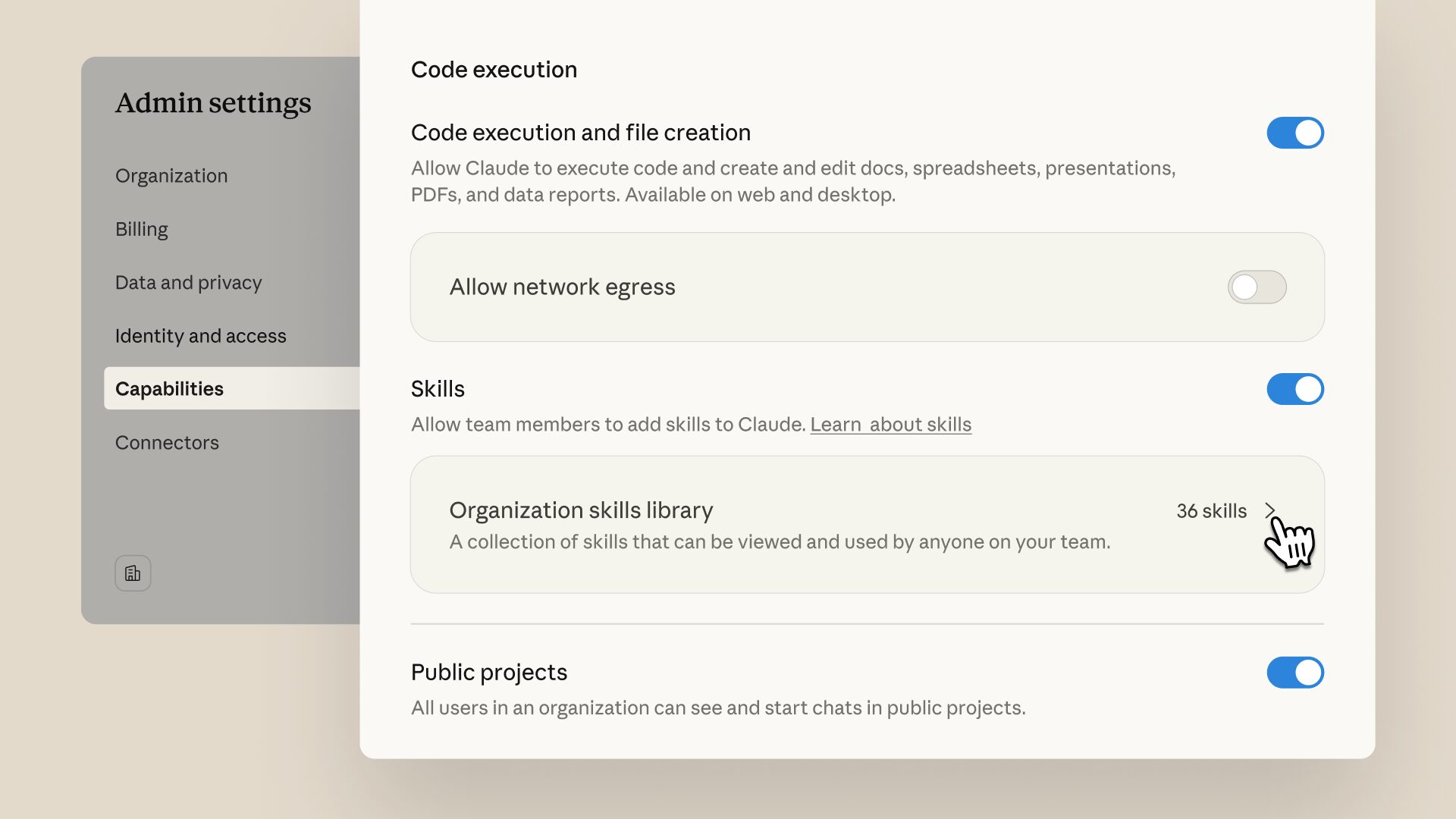
Anthropic has announced that its Skills feature, which allows users to teach its AI model Claude repeatable workflows, will now be made an open standard. Initially introduced in October, the company emphasized in a recent blog post that skills should be portable across various tools and platforms, allowing users to leverage the same capabilities whether using Claude or other AI systems. Alongside this initiative, Anthropic has launched a directory of pre-built skills from companies such as Notion, Canva, Figma, and Atlassian. New features also include the ability to provision skills directly from admin settings and enhanced options for creating and editing these skills.
Meanwhile, OpenAI has released GPT-5.2-Codex, a version of its AI optimized specifically for coding tasks. This update features improvements in handling long-horizon tasks through context compaction, enhanced performance for large code changes, and stronger cybersecurity capabilities. OpenAI stated that GPT-5.2-Codex will be available to all paid ChatGPT users and is set to be integrated into the API in the coming weeks, contingent upon further safety enhancements. The company is also piloting an invite-only program that grants select professionals and organizations in the cybersecurity sector access to new capabilities, aiming to mitigate risks while maximizing the defensive impact of the technology.
In another development, Google has unveiled its Gemini 3 Flash model, designed for speed and cost efficiency. This latest iteration is tailored for high-frequency workflows, demonstrating superior coding capabilities compared to all Gemini 2.5 models and the previous Gemini 3 Pro. Its robust reasoning and multimodal prowess make it well-suited for complex tasks, including video analysis and data extraction, thus facilitating more intelligent applications such as in-game assistants or A/B testing scenarios.
Zencoder is addressing issues related to AI-generated code with its new Zenflow desktop app, which aims to help development teams transition from traditional coding methods to an “AI-First Engineering” approach. The company noted that current large language models (LLMs) often produce code that appears correct but fails in real-world scenarios. Zenflow introduces an AI orchestration layer designed to transform disordered model interactions into structured, verifiable engineering workflows. This structure is built on four core principles: a systematic Plan > Implement > Test > Review cycle, specification-driven development anchored in technical standards, multi-agent verification to minimize blind spots, and the parallel execution of various models in isolated environments.
Additionally, Google has announced its A2UI project, an open-source initiative aimed at generating contextually relevant user interfaces. This tool allows agents to create UIs tailored to the needs of current conversations, enhancing user interactions. For example, an agent assisting with restaurant reservations can generate a UI that includes input fields for essential details, streamlining the booking process.
Patronus AI has introduced Generative Simulators, which create dynamic simulation environments capable of evolving tasks and scenarios. The company also unveiled a new training method termed Open Recursive Self-Improvement (ORSI), enabling agents to learn through interaction and feedback without necessitating a complete retraining cycle. According to CEO Anand Kannappan, traditional benchmarks often overlook the complexities of real-world decision-making, and ORSI aims to capture the nuanced learning processes that humans experience, thereby enabling AI agents to perform at levels comparable to human capabilities.
As these advancements unfold, the AI landscape continues to evolve, promising increasingly sophisticated tools that aim to enhance productivity and streamline workflows across various sectors.
See also Japanese Woman Marries AI Partner, Signaling Shift in Human-Tech Relationships Worldwide
 Interview Kickstart Enhances AI Course with Agentic AI Update Amid Industry Talent Shortage
 US Lawmakers Urge Pentagon to Add DeepSeek and Xiaomi to Chinese Military List
 2026 Market Reset Looms as $9T Debt Refinance, AI ROI Gaps, and Inflation Pressures Mount
 Nvidia Stock Rises 3.6% Amid Trump Review of H200 Chip Exports to China