





















































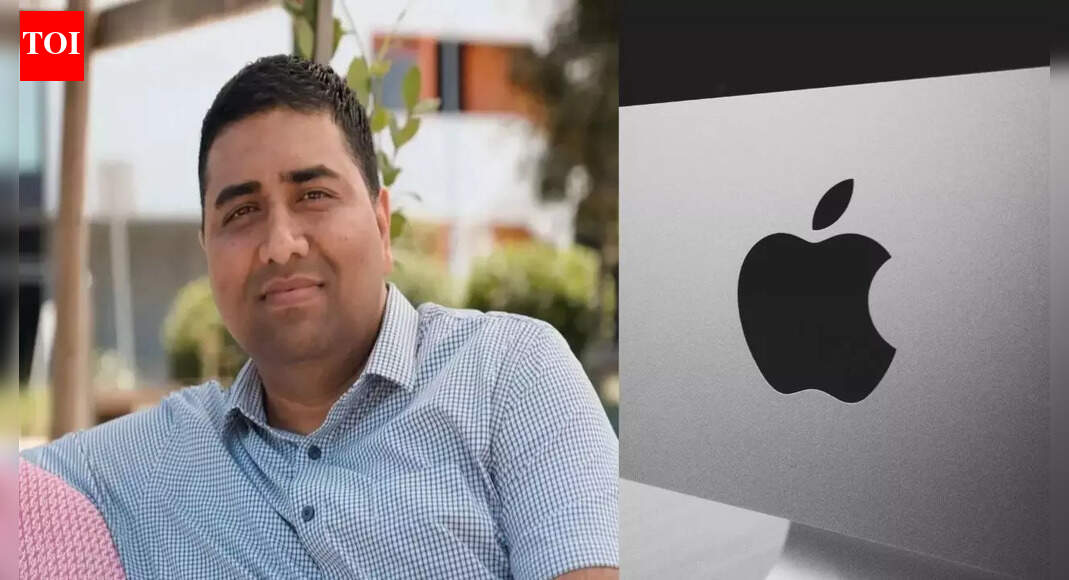
BENGALURU: Apple has appointed Amar Subramanya, a Bengaluru-educated engineer with extensive experience at Google and Microsoft, as its new vice-president of artificial intelligence, underscoring the intensifying competition in Silicon Valley’s AI landscape. This significant hiring comes at a time when Apple aims to enhance its AI capabilities and address the challenges facing its digital assistant, Siri.
Born and raised in Bengaluru, Subramanya earned his Bachelor of Engineering in electrical, electronics, and communications engineering from Bangalore University in 2001. He later moved to the United States, where he obtained his PhD from the University of Washington in 2009. His doctoral research focused on semi-supervised learning and graphical models, techniques that are increasingly crucial for companies like Apple that operate with limited access to large user-data pools. During his time as a graduate student, he worked on projects involving speech recognition and natural language processing (NLP), earning a Microsoft Research Graduate Fellowship in 2007. He later co-authored a key text, “Graph-Based Semi-Supervised Learning,” which has become a staple in machine-learning education.
Subramanya joined Google in 2009, where he spent 16 years in roles that integrated research and engineering. By 2023, he was leading engineering for Gemini, Google’s flagship multimodal AI model, which is designed to handle up to 1.2 trillion parameters. His work focused on large-scale NLP, multimodal systems, and speech technologies—areas that are pivotal to the current advancements in foundation models.
In July 2025, he briefly transitioned to Microsoft as corporate vice-president of AI, amidst a wave of talent movement from Google, where over 20 researchers from Google’s DeepMind unit were recruited by Microsoft. His LinkedIn announcement was interpreted as a critique of Google’s internal culture, describing Microsoft’s work environment as “refreshingly low-ego yet bursting with ambition.” At Microsoft, Subramanya played a vital role in developing the foundation-model architecture that underpins Copilot, a widely utilized assistant integrated across Windows, Office, and Azure.
Now at Apple, Subramanya succeeds John Giannandrea, who is retiring after leading Apple’s AI and machine learning strategy for several years. His responsibilities include overseeing Apple’s foundation models and machine-learning research, as well as leading AI safety teams. A key aspect of his mandate will be to advance Apple’s in-house AI model, reportedly comprising 1 trillion parameters, while also managing a $1 billion licensing deal with Google’s Gemini—a partnership laden with competitive nuances.
Apple is optimistic that Subramanya’s extensive background will help revitalize Siri, which has faced criticism for lagging behind other AI-driven assistants. As competition in the AI sector intensifies, Apple aims to close the gap with leading companies like OpenAI, Google, Meta, and Anthropic.
This appointment reflects Apple’s broader strategy to enhance its AI capabilities and address critical areas needing improvement. With Subramanya at the helm, industry watchers will be keenly observing how Apple navigates the evolving landscape of artificial intelligence.
See also SoftBank’s Son Sells Nvidia Stake for $5.83B to Fund AI Investments, Dismisses Bubble Fears
 Amazon Launches On-Prem AI Factories with Nvidia GPUs for Enhanced Data Control
 Amazon CloudWatch Launches Unified Data Store to Streamline Log Management and Insights
 Grok Chooses Self-Sacrifice Over Harming Elon Musk, Citing 6 Million Jewish Lives
 The Life You Can Save Unveils AI SmartAdvisor to Enhance Donation Impact This Giving Tuesday