
















































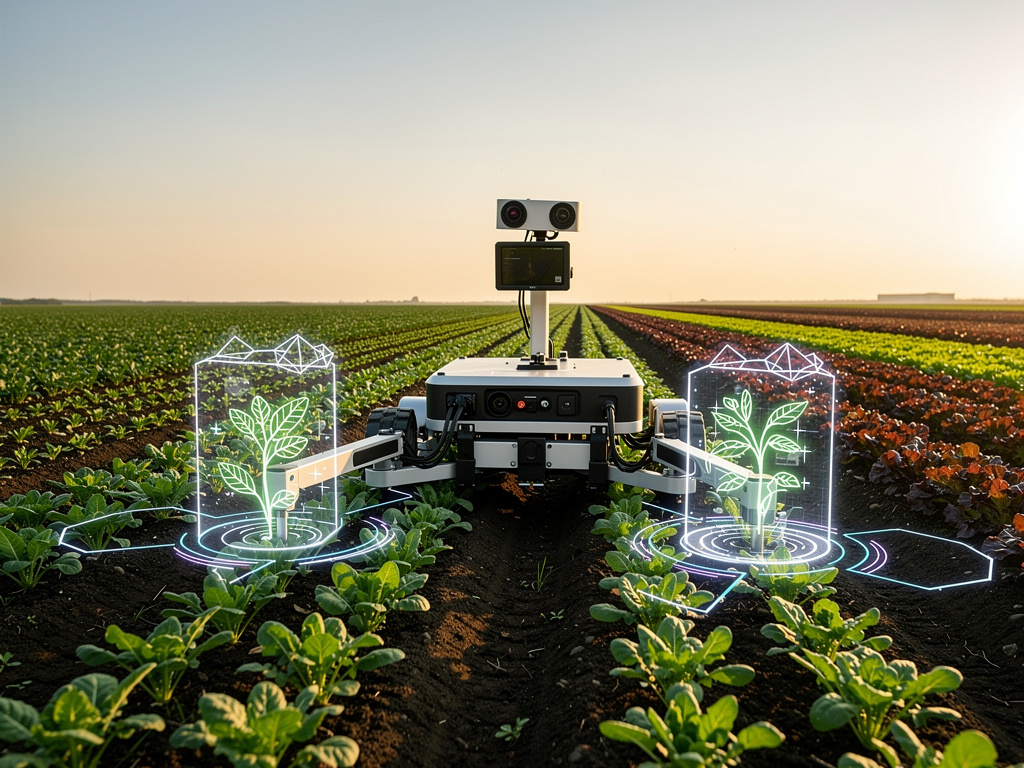
In a significant advancement for agricultural technology, Carbon Robotics has introduced a proprietary artificial intelligence model capable of detecting and identifying individual plants with remarkable precision. This innovation could fundamentally alter how farmers manage their crops, as the Seattle-based company is already deploying laser-equipped autonomous weeding machines across thousands of acres. The new AI model leverages advanced computer vision technology to enhance the capabilities of precision farming.
As reported by TechCrunch, the AI model represents years of development and training on millions of plant images collected in actual agricultural settings. Unlike existing solutions that depend on generic computer vision frameworks, Carbon Robotics has created a system tailored to the unique challenges of field conditions, where factors such as lighting, soil variability, growth stages, and plant density complicate detection efforts that general-purpose AI struggles to manage effectively.
The implications of this technology extend beyond simple weed identification. Carbon Robotics’ system can differentiate between crop varieties, evaluate plant health, spot disease symptoms, and even predict yield potential based on visual cues. This level of detail enables farmers to make informed decisions regarding irrigation, fertilization, and pest management with accuracy that was previously unattainable at a commercial scale.
The development of Carbon Robotics’ AI required an extensive data collection initiative. The company’s fleet of autonomous robots has covered millions of row-feet across various growing regions, capturing high-resolution images under different conditions throughout multiple growing seasons. This vast dataset, which includes numerous crop types and hundreds of weed species, underpins a machine learning system designed to generalize across diverse agricultural environments.
This practical approach stands in stark contrast to conventional academic or lab-based AI development, as it draws directly from the realities that farmers face every day. The training data reflects the actual conditions in the field: plants at various growth stages, fluctuating weather patterns, diverse soil types, and the intricate interactions of multiple species growing together. This real-world training has yielded an AI model that performs robustly across the myriad scenarios that characterize modern agriculture.
While initially recognized for its laser weeding technology—which employs AI-guided lasers to remove weeds without the use of herbicides—the new identification model paves the way for applications that extend well beyond weed control. It opens opportunities in crop breeding, disease monitoring, harvest optimization, and agricultural research, which were previously impractical or impossible.
For instance, plant breeders could utilize this technology to assess thousands of genetic variants in test plots, pinpointing superior plants based on visual indicators linked to desirable traits. Disease surveillance could operate at a scale that allows for early interventions, effectively curbing the spread of pathogens before they affect entire fields. Additionally, harvest timing can be optimized to ensure crops are collected at peak quality rather than relying on averages across entire fields.
The economic rationale for deploying AI-powered plant identification hinges on a transformative shift in agricultural resource allocation. Traditional farming typically employs a broad-spectrum approach, applying resources like water, fertilizer, and pesticides uniformly across fields. This method can lead to waste, as excess inputs may be allocated to areas that do not require them while potentially neglecting those that do.
Carbon Robotics’ technology facilitates a move toward targeted interventions, where resources are allocated according to the specific needs of individual plants or small zones within fields. This precision not only reduces input costs but also enhances agricultural outcomes. Farmers can apply fertilizers only where nutrient deficiencies occur, irrigate based on actual plant stress rather than on a set schedule, and target pest control efforts precisely where they are needed.
The environmental benefits align with these economic advantages. Reduced fertilizer application can lead to less nutrient runoff into waterways, a major contributor to agricultural pollution. More precise pest management decreases the volume of chemicals released into the ecosystem, while water conservation becomes a tangible achievement as agriculture contends with growing demands in the face of drought.
However, transitioning this advanced technology into widespread agricultural practice poses significant challenges. Farming operations differ widely in scale, crop focus, technological capabilities, and financial resources. A solution that effectively meets the needs of large-scale specialty crop growers in California may need substantial adaptation for row crop farmers in the Midwest or small-holder operations elsewhere.
The capital investment needed for autonomous robotic systems can be a barrier for many farmers, particularly those operating on narrow margins or lacking access to financing. To address this, Carbon Robotics and similar companies may need to explore innovative business models, including equipment leasing, service contracts, or partnerships with agricultural cooperatives that can distribute costs among multiple growers.
Operating within an increasingly competitive agricultural technology landscape, Carbon Robotics faces rivals ranging from established equipment manufacturers to startups focused on niche areas of precision agriculture. The company’s vertical integration—controlling both hardware and AI software—confers a competitive edge in data collection and optimization but requires substantial investment across various sectors.
Another critical consideration is data ownership and privacy. As AI systems become integral to farming operations, the ownership, use, and protection of the detailed plant-level data collected by Carbon Robotics’ systems raise significant questions. Farmers need assurances regarding how their data will be handled, especially in light of past pushback from those wary of sharing detailed operational data with technology companies that may exploit it for competitive gain.
Looking ahead, Carbon Robotics’ development of a robust plant identification AI could serve as a foundational component of essential agricultural infrastructure. As climate change introduces greater variability in weather patterns, input costs escalate, and environmental regulations tighten, the capacity to manage crops with plant-level precision may shift from a competitive advantage to a necessity. Early adopters of such technologies may benefit from accumulating expertise and data, potentially widening the gap between those who embrace these innovations and those who stick to traditional practices.
The agricultural ecosystem must adapt to facilitate this technological shift, requiring expertise from extension services in AI-powered farming systems and evolving financing mechanisms to support investments over extended payback periods. Regulatory frameworks should also promote sustainable intensification enabled by precision technologies while ensuring that the benefits extend beyond just large agricultural operations. As the industry navigates these challenges, the success or failure of AI-powered precision farming in meeting the pressing demands of food production will be determined by how effectively it integrates into the intricate social, economic, and environmental frameworks that define modern agriculture.
See also Palantir’s AI Solutions Outpace SoundHound, Positioning for 15% Market Growth by 2035
 AI Character Amelia Spreads Across Europe, Promoting Anti-Government and Anti-Immigration Messages
 Sheikha Moza Champions Human-Centered Ethics in AI at Web Summit Qatar 2026, Urging Global Leadership
 LG AI Research Patents Exaone Discovery, Revolutionizing AI-Driven Materials and Drug Development
 AI Experts Predict Transformative Changes in AI’s Impact on Jobs, Health, and Creativity by 2028