














































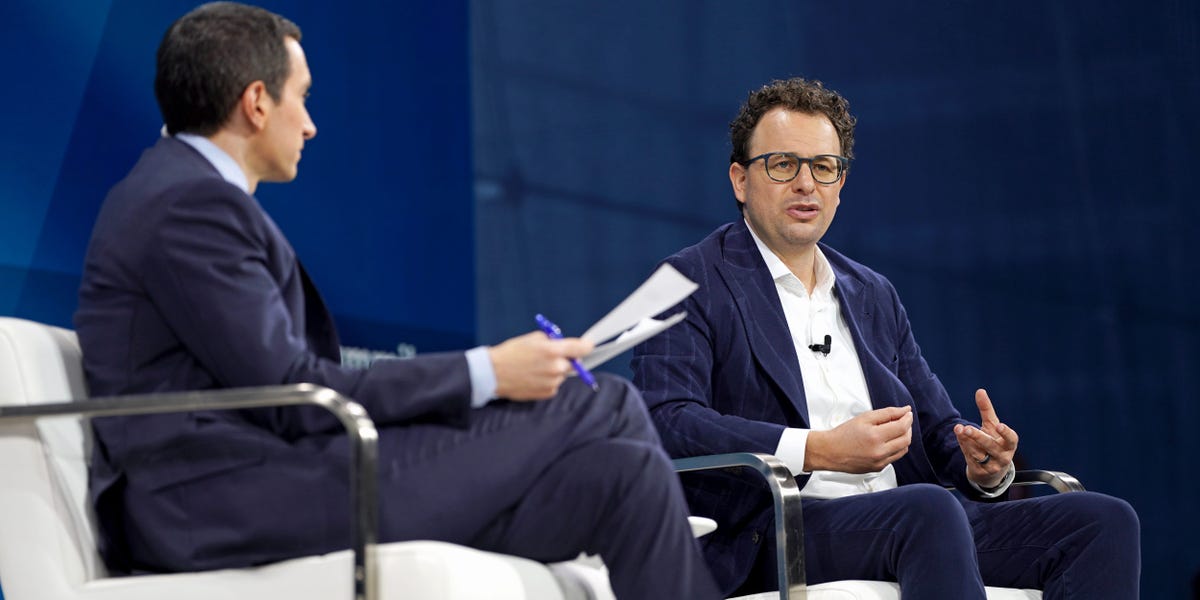
Some of the world’s most influential leaders convened in Manhattan on Wednesday to discuss a dominant topic: artificial intelligence. At the annual New York Times DealBook Summit, prominent figures, including Larry Fink of BlackRock and Lai Ching-te, President of Taiwan, weighed in on the current state of the AI industry and the potential for an AI bubble, a pressing concern in both Silicon Valley and Wall Street.
Three years post-launch of ChatGPT, which transformed perceptions and applications of AI, the arms race in this sector has intensified, with major tech entities like Meta, Alphabet, and Microsoft investing tens of billions of dollars this year primarily into AI infrastructure. As reported by TechCrunch, 49 US AI startups have successfully raised at least $100 million in 2023, highlighting the sector’s booming nature.
While the leaders at DealBook concurred on AI’s relentless expansion, they were also wary of the impending fallout. “There are going to be some huge winners and huge failures,” Fink remarked during a conversation with DealBook founder Andrew Ross Sorkin. Fink expressed confidence in sustained demand, noting that the so-called “hyperscalers”—companies like Amazon, Google, and Microsoft—are currently short on compute resources.
This sentiment was echoed by other attendees, both industry stakeholders and observers. Dario Amodei, CEO of AI company Anthropic, emphasized the inherent risks in the industry due to the substantial capital required for AI data centers. “Even if the technology fulfills all its promises, I think there are players in the ecosystem who, if they just make a timing error, they just get it off by a little bit, bad things could happen,” he stated.
Amodei revealed that his company is managing risks by collaborating with large enterprise clients and cautiously investing in compute resources. He suggested that some of his competitors have adopted a more reckless approach, stating, “There are some players who are YOLOing.” Although he did not name any competitors, he implied a critique towards his former employer, OpenAI, and its CEO, Sam Altman, referencing OpenAI’s recent internal memo concerning the potential threats posed by Google’s AI model with, “We don’t have to do any code reds.”
Leaders unanimously acknowledged that any failures within the industry could ultimately contribute to the advancement of superior technologies. Fink highlighted the urgency of investment, warning, “If we don’t spend enough faster in AI, in digitization, and in tokenization, other countries are going to beat us.” This call to action reflects a broader concern about maintaining competitive advantages in global technology.
Amodei further argued that government intervention would be vital for the industry. He advocated for proactive regulations, specifically mentioning that Nvidia chips should not be sold in China. He expressed concern that allowing the best AI models to be utilized in authoritarian regimes could result in those nations surpassing the U.S. in various domains, including intelligence, defense, and economic development.
Lai also underscored the necessity for global cooperation to mitigate potential AI crises. “Leaders around the world, especially those from countries with AI-related industries, should work together and take necessary measures to ensure AI develops sustainably and has a soft landing so that it can drive long-term global growth,” he stated.
However, the Taiwanese leader’s perspective is not purely theoretical; Taiwan is a global leader in producing the chips essential for AI, positioning itself at the heart of the ongoing AI investment surge. As the sector continues its rapid evolution, the challenge remains to balance innovation with sustainable growth to avoid the pitfalls of an overheated market.
See also AI Bubble Predicted to Burst by 2026: Key Risks for Nvidia and Broadcom’s Valuations
 Google Launches AI Mode with Gemini 3 in India, Expanding Multimodal Search Capabilities
 Hamid Ismailov and Shelley Fairweather-Vega Explore AI’s Transformative Role in Literary Futures
 Elon Musk Launches Grokipedia with 800,000 AI-Generated Entries to Challenge Wikipedia
 BRIDGE Summit 2025: AI, Cinema, and Geopolitics Transform Global Media Landscape in Abu Dhabi