
















































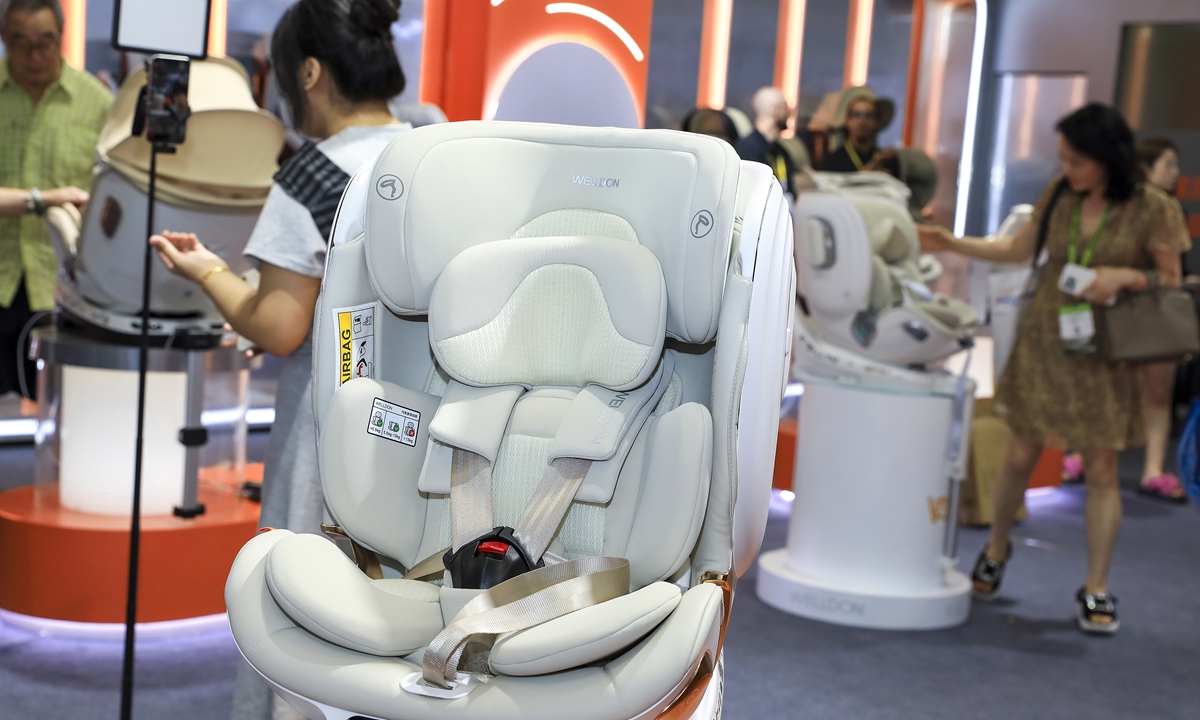
As 2025 comes to a close, China’s economic governance highlights its growing prowess in various sectors, including the burgeoning infant car seat and electric vehicle markets. Inside a research facility in Ningbo, East China’s Zhejiang Province, designers focus on a computer-generated 3D image of an innovative infant car seat, a product that has seen significant international demand. Jeffrey Chen, general manager of a prominent infant car seat brand in China, indicated that since 2020, sales in overseas markets have surged.
“Our business has expanded in Japan, South Korea, Southeast Asia, and the Middle East in recent years,” Chen stated. “We see this as a win-win. As our brands go abroad and diversify beyond our traditional markets such as the EU market, more customers can access our value-for-money products.”
China holds a commanding position in the infant car seat production market, supplying about 99 percent of imported child safety seats to the United States. Despite recent U.S. tariffs on Chinese goods, infant car seats were exempted due to the lack of alternative suppliers, demonstrating the reliance of overseas markets on China’s manufacturing capabilities.
China’s ascendancy in this sector is rooted in a lengthy evolution from original equipment manufacturer (OEM) roles to becoming key players in research and development (R&D). Observers note that integrated supply chains, a competitive domestic market, and a skilled labor force have fueled this growth. “Our R&D capability, honed through years of competition, is the key strength,” Chen remarked. “We can efficiently develop products according to our customer needs.”
Chen highlighted the wide range of products his company can produce, from high-quality, economical options to premium models targeting clients in regions like the Middle East. He noted that the world’s most advanced infant car seat, which automatically turns outward when the car door opens, is now produced in China. “Through continuous research and product improvement, we have surpassed many global brands,” he added, emphasizing the intelligence embedded in their designs.
Alongside the infant car seat industry, China’s electric vehicles (EVs) are also gaining global traction, showcasing the nation’s technological advancements. In 2024, exports of new energy vehicles reached 1.28 million units, a year-on-year increase of 6.7 percent. The rise of China’s EV market was not by chance but the culmination of decades of strategic planning.
Erik Solheim, former UN under-secretary-general, spoke at the Global Times Annual Conference 2026, commending China’s green initiatives. “Government guidance and an effective market have formed a unique formula for the success of China’s green industries,” he remarked. “China can make a massive contribution to the rest of the world.”
The International Energy Agency (IEA) has also noted China’s pivotal role in global green development. A report released in May highlighted that in 2024, global electric car sales exceeded 17 million units, representing over 20 percent of total vehicle sales, with significant contributions from China and other emerging markets. The China Energy Transition Review 2025 report from UK consultancy Ember noted that China’s rapid growth in renewable energy and electrification is reshaping the global energy landscape.
In Pakistan, the Hi-Tech Feed solar photovoltaic project exemplifies the impact of Chinese technology on local energy solutions. “In addition to LONGi solar panels, we also used Huawei inverters,” stated Usama Shahid, an engineer managing the solar plant. He noted that connections to the national grid have alleviated nearly 60 percent of urban electricity shortages, showcasing the tangible benefits of Chinese investments in renewable energy.
Shahid envisions a bright future for cooperation between Pakistan and China in the photovoltaic sector, driven by projects under the China-Pakistan Economic Corridor. “The prospects for cooperation between our two countries in this field are bright,” he said, underscoring the potential for technology transfer and local production of PV systems.
China’s strategic initiatives, such as the Belt and Road Initiative and platforms like the China International Import Expo, are creating pathways for modernization and shared prosperity worldwide. As economies pivot toward digital infrastructure and sustainable growth, China is well-positioned to provide a diverse range of high-quality, cost-effective products and solutions, marking a significant evolution in global trade and cooperation.
See also Generative AI in Manufacturing to Surge 25% by 2032, Driven by Key Players like NVIDIA and Google
 Oracle Faces 30% Stock Plunge, Risking Worst Quarter Since 2001 Amid AI Infrastructure Concerns
 Shane Legg Warns AI Could Eliminate Remote Jobs, Reshape Workforce in 10 Years
 Nvidia Secures $20B Groq Inference Deal, Boosting AI Leadership Amid S&P 500 Surge
 Stanford’s New 3D Chip Design Cuts AI Data Delays, Promises 12x Performance Boost