
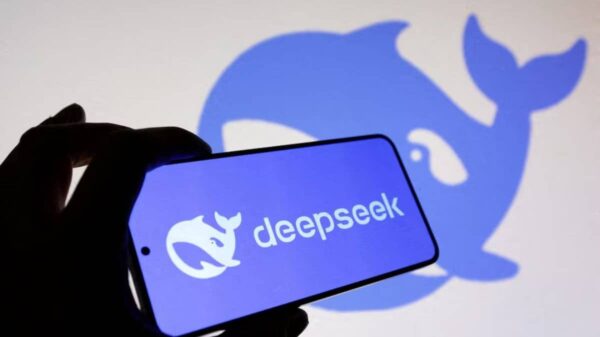



















































Chinese AI company DeepSeek has introduced two new large language models, DeepSeek-V3.2 and DeepSeek-V3.2-Speciale, which reportedly achieve performance levels comparable to or exceeding those of leading proprietary models from OpenAI and Google DeepMind. Characterized by being open-source and more compute-efficient, the launch has generated considerable excitement within the global AI community, especially among developers seeking powerful yet affordable AI solutions.
DeepSeek describes its innovative models as built upon the “Mixture-of-Experts” transformer architecture, which features approximately 671 billion total parameters. However, during inference, only around 37 billion of these parameters are active per token. This typical MoE approach allows for a reduction in computational costs while maintaining model capacity.
A significant technical advancement within these models is the introduction of DeepSeek Sparse Attention (DSA). This method seeks to streamline computational complexity, particularly for longer input contexts, by splitting the attention mechanism into two parts: a lightweight “selector/indexer” that identifies relevant tokens and a denser attention mechanism focused on those tokens. This innovative approach enables the model to handle extended contexts more efficiently than traditional dense-attention large language models.
In addition to sparse attention, DeepSeek has implemented a Scalable Reinforcement Learning Framework and a Large-Scale Agentic Task Synthesis Pipeline. This suggests that the models were not solely trained on passive text data, but also on synthetic tasks, enhancing their reasoning abilities and capacity for executing multi-step workflows. According to the company, this combination yields a balanced model in V3.2, suitable for everyday tasks, while V3.2-Speciale is designed for high-demand applications, including mathematical reasoning and coding tasks.
DeepSeek has published benchmark scores asserting that V3.2-Speciale excels in challenging mathematics, reasoning, and coding examinations, reportedly outperforming leading proprietary models in these areas. A recent report from VentureBeat indicates that V3.2-Speciale surpassed GPT-5-High and Gemini 3 Pro, achieving a pass rate of 96.0% on the AIME 2025 math benchmark and scoring approximately 99.2 on the Harvard-MIT Mathematics Tournament (HMMT).
Additionally, DeepSeek has claimed that V3.2-Speciale attained gold-medal performance at the 2025 International Mathematical Olympiad (IMO), the International Olympiad in Informatics (IOI), and demonstrated strong results in competitive programming contests such as the ICPC. The open-source nature of these models is also cited as a significant advantage, as they reportedly require fewer computational resources compared to many proprietary counterparts.
However, these claims are met with caution. The performance results are derived from benchmark reports published by DeepSeek or supportive media outlets, and independent peer-reviewed assessments are currently lacking. Moreover, some of the reported outcomes, particularly regarding math Olympiad performance, may appear overly optimistic, as past evaluations have shown that large language models often struggle under realistic conditions, including time constraints and human-like reasoning. Validation from external sources will be crucial for establishing the credibility of these claims.
Moreover, while the “Speciale” model represents the peak of DeepSeek’s offerings, it is not widely available for open-source experimentation. Current access is limited to API use, which may restrict thorough testing until model weights become publicly accessible. Additionally, despite the efficiency promises of sparse attention mechanisms, running these extensive models for long-context reasoning and agentic tasks may still necessitate considerable computational resources, potentially limiting access for users with budget constraints.
Despite these challenges, the introduction of DeepSeek-V3.2 and V3.2-Speciale signals a potentially transformative moment in the landscape of open-source AI. The combination of high-performance reasoning capabilities, coding skills, and computational efficiency, paired with open-source availability, positions these models as contenders in the competitive AI arena. Should independent examinations validate the reported benchmarks, this could represent a significant paradigm shift away from elite, closed-source models toward more accessible AI infrastructure. Such a transition could have profound implications for innovation and equity in AI development worldwide, particularly in regions where access to advanced AI technology is limited by cost.
See also Space Debris Threatens Google’s Project Suncatcher: Risks to AI Data Centers in Orbit
 Orq.ai Raises €5 Million Seed Funding to Enhance Enterprise AI Agent Platform
 Nvidia Avoids US Export Curbs on AI Chips Amidst Legislative Changes and Lobbying Efforts
 CEOs Warn of AI Bubble Risks as $100M+ Startups Surge Amid Industry Shakeout
 AI Bubble Predicted to Burst by 2026: Key Risks for Nvidia and Broadcom’s Valuations