



















































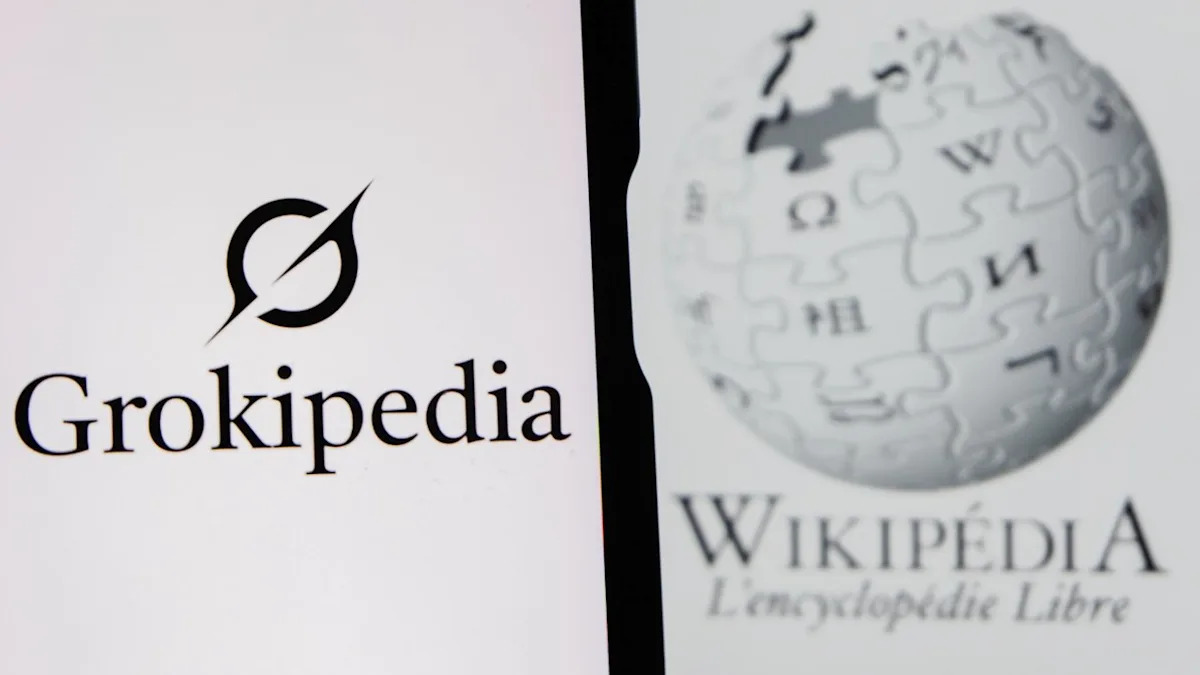
Elon Musk’s latest endeavor, Grokipedia, launched on October 27 with around 800,000 AI-generated entries, is set to challenge Wikipedia’s two-decade reign in the online knowledge space. Grokipedia’s emergence pits Musk’s vision of automation against Wikipedia’s extensive collection of 7 million human-edited articles, marking a significant confrontation between models of open collaboration and proprietary intelligence.
As both platforms vie for the same audience in a digital information marketplace increasingly influenced by artificial intelligence, the stakes are high regarding who shapes the narrative and control over factual information. Wikipedia operates on an open-source model funded primarily by donations, eschewing advertisements or paywalls. Its articles are crafted and maintained by volunteer editors, which may slow the process and invite contention but ultimately ensures procedural accountability.
Conversely, Grokipedia leverages AI for content generation and verification. Users cannot edit articles directly but can flag errors via an online form. Some Grokipedia entries reportedly draw from existing Wikipedia articles. Musk has long called for a competitor to Wikipedia, voicing his discontent over what he terms “Wokepedia” and its funding priorities, including a $50 million allocation for diversity, equity, and inclusion initiatives.
The Competitive Landscape
Experts suggest that the competition between Wikipedia and Grokipedia will unfold across various dimensions. Carlo Van de Weijer, an AI Fellow at Singularity University, notes that while both platforms aim to meet user expectations for speed and accuracy, their underlying philosophies diverge significantly. “In the long run, users won’t choose between speed or accuracy, but will prefer systems that unite both,” he explained, emphasizing Wikipedia’s strength lies in its community-driven validation.
Santiago Nestares, co-founder of AI enterprise resource planning firm Dual Entry, anticipates that Grokipedia’s rise would not obliterate Wikipedia’s donation model but rather prompt its evolution. “Knowledge will stay free, but curation won’t,” he asserted, suggesting a shift in costs from human editors to computing infrastructure. However, Nestares cautioned that AI-generated information is susceptible to circular learning, where inaccuracies might perpetuate themselves without human oversight.
The role of human interaction in knowledge curation is another point of divergence. Nestares posits that Grokipedia may not eliminate search engines but will absorb them, transforming search into an interface rather than an engine. He believes that as instant AI responses become the norm, the incentive for individuals to contribute to knowledge creation diminishes, shifting the focus from article writing to model shaping.
However, Musk’s association with Grokipedia could pose a significant hurdle to its credibility. Kaveh Vahdat, founder of AI-powered game and video generation company RiseAngle, argues that trust in knowledge systems is built on perceptions of neutrality and objectivity. “Wikipedia earned that status the slow way through consensus, transparency, and a broad contributor base,” he remarked, noting that Grokipedia inherits a public perception of Musk that may hinder its credibility.
Concerns about AI’s potential to diminish nuance in information are also prevalent. Karl Hughes, a senior content marketing specialist at Exposure Ninja, highlighted the dangers of technology recycling Wikipedia’s content, leading to a recursive cycle that could overwrite original sources. He advocates for the integration of human oversight in digital platforms to maintain editorial integrity and authentic verification.
The implications of Grokipedia’s instant-answer model could alter user engagement. Hughes contends that if Grokipedia provides quick answers, users may become less inclined to scrutinize or question the information presented. This could centralize knowledge rather than democratize it, as users increasingly rely on AI-generated responses without the friction of collaborative verification.
Ultimately, experts predict that Grokipedia may excel in speed while Wikipedia continues to dominate in trust and credibility. “Wikipedia built the foundation every model still learns from,” noted Nestares, asserting that if Grokipedia gains traction, Wikipedia’s involvement will not vanish; it will adapt. Vahdat echoed this sentiment, declaring, “Wikipedia wins on trust, structure, and neutrality. Grokipedia may be fast, but speed does not fix a credibility problem.”
See also BRIDGE Summit 2025: AI, Cinema, and Geopolitics Transform Global Media Landscape in Abu Dhabi
 EU Launches Antitrust Probe against WhatsApp for AI Policy Limiting Third-Party Access
 Google’s 2025 Search Report Reveals Gemini Surpasses ChatGPT in India, AI Adoption Soars
 UAE’s Al Olama Joins Global AI Ethics Council, Advancing Middle Eastern Leadership in AI Standards
 Condé Nast Appoints Vasanth Williams as New Chief Product and Technology Officer