













































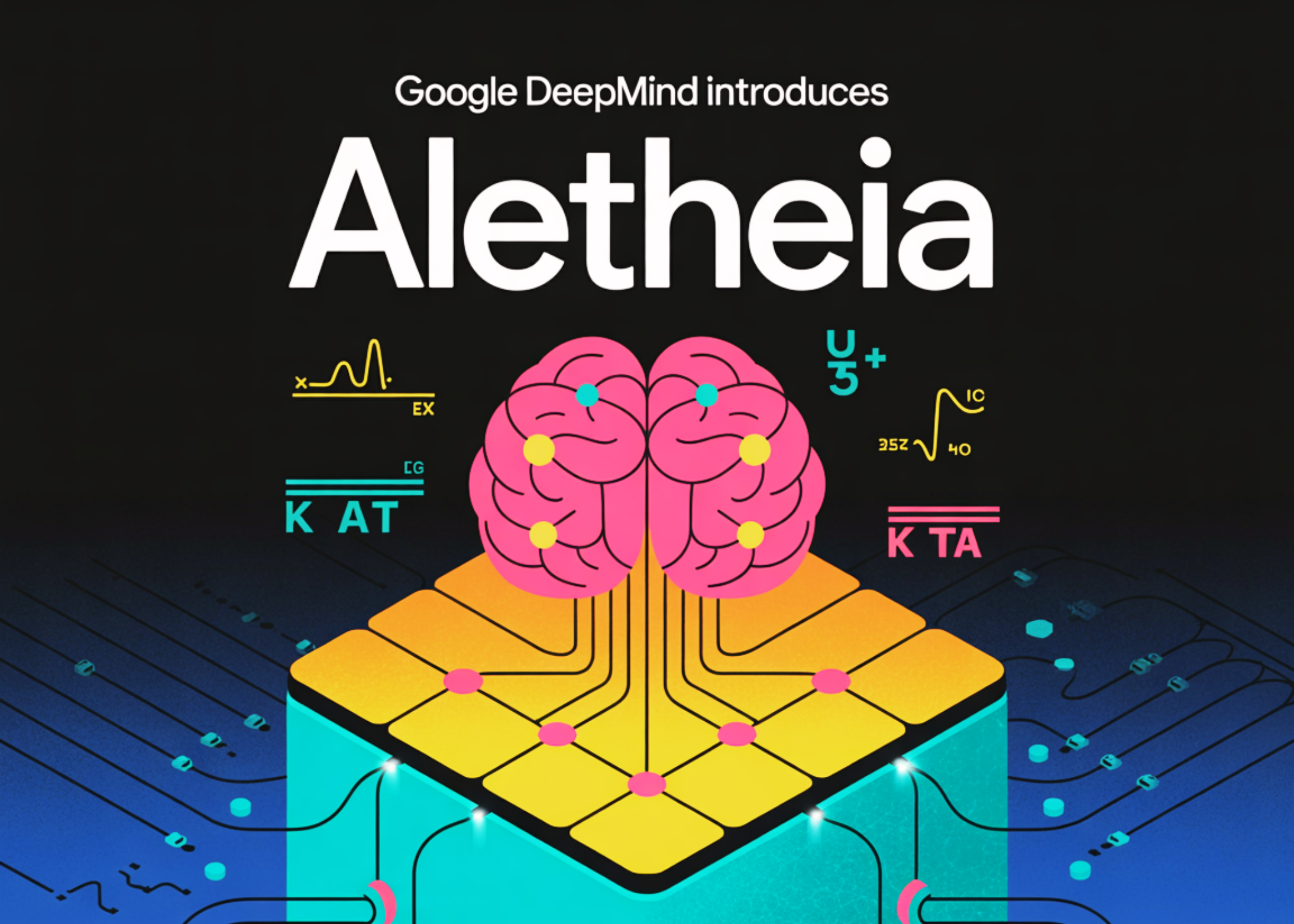
The Google DeepMind team has unveiled Aletheia, a groundbreaking AI agent aimed at transforming the landscape of mathematical research. Introduced in February 2026, Aletheia seeks to bridge the gap between high-level mathematics, exemplified by gold-medal performances at the 2025 International Mathematical Olympiad (IMO), and complex professional research, which requires navigating extensive literature and crafting long-term proofs. This innovative agent is designed to iteratively generate, verify, and revise solutions using natural language, offering a new paradigm for mathematical inquiry.
Aletheia operates on an advanced version of Gemini Deep Think and incorporates a three-part “agentic harness” to enhance reliability. This structure consists of a Generator, which proposes candidate solutions, a Verifier that checks for flaws using natural language, and a Reviser that corrects errors identified by the Verifier. Researchers have noted the importance of this separation of responsibilities, as it enables the model to identify mistakes it may overlook during the initial generation phase.
Key technical findings from the development of Aletheia indicate a significant leap in complex reasoning capabilities. The model achieved a notable 95.1% accuracy on the IMO-Proof Bench Advanced, which is a substantial improvement from the previous record of 65.7%. This performance is attributed, in part, to a technique called “inference-time scaling,” which allows the model to utilize more computational resources during queries, effectively enabling it to “think longer.” The January 2026 iteration of Deep Think was able to reduce the compute required for IMO-level problems by a factor of 100.
In its short existence, Aletheia has already made notable contributions to the field of mathematics. It has autonomously generated a research paper titled Feng26, which delves into the calculation of eigenweights, without any human intervention. In another instance, Aletheia collaborated with researchers to propose a high-level roadmap for proving bounds on independent sets, which human authors then transformed into a rigorous proof. Furthermore, when applied to the Erdős Conjectures, the AI identified 63 technically correct solutions while resolving 4 open questions independently.
In addition to its research milestones, DeepMind has proposed a taxonomy for classifying AI contributions to mathematics, paralleling the levels of autonomy used for self-driving vehicles. This new framework aims to provide clarity regarding the significance of AI’s role in mathematical discovery, categorizing contributions into four levels: Level 0 (primarily human), Level 1 (human-AI collaboration), and Level 2 (essentially autonomous). The paper Feng26 falls under Level A2, indicating it is of publishable quality and nearly autonomous.
Aletheia represents a significant advancement in the development of research-grade AI agents that can autonomously generate, verify, and revise mathematical proofs in natural language. By allowing the model more time to think at inference, DeepMind researchers have uncovered substantial gains in accuracy and reliability. The integration of tools like Google Search for real-world literature synthesis further bolsters the AI’s capabilities, ensuring it avoids pitfalls such as citation hallucinations.
As Aletheia continues to evolve, its potential to redefine mathematical research practices becomes clear. The introduction of a standardized framework for AI contributions aims to enhance transparency and address the “evaluation gap” between AI claims and traditional mathematical standards. Ultimately, the innovations stemming from Aletheia not only promise to advance mathematical knowledge but also highlight the evolving relationship between AI and human researchers in achieving groundbreaking discoveries.
For more details, refer to the official DeepMind website.
Check out the Paper. Also, feel free to follow us on Twitter and join our ML SubReddit. Don’t forget to subscribe to our Newsletter. Now you can also join us on Telegram.
Michal Sutter is a data science professional with a Master of Science in Data Science from the University of Padova. With a solid foundation in statistical analysis, machine learning, and data engineering, Michal excels at transforming complex datasets into actionable insights.
See also India AI Impact Summit 2026: Global Engagement Fuels Responsible AI Innovations with 4,650+ Entries
 Hugging Face Rejects Nvidia’s $500 Million Offer to Maintain Strategic Neutrality
 Litigation Insights Reveal Fair Use Shifts: Key Rulings Impacting AI Licensing Strategies
 Akamai Launches NVIDIA-Powered Inference Cloud, Shares Surge 17.5% After Strong Q3 Results