


























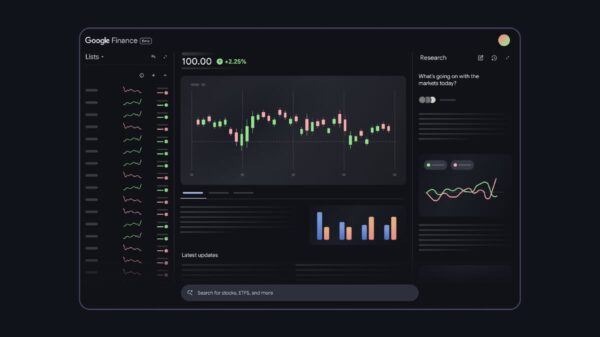




















The advertising landscape is undergoing a significant transformation as Google leverages artificial intelligence to bolster its revenue streams. In its latest financial results, the tech giant reported ad revenue of $82.28 billion for the fourth quarter of 2025, reflecting a 13.5% increase year over year. This surge brings Google’s total annual revenue to over $400 billion for the first time, underscoring the company’s successful pivot toward AI-driven advertising solutions.
Central to this growth is a suite of AI-powered advertising tools, including AI Max and Performance Max, which Google claims yield impressive results for brands. For example, Canadian fashion retailer Aritzia experienced an 80% increase in revenue after integrating AI Max into its advertising strategy, according to Courtney Rose, Google’s Vice President of Retail Ads. In an interview with ModernRetail, Rose highlighted this case to illustrate the transformative potential of AI in driving retail success.
Rose elaborated on a recent natural-language search example, where a shopper requested outfit suggestions for a spring trip, specifying items like a sweater, purse, and jeans. Such nuanced queries enable Google’s Gemini models to understand not just the products consumers desire, but the underlying motivations for those choices, leading to more accurate ad placements. This capability is crucial, especially considering that 15% of daily Google searches are entirely new, emphasizing the importance of AI-driven ad matching for retailers who cannot predict every potential keyword.
“Search is not some zero-sum game. Everything we have seen in the last few years is that search is in this expansionary moment,” said Rose, indicating a broader trend in the advertising sector. While Google currently has no plans to incorporate ads directly into its Gemini platform, it has noted that ads within the AI mode perform well and provide valuable insights for retailers. The company is also exploring new formats, such as “direct offers,” which allow brands like E.l.f. Beauty, Chewy, and L’Oréal to present personalized promotions to consumers showing intent to purchase.
Additionally, a newly introduced “business agent” feature enables retailers such as Poshmark and Reebok to curate their visibility in AI-generated search results, allowing them to articulate their brand voice. This innovation is part of a broader trend among tech companies exploring AI in advertising.
Competitors such as Amazon.com and OpenAI are also testing AI ad formats, although their results have varied. Reports indicate that Perplexity has begun phasing out its ads just a year and a half after their launch, while Amazon’s sponsored prompts within its Rufus platform are reportedly generating limited traffic, signaling challenges in the AI advertising space.
In June, it was reported that Meta Platforms aims to fully automate its advertisement processes using AI by 2026. However, many marketers view this timeline as optimistic. Meta’s tools—Andromeda, Manus, and Advantage+—offer automated targeting, budgeting, and creative optimization, yet some advertisers remain cautious about relinquishing control to these complex “black-box” systems, as noted by Marketing Brew.
As Google continues to innovate and adapt its advertising strategies, the implications for the broader industry remain significant. The integration of advanced AI tools not only enhances ad effectiveness but also reshapes how brands engage with consumers. With the rapid evolution of technology, companies must navigate the delicate balance between leveraging AI for improved outcomes and maintaining control over their advertising strategies.
See also Germany”s National Team Prepares for World Cup Qualifiers with Disco Atmosphere
 95% of AI Projects Fail in Companies According to MIT
 AI in Food & Beverages Market to Surge from $11.08B to $263.80B by 2032
 Satya Nadella Supports OpenAI’s $100B Revenue Goal, Highlights AI Funding Needs
 Wall Street Recovers from Early Loss as Nvidia Surges 1.8% Amid Market Volatility