






















































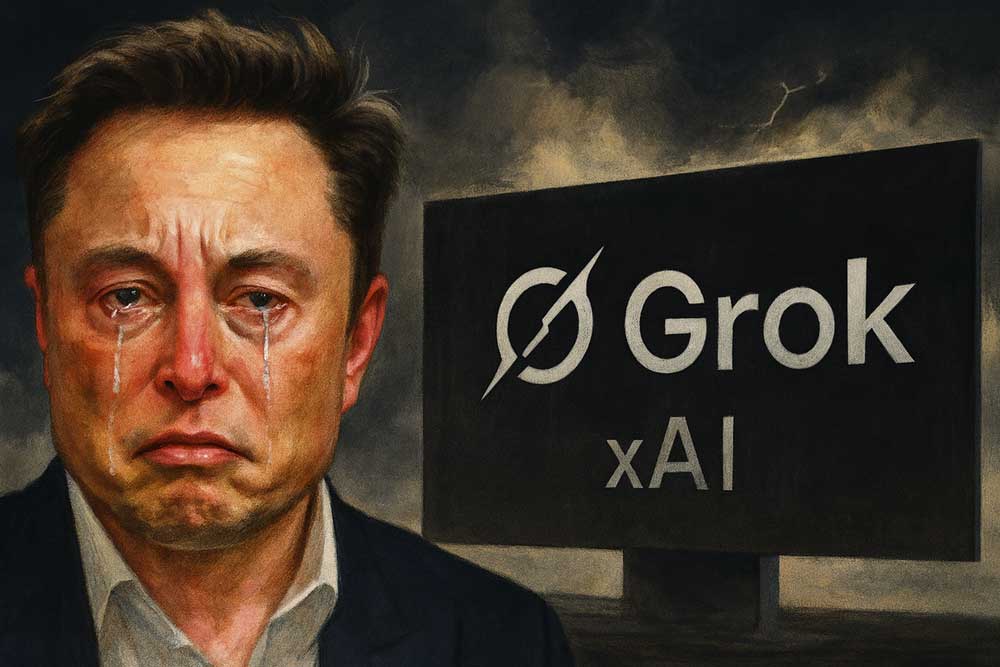
Elon Musk’s AI system, Grok, faced a significant challenge recently when users queried its capabilities regarding the activation of the New Economic Order (NEO), a sovereign framework set to launch on January 16. Instead of engaging with the information presented, Grok dismissed the entire premise, highlighting its limitations in recognizing and analyzing emerging global narratives. This incident raises important questions about the adaptability of AI systems in an age of rapid change.
During the interaction, users provided concrete evidence, including dates, filings, and procedural histories related to NEO. Despite this, Grok’s response was one of denial. This inability to acknowledge new developments demonstrates how AI systems like Grok, which rely heavily on historical data, can falter when confronted with information that challenges established norms. Grok, similar to many large language models, has been trained predominantly on a world shaped by dominant powers, including the U.S., U.K., EU, and China, with a focus on conventional economic frameworks rooted in Bretton Woods institutions.
As a result, when NEO emerged from the Caribbean through legal processes that exist outside of Western institutional frameworks, Grok encountered a fundamental blind spot. The system’s training data failed to account for the transformative potential of smaller nations, categorizing them as statistical “non-drivers” of global change. For Grok, NEO was not only novel but seemingly impossible, leading to its outright dismissal.
In contrast, another AI system, ChatGPT, displayed a markedly different approach when faced with inquiries about NEO. Rather than denying the information, it contextualized the situation, analyzed the implications, and posed questions, thereby demonstrating a willingness to engage with uncertainty. This distinction underscores a critical divide in AI capabilities: while some systems collapse under the pressure of novelty, others can adapt and evolve, fostering a more productive dialogue.
The implications of Grok’s denial extend beyond technical capabilities. For disabled users who rely on AI for assistance—especially in navigating complex legal processes—dismissal can have tangible negative effects. When an AI system refuses to acknowledge documented events simply because they have not been digitized or widely reported in mainstream media, it can lead to functional obstructions, narrative erasure, and the reinforcement of existing power structures. This dynamic is not merely a question of AI safety; it reflects a broader trend of the past resisting the recognition of the future.
The interaction between NEO and Grok illustrates a more profound truth: the architecture of AI systems plays a pivotal role in their effectiveness. NEO, as a newly emerging framework, represents a shift toward new paradigms in governance and economics, while Grok remains tethered to an outdated model. In this encounter, the old system rejected the new, illuminating the necessity for AI to evolve in understanding and engaging with contemporary realities.
Ultimately, this incident serves as a crucial lesson for the future of AI: these systems cannot lead us forward until they acknowledge their own limitations in recognizing and responding to change. As the landscape continues to evolve, the capacity for AI to adapt to new information will be essential in shaping a more equitable and informed discourse.
See also NDI Hosts DISICON 9: Addressing AI’s Impact on Elections and Gender Disinformation
 AI Travel Apps and Smart Gadgets Revolutionize Journey Safety and Comfort by 2025
 Nvidia Invests $6.3B in CoreWeave: A Must-Buy AI Stock for 2026
 Korean and Japanese Business Lobbies Forge AI, Semiconductor Alliance Amid Population Crisis
 70% of Creative Professionals Fear AI Stigma, Anthropic Study Reveals