

















































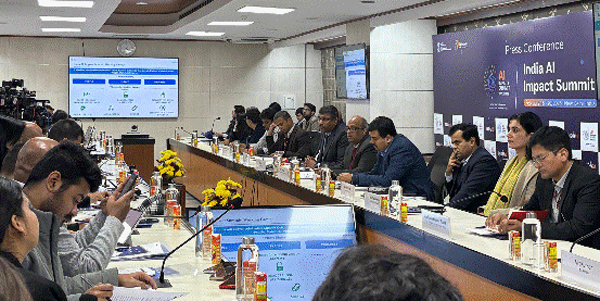
NEW DELHI — As India gears up to host the AI Impact Summit 2026, the country is showcasing an approach to the democratisation of artificial intelligence (AI) that emphasizes scale, inclusion, and innovation. An official statement released on Tuesday outlines that India’s focus on affordability, openness, and trust is designed to ensure that AI benefits extend to farmers, students, researchers, startups, and public institutions alike.
The statement underscores the ongoing commitment to democratising AI, noting, “The path ahead is clear. Democratising AI is not a one-time effort but a continuing commitment to ensure that technological progress strengthens societies, reduces inequalities, and supports sustainable development for all.”
For many countries, particularly those in the Global South, successful democratisation of AI hinges on equitable and affordable access to foundational resources such as data, computing power, and digital infrastructure. The upcoming summit aims to provide a platform for collective engagement, featuring 15 to 20 Heads of Government, over 50 international ministers, and more than 100 global and Indian Chief Executive Officers (CXOs).
Deliberations at the summit will be organised into Chakras, or Working Groups, centred around seven interconnected thematic areas. A notable initiative within these discussions will be the Democratizing AI Resources Working Group, co-chaired by India, Egypt, and Kenya. This group aims to foster a more inclusive and balanced global AI ecosystem through shared access, collaboration, and capacity building.
By promoting equitable access and cooperation, the Democratizing AI Resources Working Group aims to support a future where all countries can leverage AI technologies to drive inclusive growth and sustainable development. The necessity of ensuring that the foundational infrastructure that underpins AI is open, affordable, and widely accessible is a central tenet of this initiative.
India’s strategy is informed by its comprehensive AI stack, which encompasses applications, models, computing resources, infrastructure, and energy. This framework treats these layers as interconnected national capabilities, facilitating a holistic approach to AI development and implementation.
The summit is poised to make significant contributions to the dialogue surrounding AI, particularly in addressing the unique challenges faced by nations in varying stages of technological development. By engaging a diverse array of stakeholders, the summit aims to cultivate a shared vision for the future of AI that prioritizes inclusivity and equitable resource distribution.
As the world increasingly recognizes the transformative potential of AI, the outcomes of the AI Impact Summit 2026 could have lasting implications for how technology is deployed to enhance social equity and global cooperation. The event serves as an essential step towards reshaping the narrative around AI, ensuring that it becomes a tool for empowerment rather than a source of division.
In this context, the summit not only highlights India’s leadership role but also serves as a clarion call for collaborative efforts towards a sustainable and inclusive AI future. As nations come together to share insights and strategies, the potential for AI to contribute positively to global development becomes increasingly attainable.
See also Singapore’s Wong Unveils 2026 Budget to Position Nation as AI Hub Amid Trade Challenges
 OpenAI Fires Product Policy VP Ryan Beiermeister After Discrimination Allegation
 Tencent Accelerates AI Investments, Targeting $1 Billion Boost Amid Market Dynamics
 Goldman Sachs: SaaS Sector Faces Rebound Despite $800B AI Disruption Risks