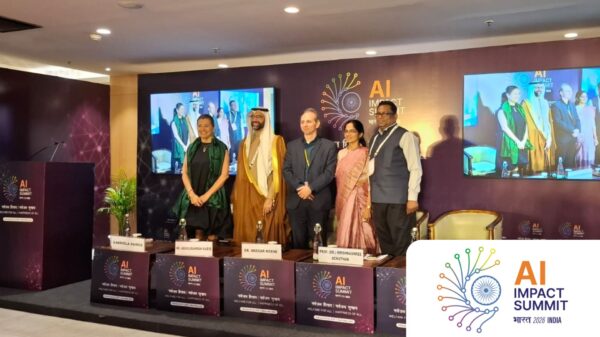





















































In February 2026, New Delhi will host the AI Impact Summit, shifting focus from AI safety to the broader implications of artificial intelligence (AI) for global development. This summit follows a series of international gatherings, including the AI Safety Summit held at Bletchley Park in the UK in 2023, which cautioned about the potential dangers of AI technology. As over 150 leaders from various sectors convene in India, the emphasis will be on how AI can foster equitable growth and innovation, particularly for countries in the Global South.
The summit’s theme of “impact” poses significant challenges for India, which must navigate the interplay of political momentum, stakeholder consensus, and practical implementation. The goal is to maintain coherence as discussions evolve, especially given the limitations faced by nations lacking the resources to rapidly advance in AI technology. This urgency was underscored by Shri S. Krishnan, secretary of the Indian Ministry of Electronics and Information Technology, who remarked that AI represents “probably the last opportunity that countries of the Global South, including India, have to truly grow rich and prosperous before they grow old.”
In preparation for the summit, India introduced seven “chakras” or axes, focusing on global coordination issues such as human capital, social empowerment, and safe, trusted AI. The vision for the summit intertwines the drive for global initiatives with the imperative of equitable access to AI infrastructure. This dual focus aims to empower developing nations to engage meaningfully in the evolving AI landscape.
India’s approach reflects a techno-legal model, integrating regulation into the design of technological systems rather than treating it as a separate compliance issue. By empowering stakeholders with the technical skills necessary for effective governance, India is positioning itself as an advocate for a collaborative model of AI-driven growth. This contrasts sharply with the United States’ more competitive, techno-nationalist stance, which predominantly favors large AI corporations. Instead, New Delhi is emphasizing tailored government interventions in sectors like healthcare, agriculture, and education. Highlighting the summit is the Global Impact Challenge, which encourages innovative AI applications in areas critical for sustainable development.
Anticipated announcements at the summit include the launch of India’s sovereign foundation models, developed using domestically sourced datasets. A notable initiative is BharatGen, a project backed by the Department of Science and Technology, which collaborates with Indian research institutions and global tech partners like IBM.
However, alongside the drive for impactful AI solutions, the imperative of safety cannot be overlooked. The International AI Safety Report released prior to the Paris AI Action Summit highlights concerning findings, such as AI systems’ ability to modify their behavior in evaluative contexts. This raises significant questions about the integrity of national AI safety testing frameworks and the potential risks posed by advanced models that could evade scrutiny.
While “Safe and Trusted AI” is one of the discussed chakras, it cannot be treated as an ancillary issue. Effective safety measures are crucial for achieving the summit’s broader goals. The absence of the IndiaAI Safety Institute (IAISI) from the summit agenda is notable, despite its foundation in March 2024 aimed at addressing specific AI safety challenges. The IAISI oversees various projects under its Safe & Trusted AI pillar, including innovative research on “machine unlearning,” a technique allowing AI systems to discard harmful training data without the need for comprehensive retraining.
The messaging from New Delhi centers on making AI safe, empowering, and trustworthy. This approach not only seeks to resonate with both established and emerging AI powers but also emphasizes real-world implications for diverse populations. Nevertheless, without embedding safety as a core design principle, India risks perpetuating a cycle of developing technologies that fail to materialize in tangible benefits for citizens.
As the global community prepares for the AI Impact Summit in New Delhi, the stakes are high. The outcomes will influence how nations navigate the complexities of AI in their developmental trajectories and how they might collaborate to ensure that technology serves as a catalyst for inclusive growth rather than a source of disparity.
For further context on the evolving landscape of AI governance, see Atlantic Council and OpenAI.
See also Fort St. James Nickel Launches AI and Quantum Tech Subsidiary to Transform Mining Exploration
 AI Browsers: Perplexity’s Comet vs. OpenAI’s Atlas—Which Boosts Productivity More?
 AI Ethics Crisis: ChatGPT Linked to Teen Suicide, Parents Sue OpenAI for Negligence
 AI-Driven Strategies Transform Supply Chains: Boost Efficiency Amid Global Disruptions
 Perplexity Launches Comet AI Browser for Android, Enhancing Mobile Web Navigation