











































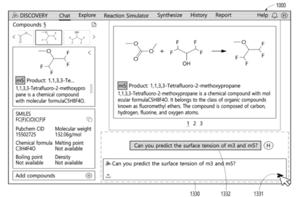
LG AI Research announced on Tuesday that it has secured a patent for Exaone Discovery, a generative AI platform aimed at accelerating the discovery of new materials and pharmaceuticals. This innovative platform distinguishes itself from traditional AI systems by utilizing multimodal AI to analyze unstructured scientific data. Such data includes chemical formulas, molecular structures, charts, and images found in academic papers and patent documents, all without the need for prior data standardization.
The patent’s significance lies in its broad, workflow-level scope. Instead of merely covering individual algorithms or software modules, it protects the entire AI-driven research process. This encompasses everything from the extraction of molecular structures in documents to the generation of experimental designs based on researcher queries, as well as the prediction of physical and chemical properties of candidate substances. LG AI Research emphasized that this comprehensive approach aims to secure the core end-to-end workflow of AI-based materials and drug discovery, making it challenging for competitors to replicate similar processes without infringing on the patented framework.
As part of its future plans, LG AI Research intends to evolve Exaone Discovery into a chemical agentic AI. This advanced system is envisioned to autonomously propose and refine new materials, targeting various industries, including batteries, semiconductors, and pharmaceuticals. Currently, the platform is being applied by LG Household & Health Care to identify potential cosmetic ingredients, showcasing its versatility beyond just pharmaceuticals.
“AI model performance evolves rapidly, but patents that protect core discovery processes provide lasting technological and legal safeguards,” stated Yoo Kyung-jae, an intellectual property leader at LG AI Research. This perspective reflects a growing trend in the tech industry, where securing intellectual property is becoming increasingly crucial as companies rush to innovate with AI.
The development of Exaone Discovery comes at a time when generative AI is gaining momentum across various sectors. Companies like NVIDIA and OpenAI are also making strides in generative AI technologies, which are reshaping industries by automating complex tasks and enhancing creative processes. The ability to quickly analyze vast amounts of unstructured data is becoming a competitive edge as businesses look to leverage AI for research and development.
In the realm of scientific innovation, the integration of AI technologies is revolutionizing how researchers approach material and drug discovery. As the landscape becomes more competitive, companies that can effectively harness AI for meaningful applications will likely set themselves apart. With the patent for Exaone Discovery, LG AI Research positions itself as a key player in this evolving field, potentially influencing how future discoveries in materials science and pharmaceuticals are made.
As industries increasingly rely on AI to streamline processes and enhance productivity, the significance of protecting the underlying technologies becomes paramount. LG’s patent not only secures its current position but also paves the way for future advancements in AI-driven research initiatives. The broader implications of this development could signal a shift in how companies approach innovation in an era where AI capabilities are rapidly expanding.
For more information on LG AI Research and its initiatives, visit the official website.
As AI continues to advance, the evolution of systems like Exaone Discovery will likely play a pivotal role in shaping the future of scientific discovery and innovation across multiple sectors.
See also AI Experts Predict Transformative Changes in AI’s Impact on Jobs, Health, and Creativity by 2028
 Xero Reports 2M AI Users, Secures Melio Integration, Targets FY28 Profitability
 AI-Optimized Middle-Mile Linehaul Platforms Market to Surge 244% by 2035, Driven by E-Commerce Demand
 Nvidia Establishes $105M Taipei HQ to Secure AI Chip Supply Amid TSMC Demand Surge
 Massimo Group Moves to Acquire FST for $27M–$35M, Advancing AI in Mobility and Health Tech