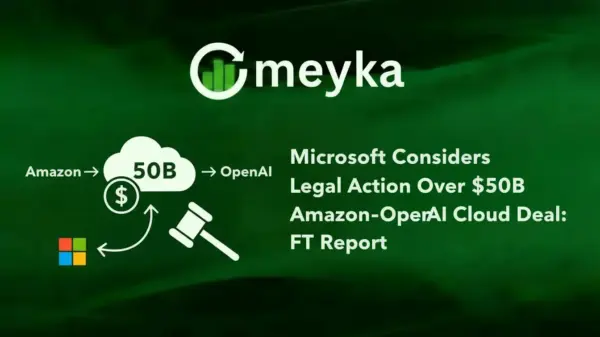





















































Microsoft is contemplating legal action against both Amazon and OpenAI concerning a multibillion-dollar agreement that has the potential to transform the delivery of advanced artificial intelligence to businesses. Central to the dispute is a reported $50 billion deal associated with OpenAI’s new commercial product, Frontier.
The crux of the issue revolves around whether Amazon Web Services (AWS) can distribute OpenAI’s models without violating Microsoft’s long-standing cloud partnership with the creator of ChatGPT. This situation underscores the rising tensions within the AI sector, where control over infrastructure is becoming just as critical as the technology itself.
Microsoft’s partnership with OpenAI grants Azure a pivotal role, positioning it as the exclusive cloud provider for OpenAI’s APIs, while permitting certain collaborations beyond Azure. This strategic arrangement has enabled Microsoft to seamlessly integrate AI tools into its products while securing a dominant position in hosting OpenAI’s services.
The current conflict arises from concerns over whether AWS can host or provide access to OpenAI’s new Frontier product. Should AWS be permitted to distribute these models directly, it could undermine Microsoft’s exclusivity and diminish Azure’s significance in the partnership. A report by the Financial Times indicated that Microsoft is assessing whether such a move would breach existing contractual terms.
The implications of this dispute extend beyond immediate financial concerns; they also encompass control over the deployment of OpenAI’s technology. OpenAI’s Frontier product is expected to feature advanced AI capabilities designed for enterprise applications, suggesting a significant expansion of OpenAI’s business model, which has traditionally relied on Microsoft for computing power, funding, and global scaling.
As OpenAI explores broader distribution avenues, including potential partnerships with AWS, it risks disrupting existing agreements with Microsoft. The Frontier product’s anticipated launch marks a shift towards a more diversified business strategy, which could open new revenue streams for OpenAI but also complicate its relationship with Microsoft.
Microsoft’s potential legal response primarily aims to safeguard its strategic investment in OpenAI. Having invested billions in the company and establishing Azure as the exclusive pathway for OpenAI’s models, Microsoft may contend that allowing AWS to host Frontier or similar products contravenes exclusivity agreements. Legal action would likely center on enforcing these contractual terms rather than outright blocking competition.
This unfolding situation also highlights a broader concern among cloud providers competing to dominate AI infrastructure. The loss of exclusivity over OpenAI’s models could significantly impair Microsoft’s standing in this competitive landscape. As the AI industry evolves, the nature of partnerships is also changing — earlier agreements were primarily focused on collaboration and funding, while the scale of commercial opportunities is now testing the limits of these arrangements.
Amazon, Microsoft, and other cloud service providers continue to invest heavily in AI to attract enterprise clients, with access to leading models like those from OpenAI emerging as a critical differentiator. If the dispute escalates into legal action, it could establish a precedent for structuring future AI partnerships. Companies may transition towards more flexible agreements or tighten exclusivity clauses to mitigate similar conflicts.
The outcome of this dispute will likely influence the global delivery of AI services, determining whether they are managed through a single cloud provider or a network of multiple platforms. Such decisions have the potential to dramatically reshape the competitive landscape of the AI industry, further emphasizing the intricate relationship between technological innovation and infrastructure control.
See also Microsoft Mulls Legal Action Over $50B Amazon-OpenAI Cloud Deal Amid Rising AI Competition
 Germany”s National Team Prepares for World Cup Qualifiers with Disco Atmosphere
 95% of AI Projects Fail in Companies According to MIT
 AI in Food & Beverages Market to Surge from $11.08B to $263.80B by 2032
 Satya Nadella Supports OpenAI’s $100B Revenue Goal, Highlights AI Funding Needs