















































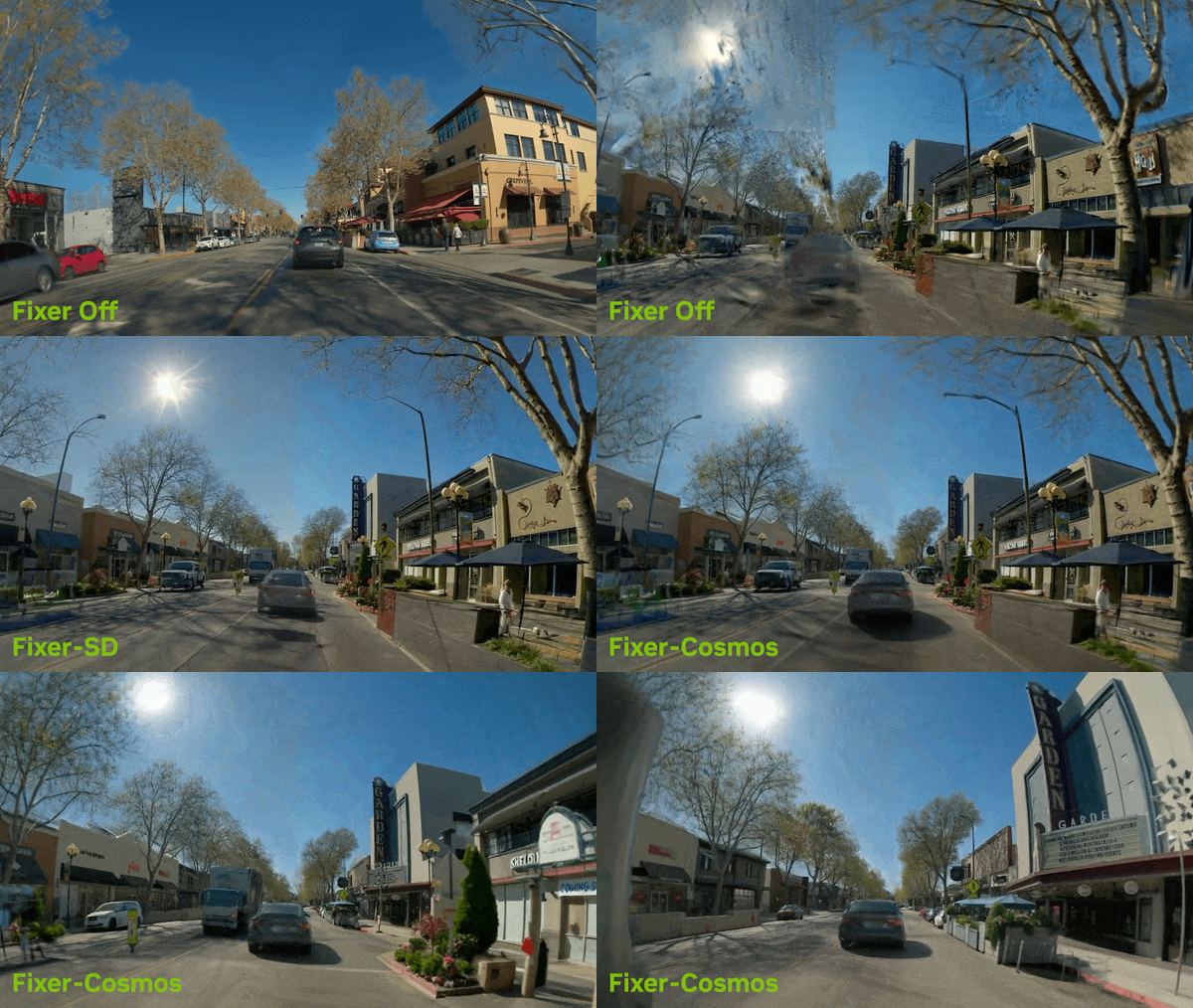
NVIDIA has unveiled its latest tool, Omniverse NuRec, designed to enhance the quality of 3D simulations for autonomous vehicle (AV) development. The tool employs an innovative generative model called Fixer, aimed at addressing challenges such as rendering artifacts that can impair visual fidelity during simulations. Despite advancements in neural reconstruction techniques like 3D Gaussian Splatting (3DGS) and 3D Gaussian with Unscented Transform (3DGUT), issues such as blurriness and geometric inaccuracies remain prevalent, particularly from novel viewpoints, thereby hindering the performance of downstream tasks.
Fixer, based on the NVIDIA Cosmos Predict world foundation model, utilizes a diffusion-based approach to eliminate these rendering artifacts and restore detail in under-constrained regions of 3D environments. This post outlines a step-by-step guide on how to utilize Fixer to convert noisy 3D scenes into clear, artifact-free environments that are primed for AV simulation. The process includes both offline and online applications of Fixer, utilizing sample scenes from the NVIDIA Physical AI open datasets available on Hugging Face.
To initiate the process, users must first download a reconstructed 3D scene that exhibits various artifacts. The PhysicalAI-Autonomous-Vehicles-NuRec dataset on Hugging Face offers over 900 such reconstructed scenes derived from real-world driving data. Users are required to log into Hugging Face, agree to the dataset’s license, and download a sample scene provided as a USDZ file, which contains the 3D environment. For example, the Hugging Face CLI can be employed to download a preview video of the scene, which Fixer will process to enhance image quality.
Once the preview video is downloaded, users should extract frames using FFmpeg for input into Fixer. Video frames serve as the primary input since Fixer operates on images rather than USD files. By using FFmpeg, users can create an input folder for Fixer and extract the frames from the downloaded video. This sets the stage for applying Fixer to improve the visual quality of the reconstructed scene.
Next, to prepare the environment for running Fixer, users must have Docker installed and ensure GPU access is enabled. The Fixer repository can be cloned from GitHub to obtain the essential scripts. Subsequently, the pretrained Fixer model can be downloaded from Hugging Face, further facilitating the subsequent inference steps.
Fixer operates in two modes: offline for pre-processing and online for real-time inference during rendering. In online mode, users can apply Fixer as a neural enhancer for each rendered frame. This requires users to build a Docker container and run inference within it, allowing Fixer to enhance rendered images. By passing the folder of input images to the model, users can obtain improved output images that showcase significantly better detail and clarity.
After processing, users can evaluate the effectiveness of Fixer by measuring the Peak Signal-to-Noise Ratio (PSNR), a standard metric for assessing image quality. Preliminary results indicate a measurable improvement in reconstruction quality, with PSNR values rising from 16.5809 to 16.6147 when Fixer is applied. This quantitative assessment aligns with qualitative observations, revealing that scenes enhanced by Fixer exhibit heightened realism, with sharper textures and finer details.
Moreover, Fixer proves to be effective in mitigating artifacts when novel view synthesis is implemented. For example, when applied to a NuRec scene rendered from a novel viewpoint, Fixer significantly reduces view-dependent artifacts, thereby enhancing the overall perceptual quality of the reconstructed scene. Video demonstrations further illustrate these enhancements, showcasing the tool’s potential in practical applications.
This advancement in simulation technology signals a significant step forward for NVIDIA, reinforcing its commitment to pushing the boundaries of AI innovation in fields such as machine learning, robotics, and autonomous vehicles. As developers increasingly seek to refine the accuracy and realism of their simulations, tools like Fixer are poised to play a crucial role in ensuring that these developments yield reliable and effective outcomes. As NVIDIA continues to explore further advancements in this domain, the potential applications for Fixer may extend well beyond AVs, fostering innovation across various sectors of technology.
See also AWS Unveils NVLink Fusion for Rapid Trainium4 AI Chip Deployment, Enhancing Performance and Scalability
 Qualcomm’s AI and Data Center Strategy Set to Drive 20% CAGR Growth by 2027
 Runway Launches Whisper Thunder 4.5, Setting New Standards in AI Video Generation
 AI’s Impact on Jobs: 71% Fear Permanent Displacement as Companies Cut Teams at Reuters NEXT 2025
 Mistral Launches 4 Open Source AI Models, Including 675B-Parameter Mistral 3 Large