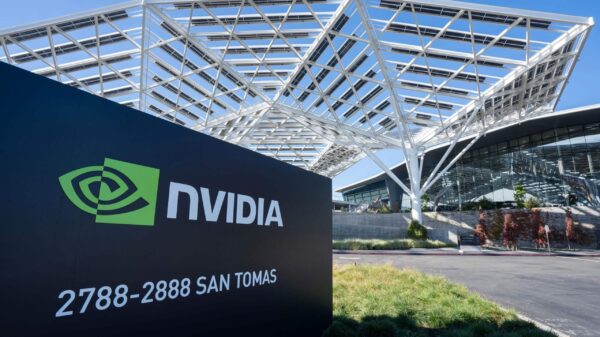






















































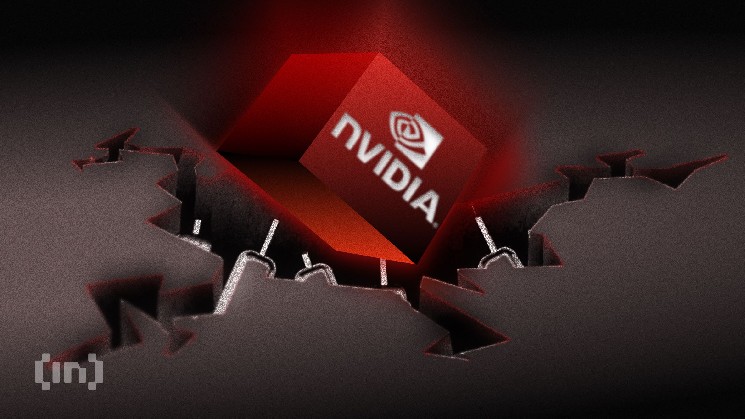
Nvidia (NVDA) stock closed above $165 on March 30, down over 9% since March 25, as the company faces a critical technical test. The decline places the stock directly on the neckline of a head-and-shoulders pattern, which projects an 11% breakdown if the price fails to hold. The recent drop marks the most significant technical challenge for Nvidia since early 2026, with conflicting signals emerging from daily charts, institutional flow data, and options positioning.
The catalyst for the 9% decline can be traced back to March 24, when Google announced TurboQuant, a new memory compression algorithm. This innovation significantly reduces AI model memory requirements by six times without sacrificing performance. The announcement sent shockwaves through the market, resulting in a sharp sell-off among AI memory manufacturers, with Micron plummeting approximately 20% and SanDisk dropping around 18% in the following days.
Introducing TurboQuant: Our new compression algorithm that reduces LLM key-value cache memory by at least 6x and delivers up to 8x speedup, all with zero accuracy loss, redefining AI efficiency. Read the blog to learn how it achieves these results: https://t.co/CDSQ8HpZoc pic.twitter.com/9SJeMqCMlN
— Google Research (@GoogleResearch) March 24, 2026
Compounding the pressure on Nvidia was news that OpenAI is scaling back its data center spending. OpenAI’s October 2025 deal to secure 40% of global DRAM supply had previously been a critical factor in the memory shortage narrative. Any retreat from this commitment undermines the demand outlook for high-bandwidth memory, which is integral to Nvidia’s GPU production.
This combination of factors drove Nvidia’s stock price down to $165 by March 30. The daily chart reveals the extent of the damage, with the AI memory sell-off nearly pushing the stock past the head-and-shoulders neckline. If this neckline is breached, analysts project a further decline of 11%. The downward slope of the neckline complicates a clean breakdown, as the price must continue to fall to reach it, placing Nvidia just inches away.
The Chaikin Money Flow (CMF) indicator, which reflects institutional buying and selling pressure, adds another layer of complexity. After a brief period of institutional buying interest between March 10 and 16, the CMF has since fallen to -0.24. However, while the stock price has trended lower, the CMF has managed to hold higher, indicating some underlying strength.
Should the CMF drop below -0.25, it would confirm that institutional sellers are driving the decline, making a breakdown of the neckline increasingly likely. In contrast, the Nvidia put-call ratio presents a different picture. On March 25, during the onset of the sell-off, the put-call volume ratio stood at 0.89, indicating a near balance between bearish puts and bullish calls. By March 30, this ratio dropped by 16.8% to 0.74, suggesting that call volume has surged relative to put volume as prices fell, indicating a potential bullish sentiment among options traders.
UBS analyst Timothy Arcuri reiterated a Buy rating for Nvidia shares on March 20, setting a $245 price target, which implies a 48% upside. This recommendation came just five days before the AI memory rout and reflects continued demand driven by expected Rubin GPU shipments. Analysts view the memory supply disruption as a temporary headwind rather than a long-term issue.
It is unusual for a stock to experience a volume ratio below 0.80 after a 9% drop in five sessions. This metric indicates that options traders appear to be taking advantage of the decline to build bullish positions rather than hedging against further downside. The open interest ratio, which indicates longer-duration positioning, remains at 0.89, suggesting that the existing put-heavy positions from earlier in the sell-off are largely intact. Although new activity appears bullish, the older short base has not yet been unwound.
This divergence between falling prices and rising call activity aligns with UBS’s view and creates a scenario where a confirmed bounce off the neckline could trigger a short squeeze in the options market. However, if the neckline breaks, call buyers could face swift losses, potentially accelerating the downward movement toward the more substantial price targets.
Nvidia’s stock is currently trading below all four major exponential moving averages (EMAs). The 20-day EMA is at $177, while the 50-day and 100-day EMAs are at $181. The 200-day EMA is positioned at $174. A bearish crossover between the 50-day and 100-day EMAs occurred during the last week of March, contributing to the long-term headwind facing the stock.
The critical technical levels to watch are around the $173-$174 zone, closely aligning with the 200-day EMA. A move back above $165 would neutralize the immediate threat posed by the neckline, while reclaiming $174 could pave the way toward $183 and $188. If the UBS analyst’s price target is reached, it could indicate a recovery for Nvidia.
A daily close above $174 would target $183 and weaken the thesis for a breakdown. Conversely, if the stock fails to reclaim $165 in the upcoming trading sessions, it would confirm the head-and-shoulders pattern and expose the stock to an 11% potential decline toward $146.
See also Germany”s National Team Prepares for World Cup Qualifiers with Disco Atmosphere
 95% of AI Projects Fail in Companies According to MIT
 AI in Food & Beverages Market to Surge from $11.08B to $263.80B by 2032
 Satya Nadella Supports OpenAI’s $100B Revenue Goal, Highlights AI Funding Needs
 Wall Street Recovers from Early Loss as Nvidia Surges 1.8% Amid Market Volatility