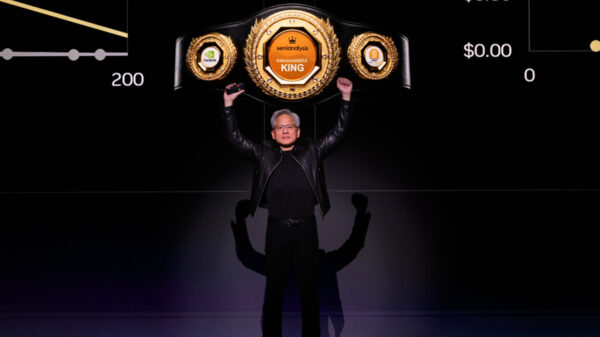




























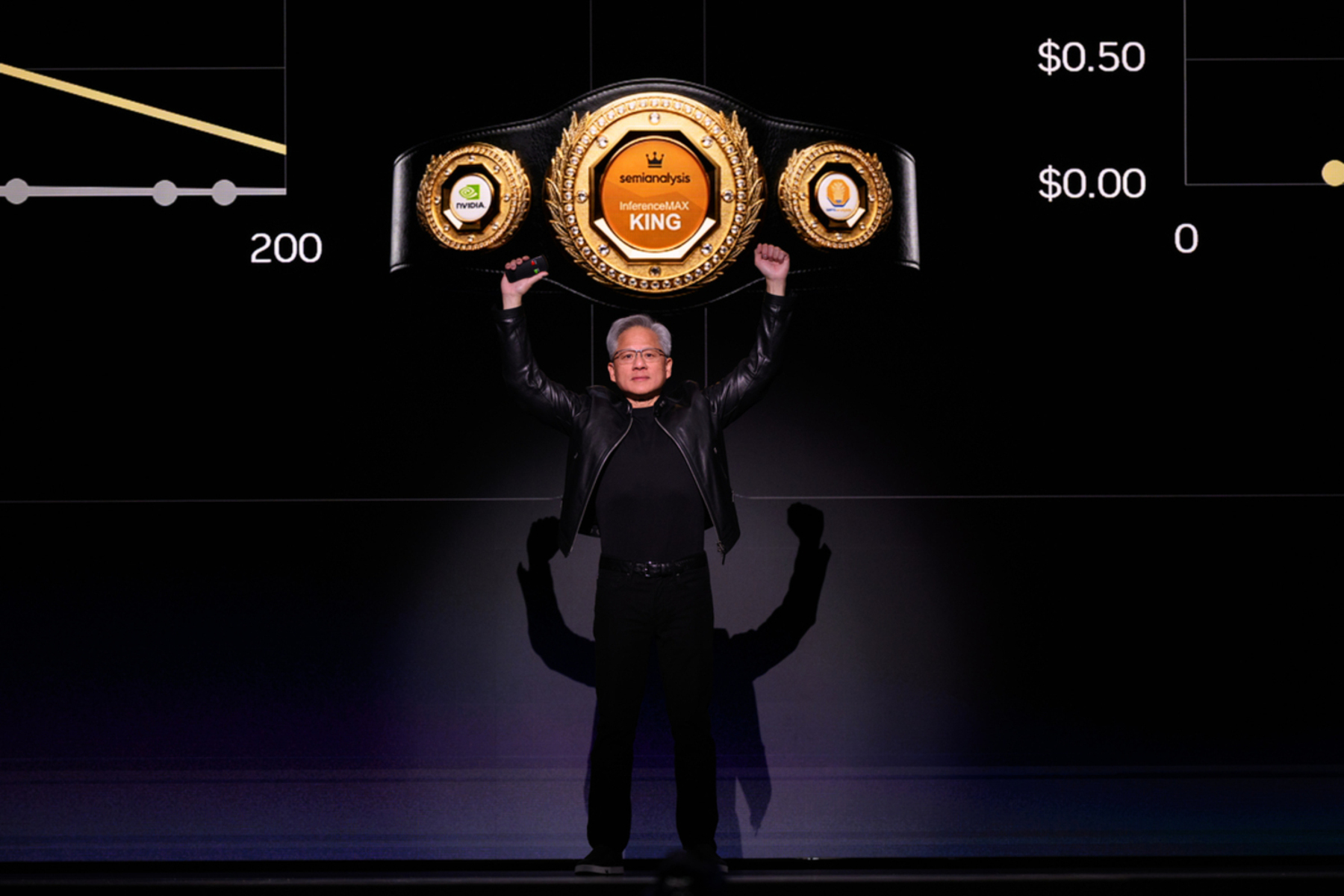
SAN JOSE – Nvidia CEO Jensen Huang projected the company’s revenue could exceed $1 trillion by 2027, fueled by the emergence of “AI natives.” These newly established companies have attracted approximately $150 billion in venture capital in the past year, spurring an unprecedented demand for computing power. “This is the first time in history that every one of these companies need compute—lots and lots of it,” Huang stated during his keynote address at the company’s annual GTC conference.
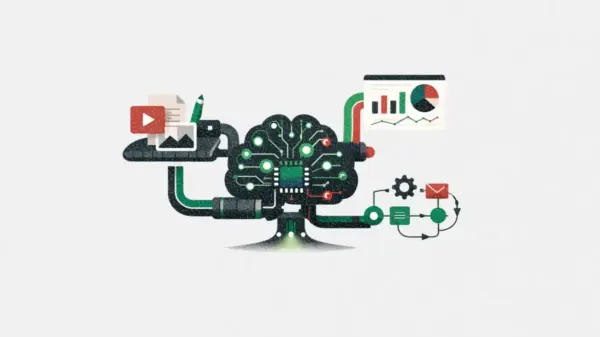
Highlighting a significant platform shift, Huang emphasized that agentic AI—systems capable of autonomous action to meet objectives—is driving transformation across various industries. This momentum builds upon advancements seen in generative AI tools, such as ChatGPT, and enhanced reasoning models, including OpenAI’s o1. He also introduced OpenClaw, a free, open-source autonomous AI agent rapidly gaining popularity in Silicon Valley, described as one of the fastest-growing open-source projects.
A standout announcement at GTC was NemoClaw, an enterprise-optimized variant of OpenClaw, which incorporates privacy and security controls to allow organizations to deploy AI agents more safely and at scale. The push toward agentic AI is particularly notable in the healthcare sector, where GTC showcased initiatives including AI infrastructure advancements in big pharma, biological reasoning for drug discovery, and physical AI aimed at enhancing healthcare robotics.
Kimberly Powell, Nvidia’s vice president of healthcare, referred to the current moment as the “transformer moment” for biology and drug discovery, noting that the $4.9 trillion healthcare industry is adopting AI at more than double the rate of the broader economy. Startups are leading this charge, capturing over 85% of last year’s healthcare AI spending. Nvidia’s Inception program now boasts over 5,000 healthcare and life sciences startups, with digital health emerging as a significant focus area, contributing more than 2,000 members.
As AI systems necessitate new infrastructures to accommodate their growing demands for reasoning and memory, a series of recent partnerships between AI-native entities and big pharmaceutical firms have highlighted this shift. Roche announced a deployment of over 3,500 NVIDIA Blackwell GPUs across hybrid cloud and on-premises environments in the U.S. and Europe, aiming to boost R&D productivity, next-generation diagnostics, and manufacturing efficiencies. Nvidia characterized this GPU footprint as the “greatest announced” for a pharmaceutical company.
This GPU deployment follows a $1 billion, five-year commitment between Eli Lilly and Nvidia aimed at addressing key bottlenecks in AI-based drug discovery, announced during January’s JP Morgan Healthcare Conference. The initiative will feature an AI co-innovation lab, staffed by teams from both organizations.
Rory Kelleher, senior director and global head of business development for healthcare and life sciences, highlighted that pharmaceutical companies possess vast amounts of internal data ideal for foundation models and multi-agent frameworks capable of unlocking insights for biological discovery. However, unlike the more agile AI-native startups, traditional pharma firms have often been hesitant to revamp their systems. “You’re seeing the leaders in this space, Roche and Lilly, start to invest in ways that pharmaceutical companies haven’t invested in AI infrastructure in the past,” Kelleher remarked. “Computing is the essential instrument to how R&D gets done.”
In drug discovery, advancements in AI models now extend beyond basic structure prediction to simulate complex protein interactions, ushering in a new era of biological reasoning to unveil disease mechanisms. A collaboration unveiled at GTC between Nvidia, the European Molecular Biology Laboratory (EMBL), Google DeepMind, and Seoul National University has contributed 1.7 million new predicted protein complexes to the AlphaFold Protein Structure Database, along with an additional 30 million predicted structures available for bulk download. This expansion alleviates a significant computational barrier for researchers, particularly in environments with limited supercomputing resources.
Additionally, Nvidia introduced a new protein design reasoning model, Proteina-Complexa, capable of generating binders for structure-based drug discovery. One million designed protein binders have been experimentally validated against over 130 targets in partnership with organizations, including Manifold Bio, Novo Nordisk, and the University of Cambridge. This model integrates a partially latent flow matching architecture with test-time compute scaling to iteratively optimize designs.
In the realm of specialized healthcare agents, IQVIA unveiled a unified agentic platform, IQVIA.ai, which has deployed over 150 specialized agents to streamline complex tasks such as clinical trial site selection. Partnerships with companies like Hippocratic AI, which is developing patient-facing agents for chronic care, and HeidiHealth, providing a multilingual clinical documentation platform, are further expanding the reach of AI in healthcare.
Nvidia has also rolled out a range of physical AI platforms for healthcare robotics, including Open-H, a dataset comprising over 700 hours of surgical procedure videos; Cosmos-H, an open model family facilitating physics-based synthetic data generation; GR00T-H, a vision language action model for clinical tasks; and Rheo, a digital twin blueprint for simulating hospital workflows.
As GTC 2026 concludes, the ambitions for autonomous agents are clear, heralding the potential for a compute revolution valued at $1 trillion.
See also Germany”s National Team Prepares for World Cup Qualifiers with Disco Atmosphere
 95% of AI Projects Fail in Companies According to MIT
 AI in Food & Beverages Market to Surge from $11.08B to $263.80B by 2032
 Satya Nadella Supports OpenAI’s $100B Revenue Goal, Highlights AI Funding Needs
 Wall Street Recovers from Early Loss as Nvidia Surges 1.8% Amid Market Volatility