














































Securing American primacy in artificial intelligence has become a central aim of President Donald Trump’s second term. Washington’s objectives are clear: to preserve America’s lead in artificial intelligence, spread its preferred “AI stack” — the full set of chips, software, data, and cloud infrastructure that make advanced systems function — and extend the country’s military, intelligence, and economic edge.
To achieve this, the Trump Administration and its allies in Silicon Valley advocate for policies that prioritize innovation over regulation and for a rapid buildout of the infrastructure AI requires: data centers, high-capacity power supplies, and fiber networks. Trump began this push on his first day back in the White House by rolling back the AI safety regulations set during the Biden era. The president’s July 2025 AI Action Plan presented a blueprint for achieving global AI dominance by accelerating AI innovation, cutting regulations, and taking a “build, baby, build” approach to AI infrastructure. In December, Trump signed an executive order aimed at constraining the ability of states to regulate AI, threatening to deny federal funds to those with “the most onerous and excessive laws” that could hinder innovation.
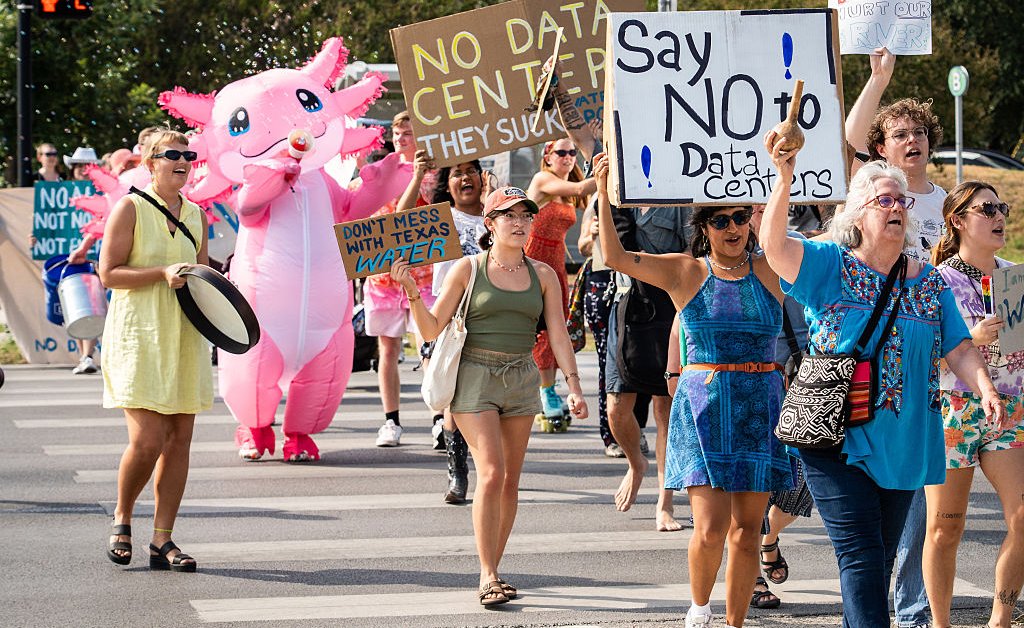
A significant segment of the American population opposes Trump’s laissez-faire approach, and this lack of broad popular support poses a threat to America’s quest for dominance in artificial intelligence. Growing community resistance against data center construction, driven by concerns about electricity and water prices and pollution, may be an early indicator of broader discontent. Politicians are taking note, with bipartisan calls for tech companies to pay their “fair share” of utility costs, including from the president himself. If 2026 becomes a pivotal year for AI, the growing concerns among Americans about its impacts on the economy, politics, and human relationships could coalesce into a potent political force.
Policy debates surrounding AI have traditionally been confined to specialists, but this dynamic is changing as Americans begin to feel the initial tremors of the coming AI upheaval: skyrocketing electricity bills, disappearing jobs, and the emergence of baffling applications like Moltbook, a new social network where AI bots interact solely with each other. AI policy is rising as a priority in American political discourse, particularly concerning affordability and job security. Recent state-level elections in Virginia, New Jersey, and Georgia have already highlighted its importance, and the upcoming midterm elections in November are likely to further crystallize this shift.
Public opinion polling on AI remains remarkably sparse, but existing surveys reveal significant anxiety. According to Gallup, six in ten Americans distrust AI, and nearly everyone agrees that regulations prioritizing AI safety and security are essential. A recent survey from the Pew Research Center indicates that half of Americans feel more concern than excitement about AI’s rising presence in daily life; 57% rate its societal risks as high, while only a quarter see its benefits as equally significant. According to YouGov, 77% worry that AI could eventually pose a threat to humanity.
Perhaps most revealing is the gap between the AI experts building the future and the public experiencing it: the experts generally express much greater optimism about AI’s potential benefits across various sectors. In my research, I convened over 300 Americans—focusing on the swing states of Arizona, Michigan, and Georgia—to gather their perspectives on America’s role in the world. I met individuals from diverse backgrounds who expressed a desire to discuss AI above all else.
Many Americans recognized that AI enhances American economic and military power, yet they were far more concerned about its long-term implications for families and communities. Concerns were voiced regarding the inadequacy of AI regulation to protect children and curb the rampant spread of misinformation. Participants voiced anxieties about AI exacerbating economic inequality, jeopardizing job prospects, and amplifying political polarization while eroding educational quality and critical cognitive abilities. Specific complaints regarding the impact of AI on communities included rising electricity costs and the disruptive presence of data centers.
Rather than being seen as a boon to local economies, data centers were perceived as a burden, benefiting from generous incentives while escalating community utility costs and generating few permanent jobs. While tech insiders remained optimistic about the necessity for swift AI innovation, many others expressed deep pessimism. These sentiments are already reshaping politics at the state and local levels, with intense debates emerging over data center construction. This issue has particularly resonated in swing states that host significant data center markets and likely explains its prominence in political discussions.
In Virginia, electricity costs were a focal point in last November’s gubernatorial election amid the proliferation of data centers, with some facilities using as much electricity as 100,000 households. In Georgia, Democrats gained their first seats on the state utility regulatory commission since 2007, propelled by similar concerns. In Arizona, local opposition has already stymied several major data center projects. These political rumbles signal the beginning of a larger reaction, as aggressive AI deployment and job disruptions may soon ignite broader discontent.
The emerging politics of AI do not neatly align with the traditional left-right ideological spectrum and are already fostering unexpected coalitions. For example, Senator Bernie Sanders and Governor Ron DeSantis have emerged as leading opponents of AI data center construction, despite Sanders’s proposed moratorium failing to sway fellow progressives. At the grassroots level, Republicans and Democrats alike have rallied to block proposed facilities, while Republican senators, including Josh Hawley, Katie Britt, and Marsha Blackburn, are calling for tougher regulations — a stance at odds with Trump’s agenda.
This political muddle reflects a deeper reality: neither party has solidified its position on AI policy. Despite majorities in both parties favoring stronger AI regulation, neither has established a clear advantage. For Democrats to prevail, they must develop a fresh political narrative around AI policy. Americans have never voted with AI as an electoral issue, and most politicians have yet to master the ongoing debate. Democrats should recognize the tangible difficulties and anxieties Americans face while balancing the economic gains promised by AI.
Crafting a responsible policy agenda is crucial in this context. Public opinion appears to favor a balanced approach prioritizing regulatory protections and consumer safety over a headlong rush to compete with China. A new Democratic platform could focus on three key areas: comprehensive regulation covering data center construction and privacy standards; social policies including retraining programs for workers displaced by AI; and national security measures to maintain America’s technological edge while managing disruptions without ceding leadership to Beijing.
The AI race is undoubtedly the most consequential strategic competition of our time. However, if politicians, tech leaders, and national security experts do not quickly adapt to the realities of American public sentiment, a populist backlash could derail America’s ambitions in artificial intelligence.
 Meta Launches Standalone Vibes App for AI-Generated Video Creation and Discovery
 AI-Driven Innovations Propel Construction Market Growth, Forecasts Show 2033 Expansion
 AI Crypto Market Surges 12%, Adding $4B; Chainbase and ChatGPT Agent Lead Growth
 Nvidia Stock Jumps 7.8% as AI Spending Surge Hits $650 Billion by 2026
 Palantir and Cognizant Forge AI Partnership to Transform Healthcare Operations and Compliance