























































Qualcomm Incorporated has made a significant entry into the mid-range AI desktop and laptop market with its latest Snapdragon X chip. This new system-on-chip (SoC) represents the fourth installment in the Snapdragon X processor lineup, following the successful launches of the Snapdragon X Plus 8-core, Snapdragon X Plus, and Snapdragon X Elite series. Leveraging a 4-nanometer manufacturing process, the Snapdragon X chip features an 8-core Oryon central processor alongside a graphics component and a neural processing unit (NPU). The NPU is designed to accelerate AI workloads, achieving a remarkable 45 TOPS (trillions of operations per second), positioning it as a strong contender for powering Copilot+PCs — Microsoft’s vision for AI-first, flagship Windows hardware.
The introduction of AI PCs, which incorporate specialized processors to enhance AI capabilities, promises improved features such as advanced personal assistants and task automation. One of the standout benefits of these AI-driven machines is their extended battery life. Qualcomm’s chips, based on designs from Arm Holdings Plc, are engineered to provide prolonged usage without the need for frequent recharging, appealing to consumers seeking efficiency in their devices.
Qualcomm’s Snapdragon mobile platforms are recognized for their speed and power efficiency, integrating multi-core CPUs with cutting-edge features and graphics, alongside global network connectivity. Devices powered by Snapdragon enable immersive augmented reality and virtual reality experiences, enhanced camera capabilities, and superior 4G LTE and 5G connectivity, all complemented by advanced security solutions.
Meanwhile, other tech giants are also intensifying their focus on AI. NVIDIA Corporation is rapidly solidifying its presence in the enterprise AI sector, extending beyond cloud services to major industries. Businesses are increasingly adopting NVIDIA’s AI platforms to streamline workflows and bolster productivity, with the company’s DGX Cloud AI infrastructure gaining traction for its ability to train and deploy AI models at scale. The expansion of its CUDA software and AI frameworks further strengthens NVIDIA’s ecosystem, making it a preferred choice for enterprises developing AI applications. With a surge in AI adoption anticipated in 2025 and beyond, NVIDIA’s software and cloud solutions are poised to significantly drive revenue.
Intel Corporation is also ramping up investments to expand its manufacturing capacity as part of its IDM 2.0 (Integrated Device Manufacturing) strategy, aiming to solidify its position in the burgeoning AI landscape. The company’s Xeon 6 processors, equipped with Performance-cores (P-Cores), are designed to handle substantial AI workloads across various sectors. With industry-leading capabilities in AI processing, the Xeon 6 family is touted as delivering the best CPU for AI at a lower total cost of ownership. Intel’s innovative AI solutions are expected to benefit the broader semiconductor ecosystem by reducing costs, enhancing performance, and fostering an open, scalable AI environment.
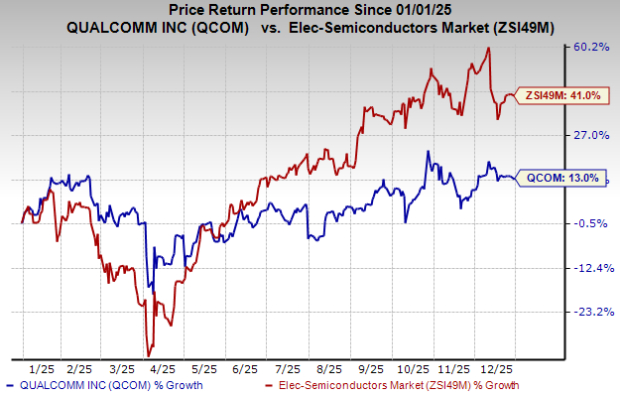
In terms of market performance, Qualcomm shares have increased by 13% over the past year, trailing the industry’s 41% growth. Currently, Qualcomm’s shares trade at a price-to-earnings ratio of 14.16 for forward earnings, significantly lower than the industry average of 34.14. Analysts have also revised earnings estimates for fiscal 2026 upward by 2%, now projected at $12.15 per share, while estimates for fiscal 2027 have increased by 3.4% to $12.6.
As Qualcomm navigates this competitive landscape, it currently holds a Zacks Rank #3 (Hold). Investors looking for promising stock picks for 2026 may want to consider insights from Zacks Investment Research, which has a robust history of identifying high-performing stocks. Since 2012, the portfolio curated by Zacks has achieved a staggering 2,530.8% gain, far exceeding the S&P 500’s 570.3% over the same period.
With the AI sector poised for growth, Qualcomm, NVIDIA, and Intel are all strategically positioning themselves to capture market opportunities, underscoring the critical role of innovation and technological advancement in shaping the future of computing.
See also Vanderbilt Scholars Urge Energy Transparency to Boost AI Efficiency, Cut Emissions by 2028
 Ai Holdings Stock Dips 0.70% Amid Sector Concerns; Meyka AI Rates ‘B+’ with Long-Term Growth Potential
 China’s AI Ambitions Stalled by State Control, Echoing Soviet Industrial Failures
 Transforming AI Integration: Channel Partners Shift from Resellers to Strategic AI Factory Builders
 Boards Must Prioritize AI Ethics: Global Regulations Shift from Guidelines to Compliance