






















































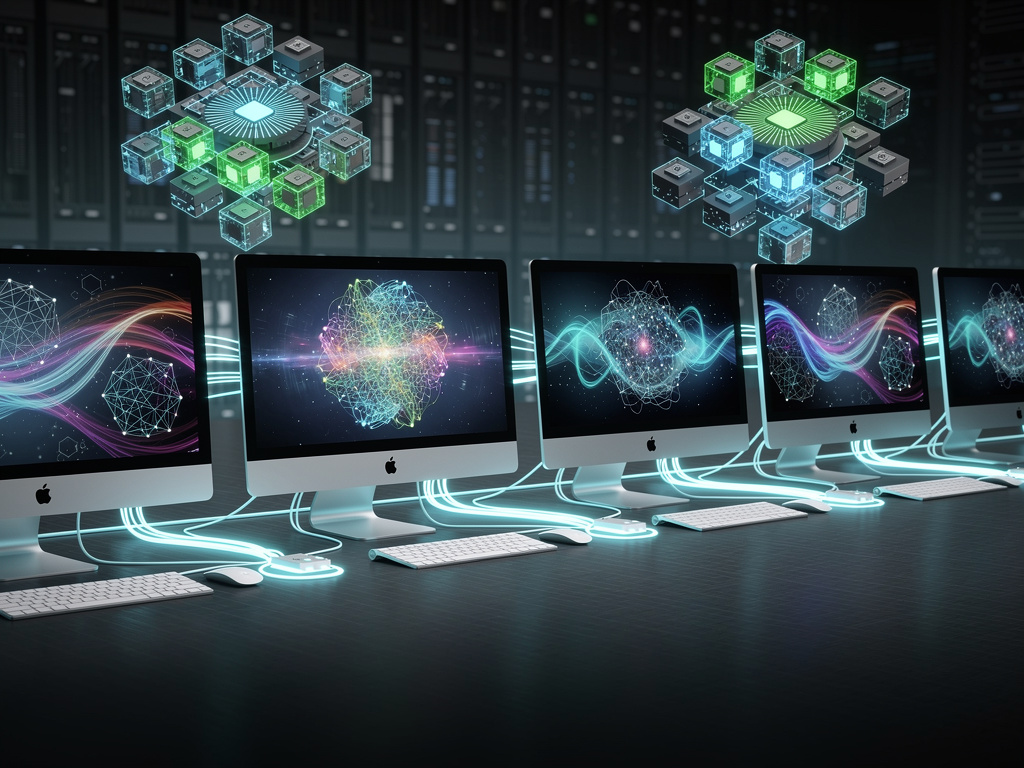
Apple has introduced a transformative feature in its latest macOS update, Tahoe 26.2, which integrates Remote Direct Memory Access (RDMA) support over Thunderbolt 5. This breakthrough allows clusters of Macs to combine their computing power, offering a new solution for developers and researchers engaged in demanding artificial intelligence tasks. With this enhancement, multiple computers can operate as a cohesive unit, sharing memory at unprecedented speeds, thus challenging traditional computing limits.
Initial tests have showcased the capability of connecting multiple Mac Studios via Thunderbolt 5 cables, enabling them to manage extensive AI models that a single device would struggle to handle. By leveraging unified memory across these machines, researchers can work with models containing trillions of parameters while avoiding the latency issues that hindered previous cluster setups. The efficiency of RDMA facilitates direct memory transfers with latencies as low as sub-10 microseconds, making it particularly beneficial for applications in natural language processing and generative AI, where rapid data processing is essential.
This development could redefine the competitive landscape for AI hardware. Apple’s implementation positions its product lineup as a viable alternative to high-cost GPU clusters from companies like Nvidia, which often come with significant power demands. With Thunderbolt 5’s bidirectional bandwidth of 80Gb/s, a small assembly of Macs can achieve performance levels akin to data centers, democratizing access to advanced AI capabilities. This shift could lower entry barriers for startups and independent researchers who may lack access to enterprise-grade infrastructure.
At the core of this innovation is Apple’s adaptation of RDMA, a technology usually reserved for high-end networking. Unlike traditional Ethernet-based clustering that incurs overhead from TCP/IP protocols, RDMA allows direct access to remote memory without engaging the host CPU. This results in significantly reduced latency, making it ideal for distributed AI workloads. Benchmarks indicate that a four-Mac configuration can share up to 1.5 terabytes of VRAM, showcasing substantial processing capability.
Apple’s M-series chips, particularly the M4 Pro and Max variants, are designed to complement this new feature. The high memory bandwidth of these chips enhances performance when clustered. For instance, a four-Mac configuration running a trillion-parameter model like Kimi K2 Thinking achieves 15 tokens per second while consuming less than 500 watts total. This energy efficiency stands in stark contrast to many GPU-based systems, which often require considerable power for similar workloads.
Feedback from the tech community indicates growing enthusiasm around this feature. Developers are experimenting with tools like Exo 1.0, an open-source clustering framework, to further explore its potential. One notable configuration involves arranging Mac Studios in compact setups, creating powerful AI rigs that maintain Apple’s signature energy efficiency, which is crucial in an era with rising data center costs.
Market Context
Apple’s venture into clustering technologies is not entirely novel; the company previously attempted high-performance computing solutions with its Xserve line in the early 2000s. However, those efforts lost momentum due to limited adoption. The macOS 26.2 update revives this concept, utilizing the capabilities of Thunderbolt 5 to create what some are dubbing “AI supercomputers at home.” Recent articles have illustrated how clustered Macs can significantly accelerate AI calculations, proving Apple’s implementation effective for professional use despite some scalability challenges.
One significant advantage is power consumption. A tested cluster of Mac Studios priced at approximately $40,000 delivers impressive results while using far less energy compared to equivalent setups from other providers. This aligns with Apple’s focus on on-device processing, which enhances privacy and reduces reliance on potentially insecure cloud services.
Early benchmarks reveal dramatic performance improvements. While a single Mac Studio might manage a 70-billion-parameter model at a steady pace, leveraging RDMA across four machines can yield up to a 3.2x speedup. This tensor parallelism enables efficient distribution of workloads, transforming theoretical possibilities into practical tools for AI development. Comparatively, Apple’s approach, utilizing standard Thunderbolt connectors, undercuts Nvidia’s InfiniBand offerings, which can be prohibitively expensive.
The tech sector’s reaction has been a blend of enthusiasm and cautious optimism. While many highlight the ease of setting up these AI supercomputers using standard cables, some critics point out limitations, such as the necessity for direct connections between Macs, which caps the scalability at about four devices without additional hardware. Nonetheless, this innovation represents a boon for fields that depend on private AI research or on-premises inference.
As Apple continues to refine these capabilities, the implications for AI development could be profound. Developers are already exploring various configurations that leverage this newfound power. With potential future enhancements in M-series chips, the lines between consumer and professional computing will likely continue to blur. Apple’s initiative to enable efficient, powerful AI systems through its clustered Macs signals a shift in the competitive landscape of AI hardware, offering new pathways for innovation in the field.
See also Voice-Activated AI Market Grows 25% to $5.4B, Set to Reach $8.7B by 2026
 Moore Threads Launches Huashan AI Chip, Surpassing Nvidia’s Hopper in Performance
 AI Hiring Increases Application Volume but Lowers Hiring Rates, Study Finds
 Alphabet Invests $10 Billion in Quantum Computing, Set to Lead Industry Advances
 Experts Warn of Gaps in AI Job Revolution Predictions Amidst Automation Surge














