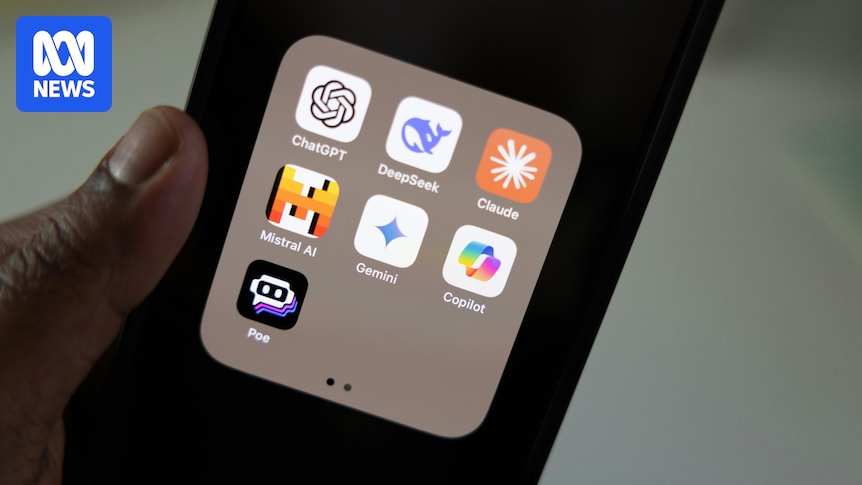
Artificial intelligence is evolving rapidly, as underscored by a recent personal experience of mine. A week ago, I was sent a link to an article detailing a fictitious confrontation between myself and Commonwealth Bank CEO Matt Comyn on the set of the program “7.30.” The 2,000-word piece included vivid descriptions and images of an argument that never occurred, clearly fabricated by AI. Although I will not share the link to avoid drawing attention to it, the convincing nature of the article has prompted numerous inquiries about its authenticity.
That same night, Matt Shumer, co-founder of an AI company in New York City, published a 4,800-word essay titled “Something Big is Happening,” which has since gained significant traction online. He noted that on February 5, two major AI laboratories released new models almost simultaneously: GPT-5.3 Codex from OpenAI and Opus 4.6 from Anthropic, the creators of Claude, a direct competitor to ChatGPT. “Something clicked,” Shumer wrote, describing the experience as akin to realizing that the water level is rising dangerously around you.
Shumer’s observations highlight a significant shift in workplace dynamics. As he explained, “I am no longer needed for the actual technical work of my job. I describe what I want built, in plain English, and it just … appears.” This sentiment echoes across various sectors, as advancements in AI are redefining roles, making once labor-intensive tasks more efficient.
For example, a Tesla owner recently demonstrated the capabilities of autonomous vehicles, noting that he could simply instruct his car to drive to the airport without taking control. While Australian law prohibits reading a book in the back seat of a self-driving car, similar freedoms are allowed in select U.S. cities, where driverless taxis conduct 450,000 trips weekly. Such examples illustrate the rapid penetration of AI into everyday life and the profound implications it holds for future work environments.
AI Wake-Up Call
This week has served as a collective wake-up call regarding the implications of AI on society. On Tuesday, Mrinank Sharma, head of safeguard research at Anthropic, resigned, citing a myriad of interconnected crises facing the world. In a letter posted on X, he expressed concern over humanity’s preparedness to govern its technological capabilities, stating, “We appear to be approaching a threshold where our wisdom must grow in equal measure to our ability to affect the world.”
On Wednesday, I met with a 27-year-old entrepreneur who initially aimed to train others on how to utilize AI. He soon recognized that teaching skills for jobs that AI would supplant was futile. Instead, he is developing an AI agent to handle receptionist tasks, ensuring customers are unaware they are speaking to a machine. This agent will access comprehensive company data, providing seamless interactions.
By Wednesday evening, Jimmy Ba, co-founder of Elon Musk’s xAI, also announced his resignation, highlighting the potential for “100x productivity” driven by AI advancements. He predicted that recursive self-improvement loops could become operational within the next year, foreseeing 2026 as a pivotal year for humanity.
On Thursday, Mustafa Suleyman, head of AI at Microsoft and a founder of Google’s DeepMind, remarked that most white-collar jobs—such as those in law, accounting, and project management—would likely be fully automated within the next 12 to 18 months. This perspective indicates a seismic shift in the job market, with significant ramifications for workers across various sectors.
Investors are beginning to wake up to the reality that AI is advancing far more rapidly than strategies to manage its consequences. For instance, the simultaneous release of GPT-5.3 Codex and Opus 4.6 stirred “AI fear” among market analysts. Software and data firms like Salesforce, Thomson Reuters, and Adobe experienced sharp stock declines. In Australia, tech companies such as Technology One, Xero, and Wisetech faced similar downturns.
Adding to the landscape, a Chinese lab called OpenBMB launched an open-source AI agent named MiniCPM-o 4.5, featuring 9 billion parameters and capable of running on local devices without the need for data centers. This development raises questions regarding the substantial investments made in cloud computing infrastructure.
As I reflect on these events, I realize that traditional frameworks for understanding AI and the so-called fourth industrial revolution are becoming inadequate. The decline in the cost of intelligence is paralleling the transformative impact of the internet on communication. Companies are rapidly adopting AI not only for cost savings but also for enhancing productivity, pushing towards greater profits. As capital increasingly replaces labor in the workplace, we may be unwittingly constructing an intelligence that operates at unprecedented speeds and capabilities, ushering in a future that is as exciting as it is uncertain.
See also Siemens Launches AI Lab to Empower Strategic Partnerships and Innovation in Munich
 AI Simplifies Medical Scan Reports by 50%, Enhancing Patient Understanding, Says Study
 Google DeepMind Launches AI Science Tools to Empower 3 Million Researchers
 Krites Enhances Asynchronous Semantic Caching, Boosts Curated Response Rate by 3.9x
 AI Simplifies Radiology Reports, Enhancing Comprehension by 100% in New Study