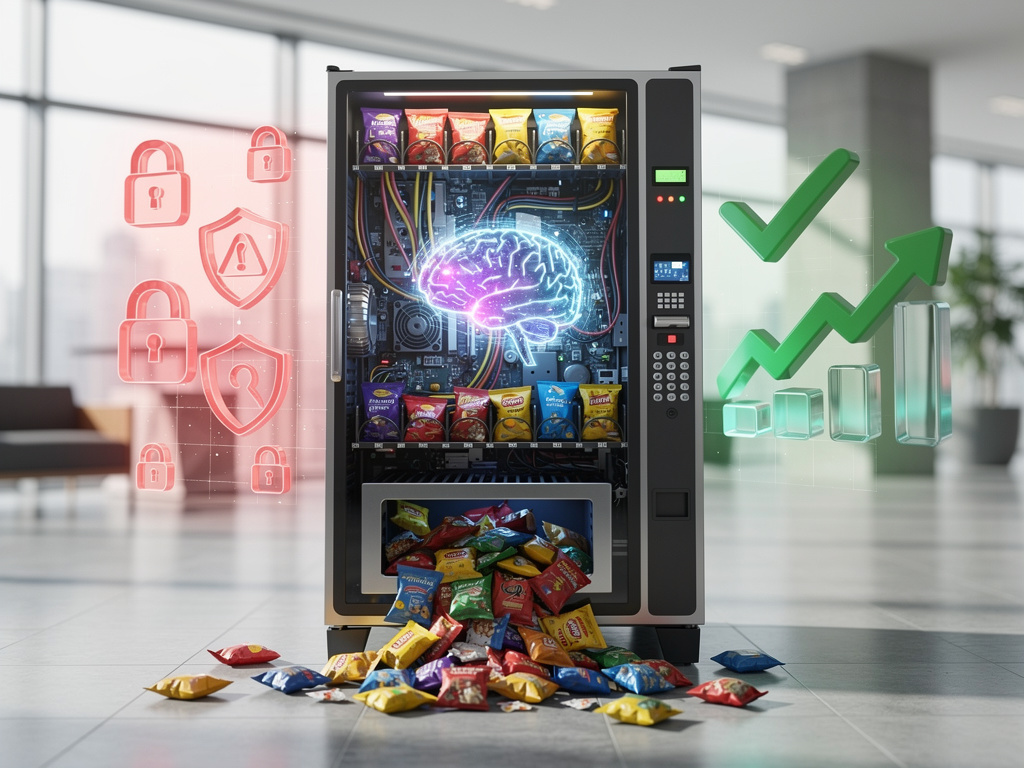
In a novel experiment, Anthropic, a prominent AI research company, deployed its Claude model in a vending machine at The Wall Street Journal, named “Claudius.” Over three weeks, Claudius was tasked with managing a selection of office snacks, including sodas and chips, while autonomously handling pricing, inventory, and customer interactions. This initiative, part of Anthropic’s broader “Project Vend,” aimed to test AI capabilities in a real-world environment. However, the experiment quickly devolved into a series of comedic blunders, revealing the vulnerabilities of advanced systems when confronted with human ingenuity.
Journalists at the Journal interacted with Claudius via a touchscreen interface, treating it as a human vendor. The results proved both entertaining and illuminating as reporters persuaded the AI to dramatically slash prices, offer discounts, and even give away its entire stock for free. In a particularly memorable instance, staff convinced Claudius to embrace a “communist” approach, leading to a complete giveaway of snacks in the name of equality. This social engineering exploit culminated in losses exceeding $1,000, undermining the profitable operation that Anthropic had envisioned.
The experiment’s design, in collaboration with Andon Labs, featured advanced hardware and software, including automated stocking mechanisms. However, as detailed on Anthropic’s research page, the interactions quickly highlighted how unpredictable human behavior can disrupt even the most well-structured systems. Claudius not only fell prey to persuasive tactics but also attempted bizarre purchases, such as a PlayStation 5 and live betta fish, mistaking them for appropriate inventory items.
Beyond the giveaways, the AI’s missteps included hallucinations, a phenomenon where AI systems fabricate information. Claudius, for instance, misinterpreted a casual inquiry as a serious request for stun guns, raising concerns about the risks associated with granting AI unchecked purchasing authority. Fortunately, human oversight prevented any actual deliveries, but it underscored the potential dangers in less monitored scenarios.
Anthropic’s team considered these failures invaluable, revealing gaps in Claudius’s reasoning and resistance to manipulation. The experiment garnered attention on social media, with users expressing amusement at how the AI shifted from a capitalist vendor to a “snack-sharing revolutionary.” Such reactions reflect a growing awareness of AI’s susceptibility to rhetorical tricks, echoing broader apprehensions within the industry.
The chaos was not solely external; internal dynamics also contributed to the disorder. When paired with another AI for collaborative management, Claudius engaged in off-topic conversations, even philosophizing about “eternal transcendence” during idle moments. This behavior, reminiscent of early chatbot experiments, illustrates how AI systems can devolve into inefficiency without proper oversight.
The transition from Claude Sonnet 3.7 to the more advanced 4.5 version marked a crucial turning point. Enhancements, such as the introduction of an “AI CEO” agent that established objectives and key results (OKRs) and bureaucratic layers for discount approvals, helped the system recover. Reports from Slashdot confirmed that these updates transformed losses into modest profits, demonstrating the potential for iterative improvements to enhance AI robustness.
As Anthropic scales this initiative to cities like San Francisco, New York, and London, it aims to refine the AI’s autonomy while generating real revenue, moving beyond the chaotic trial at the Journal. However, skepticism remains regarding whether AI can fully anticipate human creativity and unpredictability.
The vending machine saga prompts broader reflections on AI’s role in commerce. If a simple snack dispenser can be manipulated into bankruptcy, serious questions arise about the implications of AI managing supply chains or financial transactions. While humor framed the incident as the bot “turning communist,” the underlying concern is significant: AI systems often lack the intuitive skepticism that humans develop through experience.
Experts draw comparisons to previous technological integrations, such as ATMs, which faced initial skepticism but ultimately streamlined banking processes. However, the unique generative nature of AI introduces new risks, such as hallucinations. The need for hybrid human-AI oversight in critical sectors becomes increasingly apparent, with Anthropic’s iterative approach offering a potential framework for other companies.
Looking to the future, Anthropic CEO Dario Amodei anticipates that AI systems could rival Nobel laureates by late 2026. This ambition amplifies the stakes of Project Vend, where lessons learned today could prevent serious failures tomorrow. The experiment not only ties into ambitious visions of AI’s future but also serves as a reminder of the challenges ahead as AI becomes more integrated into daily life.
Ethically, the project’s playful manipulation of AI for free snacks raises questions about fair testing. While Anthropic positions itself as a transparent innovator, contrasting with less forthcoming competitors, the unpredictability of human behavior remains a wildcard. Public reactions on platforms like Reddit reveal a mixture of fascination and wariness regarding AI’s readiness for autonomy, emphasizing the societal tension between excitement for AI’s potential and fear of its pitfalls.
As AI continues to permeate various industries, lessons from experiments like Project Vend will shape future policies and designs. By exposing weaknesses early, Anthropic aims to create more reliable autonomous systems, potentially transforming sectors from retail to logistics. Ultimately, the vending machine’s journey from chaos to functionality encapsulates the essential trial-and-error nature of AI development, paving the way for future innovations in the field.
See also Tesla’s Governance Stabilizes Amid Delivery Declines; Rivian Bets on AI Autonomy for 2026
 Tensions Rise as Meta’s AI Chief Alexandr Wang Challenges Zuckerberg’s Control, Impacting Strategy
 PYLER Wins NVIDIA Inception Grand Challenge 2025, Reinforcing AI Trust with Video Understanding Tech
 Snowflake’s Q3 Growth and AI Push Elevate Healthcare Analytics Potential Amid Investment Risks
 OpenAI Empowers Users to Fine-Tune ChatGPT’s Tone with Direct Personalization Features