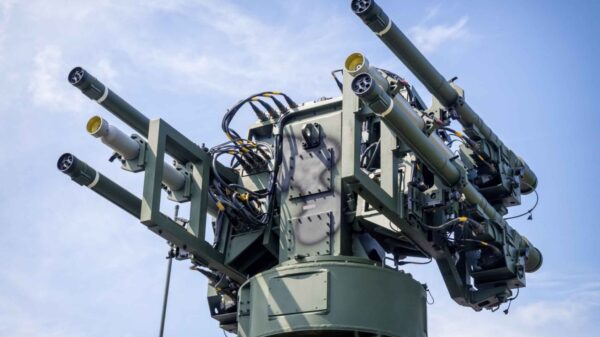
San Diego-based Shield AI is gaining traction in the defense sector, showcasing its V-BAT surveillance drone amidst geopolitical tensions. In April 2025, two HESA Shahed 136 missiles struck a facility in Kyiv where Shield AI had been conducting research, just weeks after it had relocated its team due to concerns about increased attention on its technology. Fortunately, no personnel were injured, thanks to proactive measures taken by James Lythgoe, the company’s managing director of Ukrainian operations.
The V-BAT drone has navigated the harsh conditions of the Ukrainian battlefield, successfully completing over 35 missions and identifying more than 200 Russian targets in 2025. The drone’s resilience against Russian jamming tactics has bolstered Shield AI’s valuation to $5.6 billion, making it one of the hottest defense startups of the year, trailing only behind its hardware-heavy competitor, Anduril Industries. Major defense contractors have begun piloting Shield AI’s autonomous software, Hivemind, for their experimental aircraft, while international customers—including Romania, Indonesia, and Japan—have also procured its surveillance drones.
To capitalize on this momentum, Shield AI is developing the X-BAT, a new autonomous fighter jet. Under the leadership of newly appointed CEO Gary Steele, who joined in May 2025, the company aims to achieve revenue growth of 70% to 100% annually until reaching $1 billion by March 2028, up from approximately $300 million reported for the year ending March 2025. Steele emphasizes the challenge of scaling the company, stating, “How do we scale this?”
Steele’s arrival comes during a pivotal time for Shield AI, which is eager to overcome setbacks from a 2024 incident in which a U.S. Navy servicemember suffered severe injuries during a V-BAT drill. This incident raised concerns that ultimately led to delays in contracts and tarnished the company’s public image. Getting past these hurdles will be crucial as Shield AI navigates a competitive landscape where it must persuade legacy defense firms that its AI-driven software can exceed expectations beyond its own products.
Founded in 2015 by brothers Brandon and Ryan Tseng along with Andrew Reiter, Shield AI initially focused on military applications when such ventures were uncommon in Silicon Valley. Its early product, the Nova quadcopter, was designed for reconnaissance missions, but the company pivoted to the larger V-BAT drone, capable of vertical takeoff and landing, after recognizing the limits of the quadcopter market. This shift paid dividends, particularly as the war in Ukraine prompted substantial interest in advanced defense technology.
Despite early challenges, Shield AI’s V-BAT has proven its mettle in combat zones. The drone underwent significant upgrades, including the integration of the Hivemind software, which enhanced its operational capacity in GPS-denied environments. Ukrainian documents confirm that V-BATs have successfully conducted missions deep into Russian territory, significantly boosting its profile in international defense circles. This year alone has seen a surge in new contracts from countries like the Netherlands and Egypt, with Steele noting that “hundreds of millions” of dollars are on the line across Asia, Europe, and the Middle East.
In October 2025, the company unveiled the X-BAT, a fighter jet designed for long-range operations. The ambitious project reflects a broader strategy of diversification and adaptability within the defense sector. Shield AI aims to solidify its role among major military contractors, including General Atomics and Airbus, and is keen to establish itself across various platforms, not limited to aerial technologies.
As Shield AI’s trajectory continues to evolve, the dynamics of leadership play a significant role. Ryan Tseng has transitioned to the position of Chief Strategy Officer, emphasizing a collaborative approach with Steele to ensure seamless operations. The Tseng brothers maintain substantial influence within the company while navigating the complexities of scaling a tech startup in a sensitive sector like defense.
With the backing of significant venture capital and a clear focus on AI autonomy, Shield AI is poised to become a key player in the defense technology landscape. As Steele noted, trust and proximity to operational needs are vital in ensuring that their innovations provide necessary support to military operations. The company’s commitment to moral standards amidst high-stakes environments positions it uniquely within the burgeoning field of defense technology, reflecting a comprehensive understanding of both technological and human elements in warfare.
See also AI Infrastructure Scrutiny and $10B Google-Palo Alto Deal Shape Holiday Trading Landscape
 Alphabet Set to Outperform Nvidia as AI Infrastructure Investment Surges Ahead of 2026
 xAI Faces Sales Challenges Despite Musk’s 2026 AGI Ambitions and $230 Billion Valuation
 Notre Dame Secures $50.8M Grant to Pioneer Faith-Based AI Ethics Initiative
 AI’s Value Under Fire: Critics Cite 95% Fail Rate in Corporate Pilot Programs Amid Regulatory Showdown