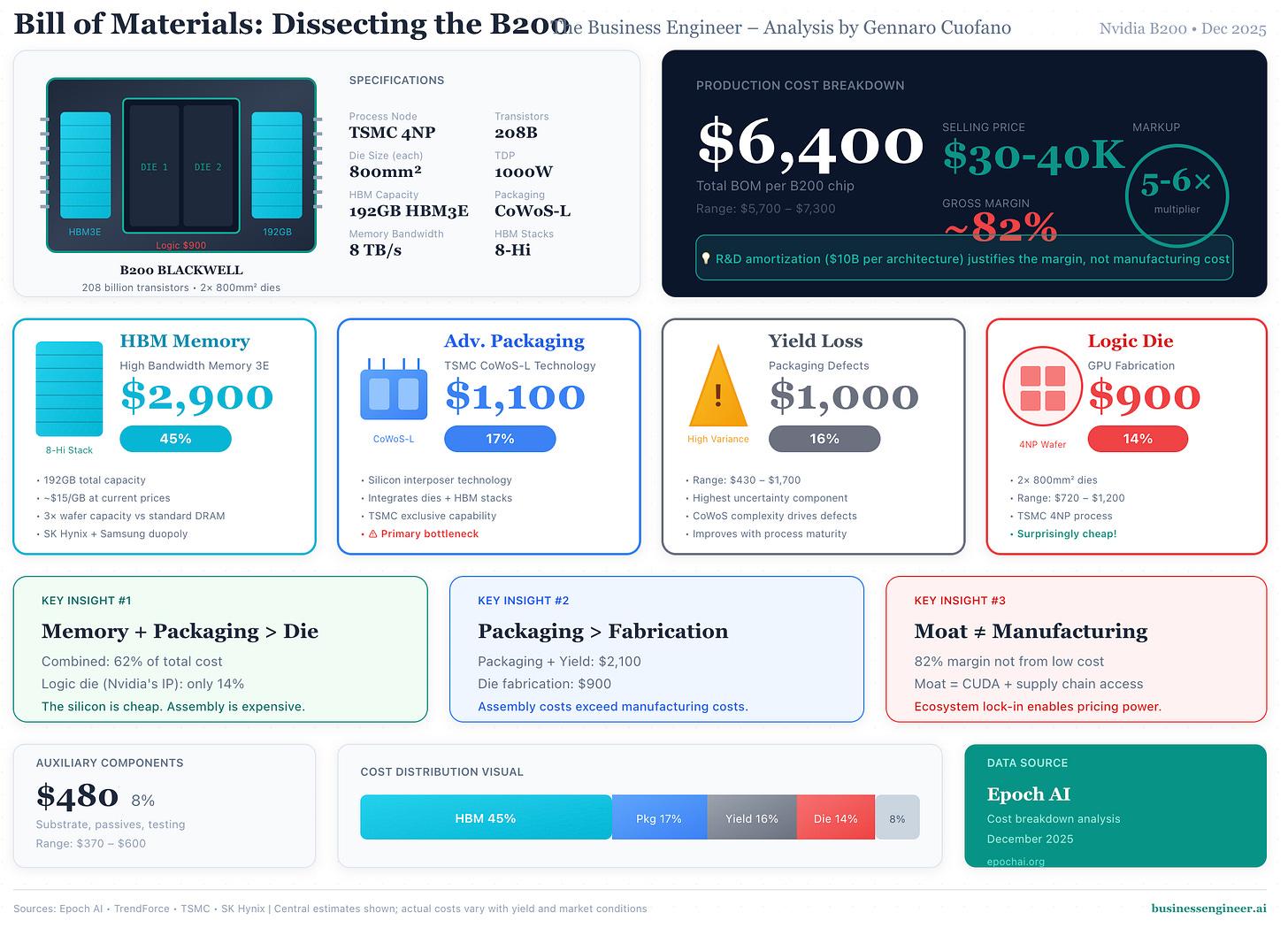
The economics of Graphics Processing Units (GPUs) reveal a complex landscape where traditional assumptions about value are turned on their head. Increased demand for AI infrastructure has shifted the focus from silicon to memory, from hardware to software, and from individual components to complete systems. This change is epitomized by Nvidia, which has positioned itself at the forefront of this evolution, generating significant revenue from its GPUs, which can sell for up to $40,000 despite a production cost of just $6,400.
In examining the GPU market, four key inversions in value become evident. First, memory is now deemed more crucial than silicon. High Bandwidth Memory (HBM) represents 45% of production costs compared to just 14% for logic fabrication. While Nvidia’s chip design remains vital, it is ultimately the supply of memory that dictates shipping capabilities. This reliance on memory suppliers highlights a shift in where power lies within the supply chain.
Second, advanced packaging techniques are surpassing traditional processing power in importance. The cost of advanced packaging, alongside yield loss, now outweighs the expenses associated with the GPU dies themselves. In this regard, Taiwan Semiconductor Manufacturing Company’s (TSMC) capacity for Chip-on-Wafer-on-Substrate (CoWoS) packaging is becoming a critical bottleneck, more so than its fabrication capacity.
Software also plays a pivotal role, as the CUDA ecosystem, developed over 17 years, creates significant switching costs that protect Nvidia’s margins, even as competitors close in on hardware capabilities. This moat exists not within the chip itself but throughout the entire software stack, underscoring the strategic value of software in enhancing hardware performance.
Finally, the trend is shifting towards integrated systems over individual components. Nvidia’s strategic focus has been on providing complete solutions—racks, clouds, and platforms—rather than merely selling standalone chips. This approach helps mitigate margin compression at the component level by fostering deeper customer lock-in at the system level.
The implications of these dynamics are substantial for the ongoing AI infrastructure buildout. Supply constraints are expected to persist, ensuring that profit margins remain elevated. Companies capable of securing necessary hardware through capital, relationships, or vertical integration are likely to emerge as leaders in this competitive landscape, while others may struggle to keep pace.
Importantly, the GPU economics underscore a critical lesson in value capture: it is those who control bottleneck resources—such as memory suppliers, packaging experts, and integrated software systems—who will dominate the market, rather than merely those who design chips. As enterprise AI increasingly shifts from software-driven solutions to hardware substrates, understanding these structural dynamics will be crucial for stakeholders in the technology sector.
See also Micron Technology’s 170% Surge: Is It Still a Millionaire-Maker Stock?
 Shanghai Jiao Tong University Unveils LightGen, Breakthrough All-Optical Chip for Generative AI
 AI Bubble Fears Rise: $1.4 Trillion OpenAI Investment Faces Profitability Challenges
 MINISFORUM and AMD Launch AI Mini Workstation MS-S1 MAX, Cutting Costs by 80%
 Siléane Launches First International Subsidiary in Western Switzerland to Enhance Automation Solutions