






















































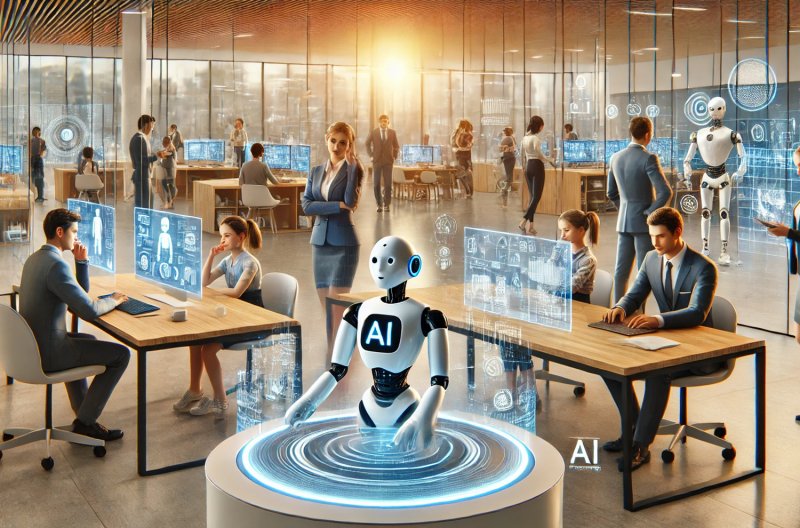
Artificial intelligence is reshaping the job market, shifting the focus from machine replacement to task redistribution and the creation of new roles centered around AI. As reported by News.Az, companies are increasingly hiring for skills that complement AI capabilities, transforming workflows to incorporate AI as an essential component of daily operations.
This evolution is primarily driven by automation, but it diverges from traditional forms that eliminated physical tasks. Today’s AI automation targets cognitive tasks, such as sorting information, drafting text, and generating code. This transition does not eliminate human roles but redefines the boundaries of “human work” and “machine work,” with humans taking on responsibilities like goal-setting, quality assurance, and ethical decision-making.
The rapid pace of this change can be attributed to the accessibility of modern AI tools. Users need not be software engineers to leverage AI for drafting reports or creating troubleshooting checklists. Many organizations are witnessing a phenomenon termed “shadow adoption,” where employees utilize AI tools informally to enhance productivity, leading to institutional changes as these improvements are recognized by leadership.
The impact on the job market is best understood through the lens of tasks rather than job titles. Most roles consist of a blend of routine, semi-routine, and variable tasks. AI excels at routine information tasks, offering assistance in drafting contracts, generating basic code, and summarizing meetings. Conversely, positions that require interpersonal skills or complex decision-making remain less affected, although AI tools are increasingly aiding planning and diagnostics.
This phenomenon suggests that the discussion should not center on “AI replacing workers” but rather on how “AI alters the value of specific activities.” For instance, while drafting a document may become cheaper with AI, the roles of editing, fact-checking, and narrative crafting are growing in importance. Similarly, as data analysis becomes automated, the need for individuals who can interpret results and communicate effectively remains critical.
Generative AI tools, like ChatGPT, serve as universal interfaces for knowledge work, facilitating quicker task initiation and idea exploration. This development is prompting a reevaluation of entry-level and mid-level positions within companies, as AI reduces the demand for large teams engaged in repetitive tasks while simultaneously increasing the need for skilled workers capable of crafting effective AI prompts and verifying outputs.
The increasing adoption of AI also leads to the emergence of new careers and the reframing of existing roles. Fast-growing positions are often operationally focused, such as AI product managers who align AI features with user needs, and AI governance professionals who oversee compliance and risk issues. While specific titles like prompt engineer may fluctuate, the underlying capabilities associated with instructing AI and building repeatable processes are becoming foundational skills across various sectors.
Another critical aspect is the “human-in-the-loop” approach, where individuals supervise AI-generated outputs. This is particularly vital in sectors such as healthcare and finance, where errors can have significant repercussions. Many organizations are establishing approval processes that require human oversight, emphasizing the importance of domain expertise in these supervisory roles.
As AI also accelerates skills shifts in technical careers, software development is becoming increasingly AI-assisted. While this lowers barriers for newcomers, it raises expectations for experienced professionals, as employers seek engineers capable of designing and securing complex systems beyond mere coding. In cybersecurity, for example, AI tools can detect threats, but they also broaden the attack surface, necessitating a greater focus on governance and incident response.
For workers, adapting to AI involves treating it as a versatile toolset, akin to how spreadsheets transformed business operations decades ago. Developing practical AI literacy entails understanding where AI excels, recognizing its limitations, and learning how to work collaboratively with it. As a result, the ability to clearly define problems and evaluate outputs becomes increasingly valuable.
Employers also face strategic decisions regarding AI integration. Some organizations opt for utilizing AI for cost reduction, while others leverage it to foster growth and enhance services. The latter approach tends to generate more opportunities by creating demand for new workflows and improved customer experiences. Organizations that invest in training and governance structures typically enjoy the greatest benefits from AI adoption.
As the job landscape evolves, companies are placing greater emphasis on portfolios and demonstrated capabilities rather than solely formal credentials, particularly in digital roles. Candidates who can illustrate their use of AI in solving real-world problems are likely to stand out in a competitive environment.
Looking forward, the job market is expected to polarize, with routine cognitive tasks diminishing while higher-value work involving strategy and complex decision-making becomes more sought after. Many roles will inherently involve AI, and the key differentiating factor will be the ability to utilize AI responsibly and effectively. Ultimately, as AI continues to redefine work, professionals and organizations alike must focus on building fluency in AI and leveraging human judgment and accountability to navigate an increasingly complex landscape.
See also Trump’s AI Executive Order Empowers DOJ to Challenge State Regulations, Threatens Funding Cuts
 Anthropic Launches Open-Source Agent Skills Framework to Compete with OpenAI
 Notre Dame Secures $50.8M Grant to Pioneer Faith-Based AI Ethics Framework
 BigBear.ai Jumps on C Speed Defense Partnership Amid Share Vote and Market Volatility
 OpenAI Launches “Your Year with ChatGPT” Feature for Personalized Annual Reviews















