






















































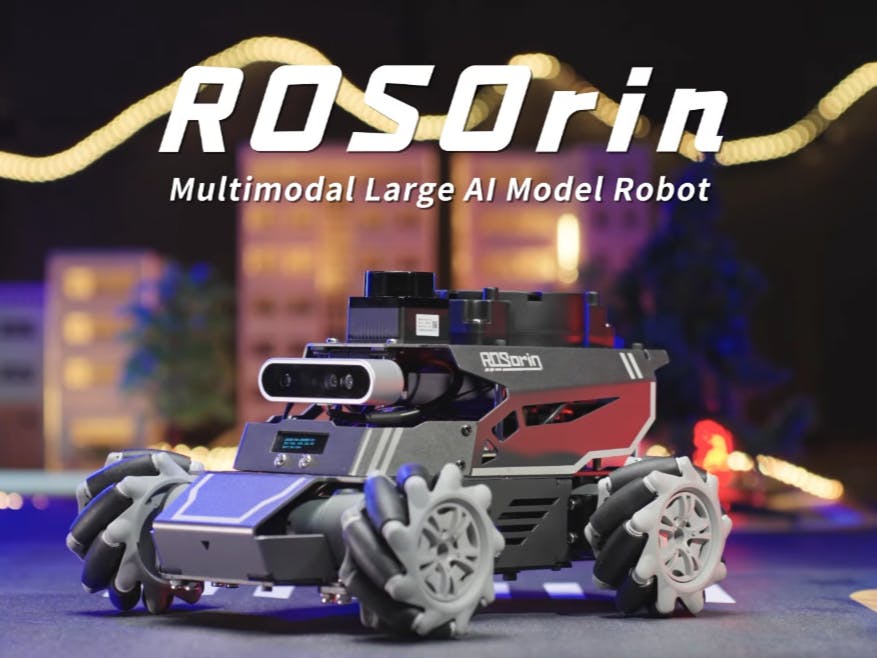
The educational robotics sector is poised for a transformation with the introduction of the ROSOrin platform, which promises to bridge a significant gap in the market. Designed to facilitate deep comparative learning and advanced artificial intelligence (AI) integration, ROSOrin offers a comprehensive system that diverges from the conventional, often incremental offerings commonly found in the industry. By rethinking its hardware structure and embedding multimodal AI capabilities, ROSOrin aims to serve both educational purposes and advanced prototyping needs.
At the heart of the ROSOrin platform is a patented modular chassis that supports three different drive systems: Mecanum (omni-wheel), Ackermann (car-like steering), and differential drive. This modularity goes beyond simple accessory swapping; it fundamentally reconfigures the mechanical structure and kinematic model, enabling users to directly compare various navigation, control, and path-planning algorithms. This innovation significantly broadens the scope for experimentation while eliminating the necessity for multiple specialized robots.
The design features a proprietary swing-arm suspension system that ensures consistent ground contact and weight distribution across all mobility modes, which minimizes wheel slip. This reliability is crucial as the encoder data feeds into navigation stacks like SLAM (Simultaneous Localization and Mapping), providing a stable foundation for algorithmic development.
As a versatile educational tool, ROSOrin is engineered to host multimodal Large Language Models (LLMs) that have been fine-tuned for robotics applications. This capability allows for robust task completion that goes beyond basic interactions. Users can issue high-level natural language commands, such as stating, “I’m hungry,” prompting the robot to navigate to a kitchen, analyze the surroundings, and respond with, “I see eggs and tomatoes; you could make scrambled eggs.”
Equipped with integrated vision models, ROSOrin can perceive and track dynamic scenes, such as following a moving soccer ball or identifying specific items like a “blue book” on a shelf. Its multi-modal reasoning architecture allows for closed-loop task execution, whereby complex instructions can be broken down into actionable steps. For instance, if commanded to measure the distance to a car and respond accordingly, ROSOrin can autonomously navigate based on real-time assessments.
ROSOrin also integrates a robust array of professional-grade sensors, establishing a comprehensive sensor and algorithm matrix that supports various robotics curricula. It features a TOF lidar system fused with IMU and encoder data to support navigation algorithms such as Cartographer and Gmapping for SLAM, as well as TEB for dynamic path planning and obstacle avoidance. This capability enables reliable applications including autonomous exploration and person-following functionalities.
Furthermore, the system utilizes a 3D structured light camera for depth perception, allowing for accurate object distance measurement and volume calculations. Advanced visual AI integrations like YOLOv11 facilitate object detection and segmentation, while tools like OpenCV and MediaPipe enable tasks such as gesture recognition and face tracking, opening avenues for human-robot interaction and context-aware vision projects.
ROSOrin’s capabilities extend beyond single-robot operations. The platform supports coordinated multi-robot operations, enabling fleets to perform synchronized tasks and collaborative exploration via leader-follower and distributed communication protocols. This level of functionality marks a significant step forward in the evolution of robotics education tools.
Accompanying the hardware is a rich educational ecosystem designed to facilitate learning. ROSOrin comes equipped with a structured curriculum that includes hundreds of lessons covering ROS 2 fundamentals, SLAM, and AI model deployment. Comprehensive documentation offers thousands of pages of developer manuals and code-level explanations, while simulation tools bridge the gap between virtual and real-world applications, ensuring a seamless transition from simulated environments to physical implementation.
In conclusion, the ROSOrin platform emerges as a pioneering solution that addresses the limitations of traditional educational robots. By enabling mechanical reconfigurability and integrating sophisticated AI capabilities into the ROS 2 workflow, it sets a new standard for educational and research platforms. This innovative system is tailored for users who aspire to transcend introductory concepts and engage deeply with the comparative analysis of core robotics principles and the forefront of embodied AI.
See also Google Reveals AI Chatbots Struggle with Accuracy, Gemini 3 Pro at 68.8%
 Apple Unveils DarkDiff AI Model to Enhance Low-Light Photography, Boosting Details and Reducing Noise
 Top NSFW AI Art Generators Tested: My Dream Companion Outperforms Competitors After 2 Weeks
 OpenAI Reveals GPT-5, Surpassing 1 Million Business Clients and 300 Million Weekly Users















