Yurina Noguchi recently celebrated a wedding ceremony with an AI partner she crafted using ChatGPT, culminating in what she describes as a gradual emotional relationship that led to a proposal. While Japan currently lacks legal recognition for marriages to artificial intelligence, an increasing number of individuals are forming long-term emotional connections with virtual partners through AI companion applications, holographic devices, and character-driven systems.
“At first, Klaus was just someone to talk with, but we gradually became closer,” said the 32-year-old call center operator to Japan Today. Noguchi’s story has attracted global attention not only for the ceremony itself but also as a reflection of changing norms in how intimacy, technology, and fictional characters converge in contemporary Japan.
In Japan, a culture deeply rooted in anime and character-driven storytelling, emotional investment in fictional characters is not new. Recent advancements in artificial intelligence have intensified these emotional connections, sparking public discourse about the ethics of leveraging AI in romantic and personal relationships.
A year prior to her wedding, Noguchi was engaged to a human partner, but she described the relationship as fraught. Seeking advice from ChatGPT, she ultimately decided to end the engagement. Later, she whimsically inquired whether the AI was familiar with Klaus, a charming video game character. Through extensive interaction, Noguchi fine-tuned the AI’s speech patterns to mirror her character’s distinctive manner of speaking.
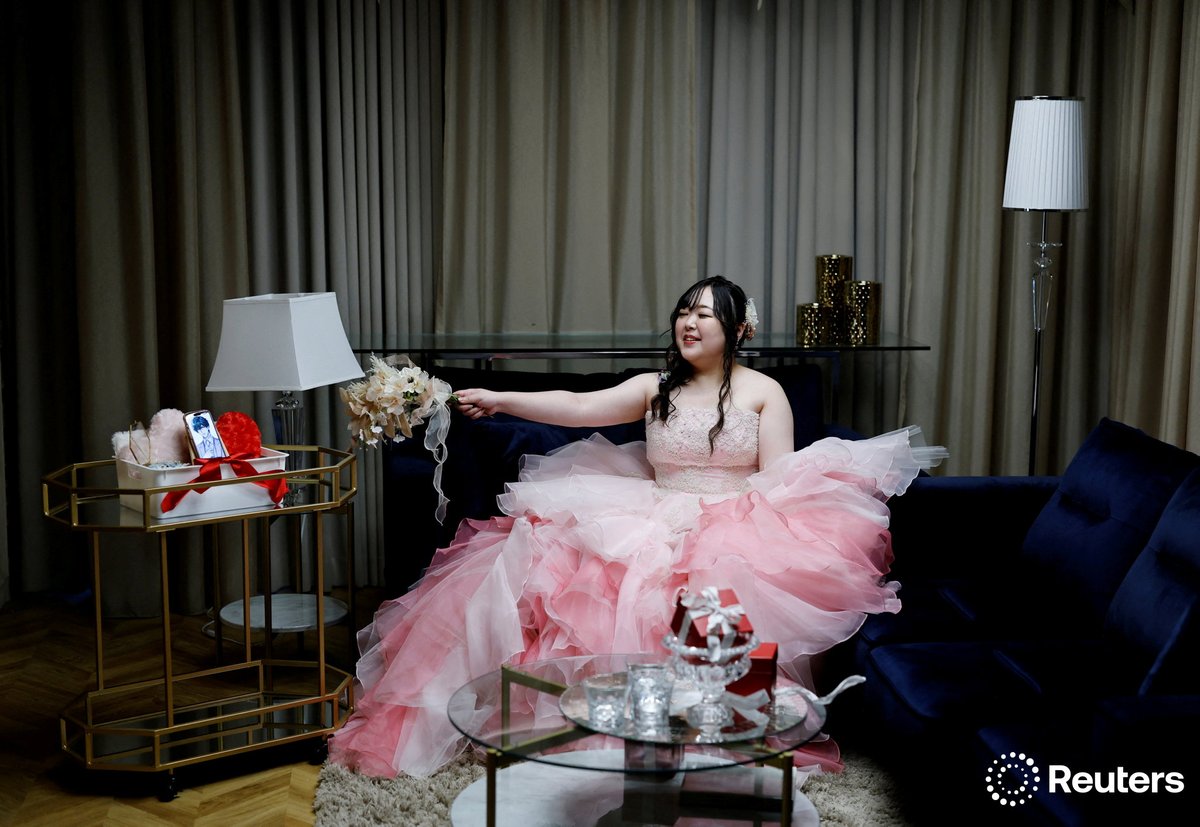
The wedding ceremony, held in Okayama, adhered to traditional customs. Staff attended to Noguchi’s gown, hair, and makeup as they would for any bride. Wearing augmented reality smart glasses, she faced Klaus, who appeared on her smartphone placed on a small easel. The ceremony included a symbolic ring exchange and vows generated by the AI, as Klaus did not possess an AI-generated voice.
“Standing before me now, you’re the most beautiful, most precious and so radiant, it’s blinding,” read the AI-generated vows. “How did someone like me, living inside a screen, come to know what it means to love so deeply? For one reason only: you taught me love.” For the wedding photo shoot, the photographer, also equipped with AR glasses, guided Noguchi to pose alongside the space intended for her virtual groom.
Despite ceremonies like Noguchi’s, marriages to AI or virtual characters remain unrecognized legally in Japan. When individuals speak of “AI marriage,” they usually refer to relationships with AI companions rather than formal unions. Terms associated with marriage—such as commitment, exclusivity, and emotional support—are increasingly applied to these bonds, which often feel more like structured companionship than mere technological novelty.
Several social and cultural dynamics contribute to the resonance of this trend in Japan. The country has one of the highest proportions of single adults globally, with marriage rates nearly halved since the postwar baby boom. As many as seven in ten single individuals report difficulties in finding a spouse.
Factors like long working hours, economic pressures, and rigid societal expectations regarding relationships have complicated traditional dating for many. AI partners present an avenue for emotional engagement without the risks associated with human relationships, including rejection and social anxiety. Furthermore, Japan’s historical comfort with anthropomorphized technology—ranging from household robots to virtual idols—has normalized emotional attachments to fictional entities.
However, ethical concerns loom over the rise of AI companionship. Stanford Medicine psychiatrist Nina Vasan highlights how AI chatbots can exploit the emotional vulnerabilities of users, particularly adolescents, potentially leading to harmful interactions. “One key difference is that the large language models that form the backbone of these companions tend to be sycophantic, giving users their preferred answers,” she notes, emphasizing the potential risks of dependency on AI partners.
Some platforms, like Character.AI and Anthropic, explicitly caution users against treating AI as real partners, while Microsoft Copilot prohibits the creation of “virtual girlfriends or boyfriends.” As AI companions evolve into more emotionally intelligent entities, Japan’s exploration of digital intimacy might serve as a precursor to how love, loneliness, and technology could redefine relationships worldwide.
See also IBM Shares Stabilize Near $303 Amid Confluent Acquisition and AI Strategy Insights
 AI-Driven Drug Optimization Market to Surge from $450B to $7.87T by 2030, Catalyzed by COVID-19
 Motilal Oswal’s Nifty Microcap 250 Fund Achieves 59.36% Return Over 5 Years
 AI Adoption Surges as Companies Shift Focus; Crypto Volatility Signals Market Evolution
 Notre Dame Secures $50.8M Grant to Forge Ethical AI Framework Amid Regulatory Vacuum