






















































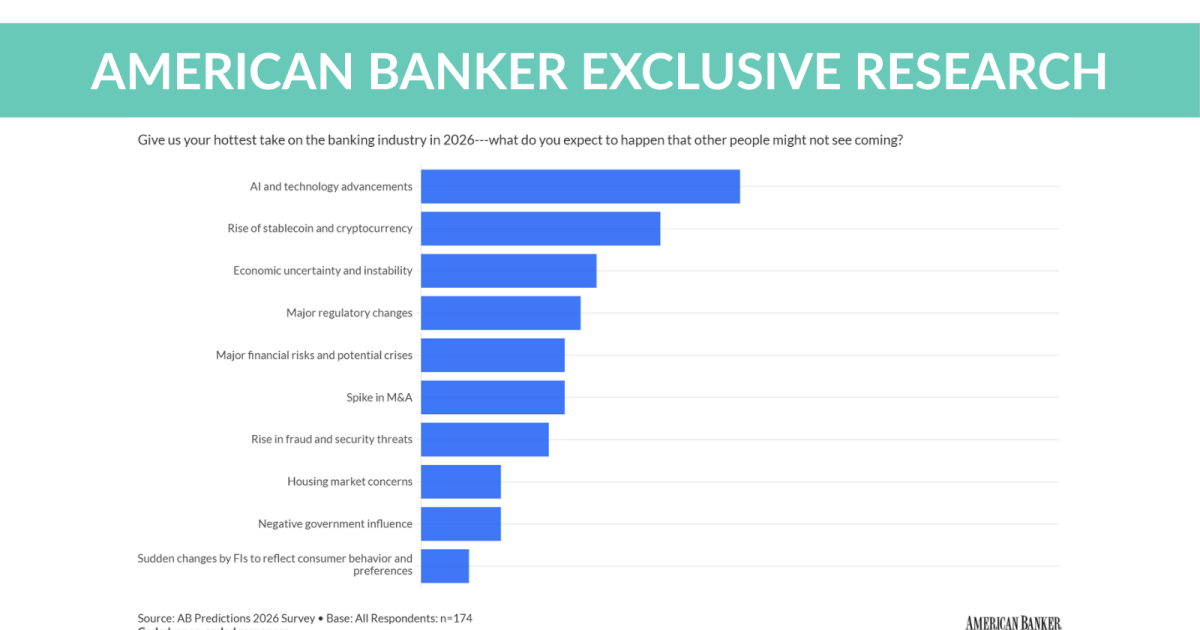
Advancements in artificial intelligence, the rise of digital assets, and ongoing economic uncertainty are trends that bankers predict will significantly impact the industry in the coming year, according to a new report from American Banker. The report, titled “2026 Predictions,” surveyed 174 banking professionals, including executives from banks, credit unions, neobanks, and payments companies, during October and November of 2025.
Among the findings, approximately 20% of respondents identified advancements in AI as the most likely change that could catch many in the banking sector off guard. Optimism surrounds the potential of agentic AI to provide more customized financial products and enhance marketing strategies. However, concerns have also been raised about the use of AI by fraudsters, which could lead to significant financial losses. “AI will have a bigger impact [on the banking industry than] expected,” one respondent stated. “It already has [had a great impact], but it will be exponential through 2026.”
In light of these developments, the National Institute of Standards and Technology (NIST) recently released a preliminary draft of an AI cybersecurity risk profile. This framework aims to guide financial institutions on safely integrating AI into their cybersecurity strategies. The Cybersecurity Coalition emphasized in a letter to NIST that defending against AI-enabled attacks is fundamentally different from securing AI systems, highlighting the need for tailored strategies.
Another notable trend from the survey was the anticipated impact of stablecoins and cryptocurrencies, which 15% of executives believe could take the banking industry by surprise. Some respondents highlighted a potential “resurgence of bitcoin in real-time payments” and suggested that stablecoins may assert a more substantial presence than the banking sector expects. One banker remarked on the urgency of legislative changes: “If Congress does not fix the loophole for payment of interest on stablecoins, that would be a real game changer for banks, especially community banks. It has the potential to disintermediate our funding sources.”
Moreover, the Federal Deposit Insurance Corporation (FDIC) has initiated groundwork for a proposed rule that would allow FDIC-supervised banks to issue payment stablecoins through subsidiaries under the GENIUS Act. If enacted, this rule would establish eligibility criteria for institutions aiming to issue stablecoins, as outlined by acting FDIC Chair Travis Hill.
Economic uncertainty was also highlighted as a critical concern, with 11% of respondents citing it as their top prediction for 2026. Views varied significantly regarding the housing market. Some industry professionals expressed optimism that recent governmental changes could improve housing and mortgage conditions. In contrast, others warned that escalating prices could exclude first-time homebuyers and potentially trigger another recession and mortgage crisis. “I do not trust the current administration to execute well on common-sense ideas,” one banker stated, voicing fears that inadequate guidance combined with a recession could destabilize the banking sector.
Respondents also identified several other trends, including major regulatory changes (10%), significant financial risks and crises (9%), spikes in mergers and acquisitions (9%), and increases in fraud and security threats (8%). Concerns related to the housing market and negative government influences were reported by 5% of respondents each, while 3% mentioned shifts in financial institutions to meet consumer behavior changes.
As the financial landscape evolves, the integration of AI and digital assets is likely to challenge traditional banking paradigms. The survey indicates that while some bankers are preparing for these shifts, many remain unprepared for the rapid changes ahead. The dialogue around AI’s impact and regulatory frameworks surrounding cryptocurrencies underscores a pivotal moment for the banking industry, which must adapt to maintain relevance in an increasingly digital economy.
See also India’s Job Market in 2026: Surge in High-Skill Roles Amid Salary Normalization and AI Integration
 Tsinghua University Launches TurboDiffusion, Achieving 200x Acceleration in AI Video Generation
 Japan’s $6.34B National AI Plan to Transform Startups with Foundation Models and Governance Reforms
 AI Investment Surge: 2026 Projected for Rapid VC Growth and Record IPOs
 Amazon Launches Alexa+ with AI Integrations for Booking Hotels, Services, and Appointments















