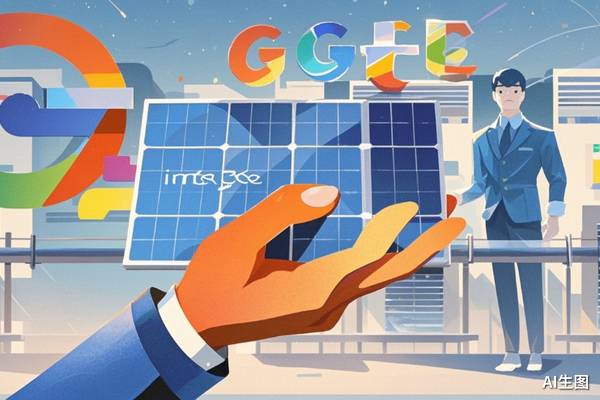
Alphabet, Google’s parent company, announced on the evening of the 22nd that it will acquire the U.S. data-center and energy infrastructure firm Intersect for $4.75 billion (approximately RMB 33.85 billion) in cash, along with assuming relevant debts. The completion of this acquisition is scheduled for the first half of 2026.
Founded in 2016, Intersect is led by Chief Executive Officer Sheldon Kimber. The company, which is backed by the U.S. private equity firm TPG, focuses on developing infrastructure, including renewable energy solutions for data-center parks. Kimber expressed that their mission is to provide innovative energy solutions and modern infrastructure.
Kimber, a graduate of the University of California, Berkeley, where he also taught for nine years, co-founded the Berkeley Energy and Resources Collaborative and has served on its board. He previously held the position of Chief Operating Officer at Recurrent Energy, a subsidiary of Canadian Solar Inc.
Ben Hertz-Shargel, an analyst at Wood Mackenzie, a global energy consulting firm, noted that Intersect currently operates around 7.5 gigawatts of solar and energy-storage projects, with an additional 8 gigawatts in the development pipeline, primarily located in Texas. Intersect’s energy assets, either operational or under construction in the U.S., are valued at approximately $15 billion (around RMB 105.43 billion), according to the company’s official website.
In December 2024, Google announced a collaboration with Intersect and TPG to advance a $20 billion (approximately RMB 140.57 billion) initiative aimed at developing data centers across the U.S. by 2030. Alphabet had previously led an $800 million (approximately RMB 5.62 billion) financing round for Intersect, acquiring a minority stake in the firm.
The acquisition encompasses Intersect’s team and several gigawatt-scale energy and data-center projects that are currently in development, reflecting their existing cooperation. Moreover, Intersect will explore a range of emerging technologies to enhance the diversified supply of energy, aiding Google’s data-center construction and meeting the needs of Google Cloud customers.
Hertz-Shargel emphasized that this transaction represents the first instance of a technology giant acquiring a large-scale renewable energy developer.
Following the acquisition, Intersect will continue to operate as an independent brand under Kimber’s leadership. The firm will collaborate with Google’s technical infrastructure team to advance ongoing and new initiatives, including a data center and energy base in Haskell County, Texas, which they previously announced together.
Notably, Intersect’s existing operational assets in Texas and its operational and developmental assets in California will not be included in the acquisition. Instead, these assets will transition to other investors and function independently.
Sundar Pichai, CEO of Alphabet and Google, commented, “Intersect will help us scale our infrastructure, enabling us to more flexibly synchronize the construction of new power-generation facilities with new data-center loads and revolutionize energy solutions.” Alphabet has committed to exploring new cooperation models, responsibly increasing energy supply, and accelerating the commercialization of next-generation energy technologies such as advanced geothermal, long-duration energy storage, and carbon capture and storage gas technologies.
The acquisition of Intersect aligns with Alphabet’s broader strategy to enhance the energy layer of its data centers, a crucial element in the ongoing race for AI infrastructure. The company aims to accelerate the grid-connection process for new power plants to improve energy efficiency and optimize costs for data-center communities.
Simultaneously, Alphabet is ramping up its capital investment in AI infrastructure. In July, Google revealed plans to invest $25 billion (approximately RMB 175.71 billion) over the next two years in building data centers and enhancing AI infrastructure. Furthermore, Forbes reported that Alphabet anticipates its spending for the year could reach as high as $93 billion (approximately RMB 653.65 billion), marking a significant increase from $52.5 billion (approximately RMB 368.99 billion) in 2024. A substantial portion of these funds is earmarked for AI, with plans to significantly boost its capital-expenditure budget in 2026.
See also Neurable Secures $35M to Advance Brain-Computer Interface AI Technology
 AI for Enterprises Reveals 7 Proven Use Cases to Eliminate Engineering Bottlenecks
 Gold Hunter Deploys AI with Windfall Geotek to Optimize Drill Targets at Great NorthernByteDance Announces $23 Billion AI Spending Spree to Boost Doubao and Infrastructure
 iFlytek Launches Shandong Yixun with $7.1M Capital to Expand Semiconductor Design