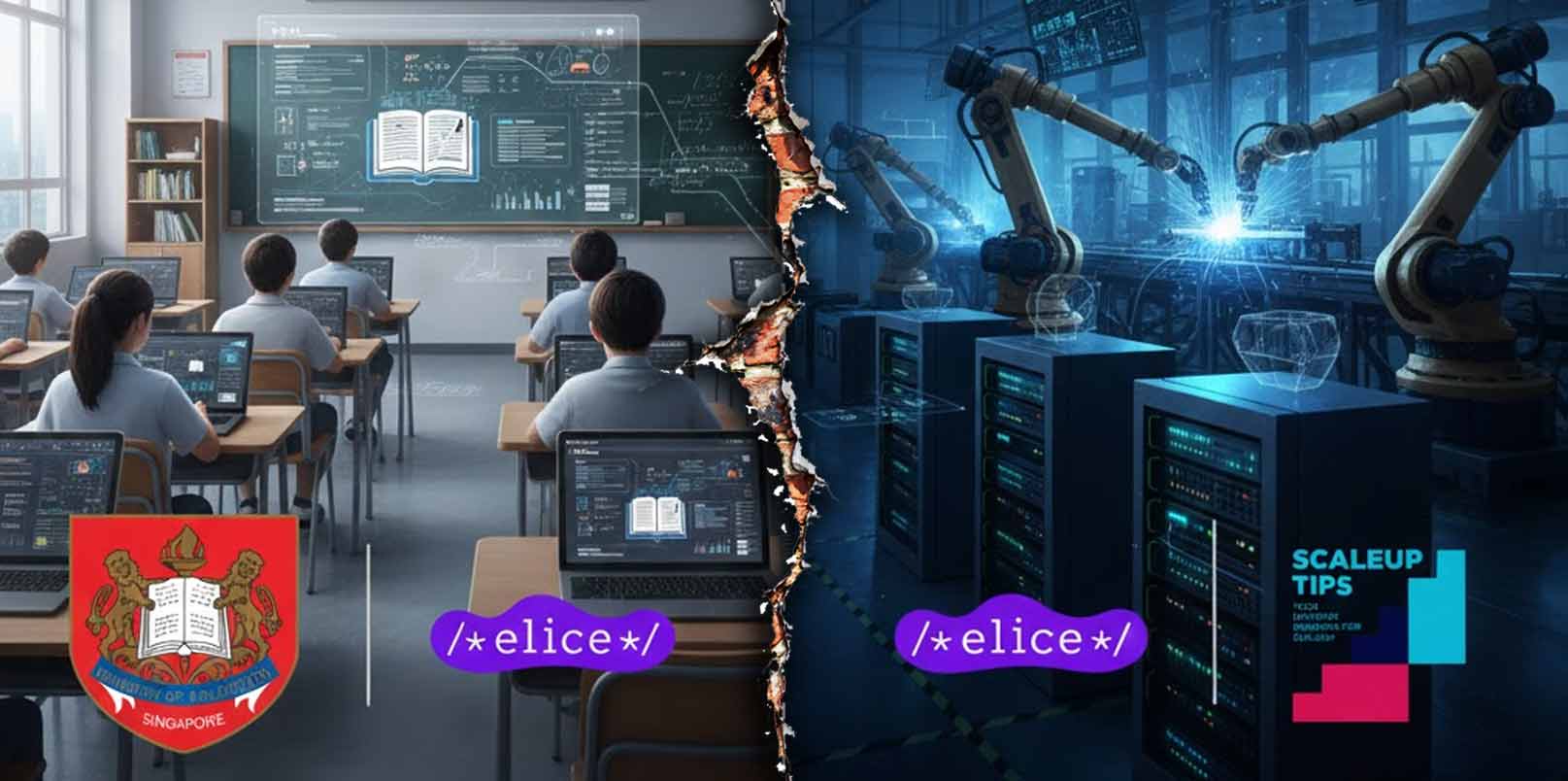
As governments worldwide accelerate the integration of artificial intelligence into education, Korea’s Elice Group has found a breakthrough abroad. After facing political and regulatory challenges that hindered its AI textbook project domestically, the startup is now at the forefront of Singapore’s digital curriculum initiative. Meanwhile, the Korean government is redirecting support to Elice’s industrial AI research, highlighting how national policy priorities can shape innovation trajectories.
Elice Group, a Seoul-based AI education and infrastructure company, has clinched a contract with Singapore’s Ministry of Education to develop digital textbooks for secondary schools. Over the next six months, the company will create and test an AI-based prototype that employs adaptive learning and automated feedback tools to customize educational instruction.
This initiative aligns with Singapore’s broader roadmap to digitize learning, modernize classroom infrastructure, and incorporate AI into its public education system. The collaboration follows a visit from Singapore Deputy Prime Minister Heng Swee Keat in 2024 to Elice’s education center in Seoul, where he expressed keen interest in Korean educational technologies after reviewing the company’s AI learning models.
Industry analysts note that this partnership validates Elice’s technological maturity and underscores Korea’s global competitiveness in AI education, despite setbacks in domestic deployment.
Ironically, Elice Group initially developed its technology for Korea’s classrooms. The company created the nation’s first AI-driven digital textbooks for elementary and middle schools, achieving approval from the Ministry of Education in early 2024. However, a change in administration led the National Assembly to amend the Elementary and Secondary Education Act, demoting AI textbooks from “official textbooks” to “educational materials.” This decision effectively barred their adoption in schools, prompting an audit of the previous government’s AI textbook initiative and freezing public rollout.
Elice CEO Kim Jaewon described the situation as a “consequence of political volatility and overregulation,” arguing that fluctuating policies have diminished predictability for startups. He cautioned that without stable frameworks, Korea risks losing ground in AI education to more agile nations.
In an interview with Seoul Economic Daily, Kim asserted,
“Startups are playing on a field where the rules keep changing. This weakens not only their business confidence but also Korea’s competitiveness in the AI market.”
He further criticized existing AI policies for favoring large corporations and integrated consortia, effectively sidelining smaller startups from government-led innovation projects. Kim stressed the need for a more inclusive framework, akin to the successful deregulation in Korea’s fintech sector that accelerated growth through open participation.
“Just as the Financial Services Commission opened the market for fintech, we need similar courage in AI.”
While Elice Group’s educational solutions have not yet gained traction domestically, the Korean government has recently recognized the company under the Scale-Up TIPS program, which links private investment with R&D funding. Through this initiative, Elice will receive up to KRW 12 billion (approximately USD 8.8 million) over three years to enhance AI applications for manufacturing and industrial automation.
The company plans to develop high-reliability Intelligent Document Processing (IDP) systems that integrate Vision-Language Models (VLMs) and multi-agent AI frameworks. These technologies aim to mitigate productivity losses by automating document reading, verification, and integration within complex manufacturing workflows.
Elice’s project aligns with Korea’s broader AI Transformation (AX) policy, which prioritizes industrial digitalization and smart factory innovation. By focusing on industrial AI infrastructure—including private clouds, GPU-as-a-Service, and modular data centers—the startup is adapting its expertise to the government’s strategic emphasis on deep-tech industrial competitiveness.
Elice Group’s trajectory illustrates how policy direction can significantly influence, and even redirect, innovation. In education, policy uncertainty and legislative actions have stalled a world-class technology that could have enriched Korea’s AI literacy pipeline. Conversely, government-led initiatives are now channeling that same talent toward enhancing manufacturing efficiency and transforming industrial AI.
This dual narrative reveals both Korea’s strength in adaptive deep-tech capacity and its structural weaknesses in maintaining policy continuity. As nations like Singapore swiftly embed AI in education, Korea risks bureaucratic inertia delaying innovations crucial for its future workforce.
Ultimately, Elice Group’s experience highlights a broader truth: in Korea’s evolving AI ecosystem, success often relies more on the prevailing policy environment than on technological capability. Korea’s substantial investment in its “Venture 4 Powerhouse” vision further emphasizes this imbalance, directing unprecedented resources toward deep tech and manufacturing while potentially neglecting high-potential sectors like AI education.
As Elice Group pivots from developing AI textbooks for students to creating AI systems for factories, the shift is less about market failure and more about a reorientation of policy priorities. If Korea aims to be a leader in human-centered AI, it must ensure that educational innovation receives institutional support comparable to that granted to industrial transformation. Otherwise, the country risks exporting its finest ideas only to re-import them later as global standards.
– Stay Ahead in Korea’s Startup Scene –
Get real-time insights, funding updates, and policy shifts shaping Korea’s innovation ecosystem.
➡️ Follow KoreaTechDesk on LinkedIn, X (Twitter), Threads, Bluesky, Telegram, Facebook, and WhatsApp Channel.
 Weskill Launches Wena AI, India’s First Fully Autonomous Education System, on Dec 25, 2025
 Yotta Partners with GGSIPU to Launch AI-Enabled Education Model for 200,000 Students
 AI-Driven Listening Systems Transform Language Learning, Enhancing Auditory Cognition
 New AI Essay Scoring System by Tiantian W. Enhances Grading with Real-Time Feedback
 Zuo Reveals AI-Driven ESL Materials Tailored to CEFR Levels Using Reinforcement Learning