Deutsche Bank analysts have raised alarms regarding the importance of investments in artificial intelligence (AI) following the release of better-than-expected U.S. GDP data, which highlights its role in the country’s economic stability. The analysts, Adrian Cox and Stefan Abrudan, noted in a recent report that spending on AI-related sectors is a critical factor in sustaining economic growth, as other areas of consumer spending have largely stagnated since the Covid-19 pandemic.
The analysis comes in light of the U.S. economy expanding at an annualized rate of 4.3% in the third quarter of 2025, according to the Bureau of Economic Analysis. The report attributes this growth, in part, to significant investments in AI. Cox and Abrudan warned that without tech-related spending, the U.S. would be “close to recession” this year. They emphasized the urgent necessity for continued investment in technology to support economic momentum.
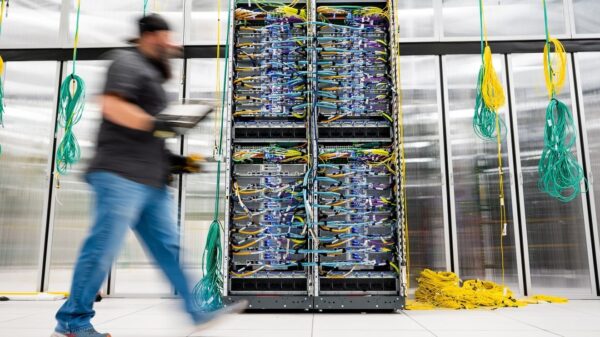
Deutsche Bank’s note further highlights that hyperscalers are projected to spend a cumulative $4 trillion on AI data centers through 2030. This figure is ten times the inflation-adjusted cost of the U.S. government’s moon-landing program in the 1960s, a staggering comparison given the lack of guaranteed returns from such investments.
Bank analysts underscored that this strong economic growth has been accompanied by elevated inflation, a phenomenon echoed by economist Mohamed El-Erian. He noted that resilient consumer spending is now bolstered by an AI-driven surge in capital investments, which has countered other areas of economic weakness.
Concerns of a potential bubble driven by debt have been countered by Goldman Sachs Asset Management, which indicated that much of the AI sector’s extensive infrastructure buildout is backed by solid corporate cash flows rather than risky borrowing. This financial foundation has contributed to the overall structural soundness of the sector.
Similarly, Daniel Newman, CEO of Futurum, opined that the AI market is not merely a bubble but rather represents a multi-decade technology supercycle. While he acknowledged the potential for hype and overspending among some companies to suggest a bubble, he stressed that key players such as Nvidia Corp (nvidia.com), Google (google.com), and Microsoft Inc. (microsoft.com) are generating real revenues that defy this narrative.
In a related perspective, billionaire and Microsoft co-founder Bill Gates acknowledged the presence of an AI bubble, but he differentiated it from the infamous 17th-century Tulip Mania, suggesting instead that it resembles the early days of the internet—a time marked by both exuberance and transformative potential.
The evolving landscape of AI investment reflects not only the resilience of the U.S. economy but also its dependence on technology as a foundational element for growth. As AI continues to mature, its implications for various sectors will likely shape the economic discussions of the coming years, reinforcing the need for sustained investment and innovation at all levels.
See also Free Trade Agreements: The Key to Effective AI Governance Amid Global Regulatory Gaps
 Italy Orders Meta to Halt WhatsApp Terms Blocking Rival AI Chatbots Amid Antitrust Probe
 Global Leaders and CEOs Unite at India AI Impact Summit 2026 to Drive Sustainable Innovation
 Missouri Lawmakers Propose 11 Bills to Regulate AI Amid Growing National Concerns
 Mistral AI Expands to Switzerland, Driving DeepTech Innovation and Funding Opportunities