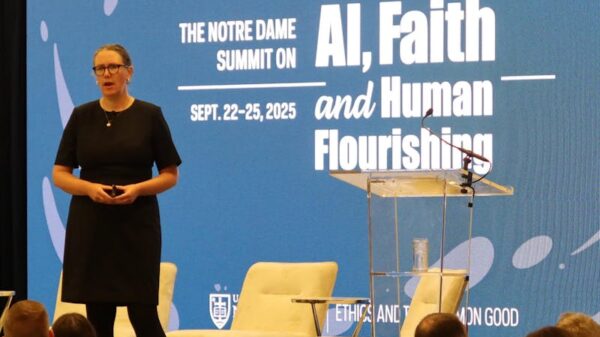
The University of Notre Dame’s Institute for the Ethics and the Common Good (ECG) has received a substantial grant of $50.8 million from the Lilly Endowment to address various moral challenges associated with artificial intelligence (AI). Directed by philosophy professor Meghan Sullivan, the initiative builds upon a previous $539,000 planning grant awarded to the ECG last year.
The funding will advance what Sullivan describes as the “DELTA” approach to AI, which emphasizes a faith-informed ethical framework. According to Sullivan, as AI’s capabilities expand, Christian institutions should aim for more than just an “ethical floor” that ensures safety, privacy, and transparency. Instead, DELTA promotes a more profound ethical perspective rooted in essential Christian values: Dignity, Embodiment, Love, Transcendence, and Agency.
This grant is notable for being possibly the largest single grant awarded for a project led by a philosophy professor, highlighting the increasing importance of ethical considerations in technology.
According to a press release from Notre Dame, the funding will facilitate the creation of a shared, faith-based ethical framework that can be utilized by scholars, religious leaders, tech industry professionals, educators, journalists, young adults, and the general public to navigate the complex landscape of AI. This framework is designed to be inclusive, drawing on principles from Christian traditions while remaining accessible to individuals from all faith backgrounds.
Notre Dame’s DELTA network will focus on fostering interdisciplinary and intergenerational communities dedicated to education, pastoral ministry, and public engagement. These communities will promote dialogue between technology developers and individuals in various fields—including education, workplaces, and religious organizations—to explore ethical applications of AI.
As part of this initiative, the ECG plans to launch programs aimed at empowering young adults to lead with convictions shaped by DELTA principles. Additionally, the institute will establish hubs in technology-driven regions such as Silicon Valley and the Northeastern United States, encouraging collaboration through issue-focused events and retreats.
The grant reflects a growing recognition of the need for ethical frameworks in technology development, particularly as AI continues to transform various sectors. By fostering a community that prioritizes ethical considerations, Notre Dame aims to influence how AI technologies are developed and implemented, addressing potential moral dilemmas before they arise.
For more details about the grant and the DELTA approach, visit the University of Notre Dame’s official site.
In a world increasingly shaped by AI, initiatives like this underscore the importance of grounding technological advancement in ethical discourse. The work of the ECG may serve as a model for how institutions can engage with the moral challenges posed by emerging technologies.
See also Nvidia Licenses Groq’s Inference Tech, Attracts Key Leadership Amid Competitive AI Landscape
 Mother Sues Character.AI After Allegations of ‘Sexting’ with 11-Year-Old Son
 Western Digital Surges 8% Post-Nasdaq-100 Entry; AI Storage Strategy Reshapes Outlook
 Thai Military Photos Exposed as AI Fabrications Amid Renewed Border Clashes with Cambodia
 OpenAI Whisper Achieves 4.1M Monthly Downloads, Expands to 99 Languages with 2.7% WER