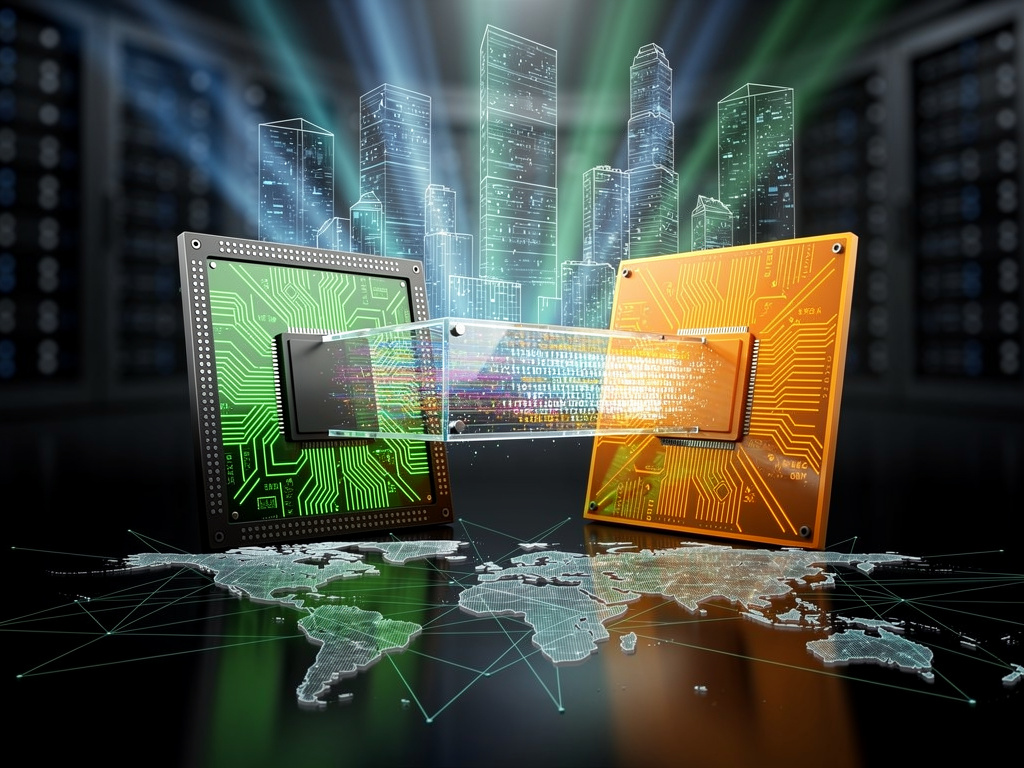
Nvidia Corp. has announced a non-exclusive licensing deal with AI inference startup Groq Inc., enabling access to its specialized chip technology while onboarding key executives, including Groq’s founder Jonathan Ross and President Sunny Madra. The agreement, unveiled on December 24, 2025, allows Nvidia to integrate Groq’s innovations into its extensive AI ecosystem without pursuing a full acquisition, as Groq commits to operate independently under new CEO Simon Edwards.
This strategic move highlights Nvidia’s ongoing efforts to reinforce its position in AI inference—the deployment of trained models for practical applications—amid increasing competition from companies such as Amazon.com Inc. and Alphabet Inc. Groq, recognized for its Language Processing Unit (LPU) chips, promises faster and more efficient inference compared to traditional GPUs. The technology licensed from Groq is expected to enhance Nvidia’s offerings on a global scale, according to a post from Groq.
Founded in 2016 by Jonathan Ross, a former Google engineer who led the Tensor Processing Unit (TPU) team, Groq has quickly disrupted the AI chip industry with its LPU architecture. Unlike Nvidia’s graphics processing units, which are optimized for both training and inference, Groq’s deterministic design emphasizes low-latency inference, making it ideal for applications such as real-time chatbots and voice assistants. The startup has raised over $1 billion from prominent investors, including Chamath Palihapitiya, facilitating the rapid expansion of GroqCloud data centers.
In a post on X, Palihapitiya reflected on his early investment in Groq, recalling a 2016 meeting where Ross convinced him of the potential to challenge industry giants and innovate in silicon technology. This licensing deal validates Groq’s growth trajectory, even as it results in the departure of its top talent to Nvidia.
According to the agreement, Nvidia will license Groq’s inference intellectual property non-exclusively, allowing Groq to continue developing and selling its own chips. Ross, Madra, and other team members will join Nvidia to enhance and scale the licensed technology, per Groq’s announcement. Simon Edwards, previously Groq’s COO, will take over as CEO, ensuring continuity for GroqCloud customers.
The Wall Street Journal reported that Nvidia’s agreement furthers its investments in companies linked to the burgeoning AI sector, citing sources familiar with the matter. This ‘acqui-hire lite’ model reflects a trend among Big Tech companies, enabling them to secure talent and technology while minimizing antitrust scrutiny.
As demand for AI inference soars, driven by models like OpenAI’s GPT series shifting from training to deployment, Groq claims its LPUs deliver ten times the speed and lower costs, attracting developers via GroqCloud’s API. Facing supply constraints, Nvidia views this licensing deal as a strategic means to counter its rivals. CNBC initially speculated on a possible $20 billion asset deal but later clarified that the arrangement is focused on licensing.
Industry observers have noted that Nvidia’s acquisition of Groq’s leadership is aimed at embedding LPU-like efficiencies into its Blackwell platform. Posts on X from analysts such as Gergely Orosz indicate that this deal could have significant implications for open inference standards.
For Nvidia, this development strengthens its capabilities in inference at a time when CEO Jensen Huang has described the current AI landscape as a “once-in-a-generation” opportunity. Integrating Groq’s technology could enhance Nvidia’s Inference Microservices, potentially reducing latency for edge AI applications. Bloomberg reported that the deal allows Nvidia to introduce a new type of technology into its product lineup.
Despite the changes, Groq’s independence is expected to preserve competition in the market. The company emphasized on its blog that GroqCloud will continue to operate without disruption. Investors like Palihapitiya took to X to express their support, signaling a positive outlook for Groq despite the departure of key personnel.
With Edwards at the helm, Groq is now looking towards partnerships with the U.S. Department of Energy to explore energy-efficient computing solutions. Reports indicate that Nvidia aims to leverage Groq’s accelerator technology for broader AI adoption. Business Insider highlighted the talent acquisition, emphasizing Ross’s background at Google, which positions Nvidia to dominate inference engineering. TechCrunch cautioned that this deal further cements Nvidia’s lead in chip manufacturing in the evolving AI landscape.
The New York Times characterized the agreement as enhancing Nvidia’s influence in the AI chip market. As the industry shifts its focus to inference, more partnerships like this are anticipated; Groq’s LPU could pave the way for hybrid Nvidia chips by 2026. Market reactions to the news were subdued on Christmas Eve, but analysts predict a positive impact on Nvidia’s share prices. Meanwhile, Groq’s continued operation as an independent entity challenges assumptions surrounding inevitable buyouts in the tech sector.
Groq’s LPU technology utilizes a spatial array of tensor cores combined with compiler-optimized scheduling to deliver predictable inference, which contrasts sharply with GPUs’ sequential processing. Licensing this technology will enable Nvidia to adapt it within its CUDA ecosystem, potentially yielding sub-millisecond latencies crucial for advanced AI applications. Observers in the industry have expressed excitement over the potential for Nvidia to develop LPU-GPU hybrids that could transform hyperscale deployments.
See also AI Disrupts U.S. Labor Market: 12% of Jobs at Risk, MIT Study Reveals
 TCL Unveils AI-Driven Innovations, Projecting $140M Economic Impact by 2025
 Texas Developer HGP Proposes Recycled Navy Nuclear Reactors for AI Data Centers
 MindMap AI Launches Chat-Driven Mind Mapping with 50% Off Annual Plans and 30,000 AI Credits
 Local AI PCs Surge as Intel, AMD, and Qualcomm Achieve 180+ TOPS Performance