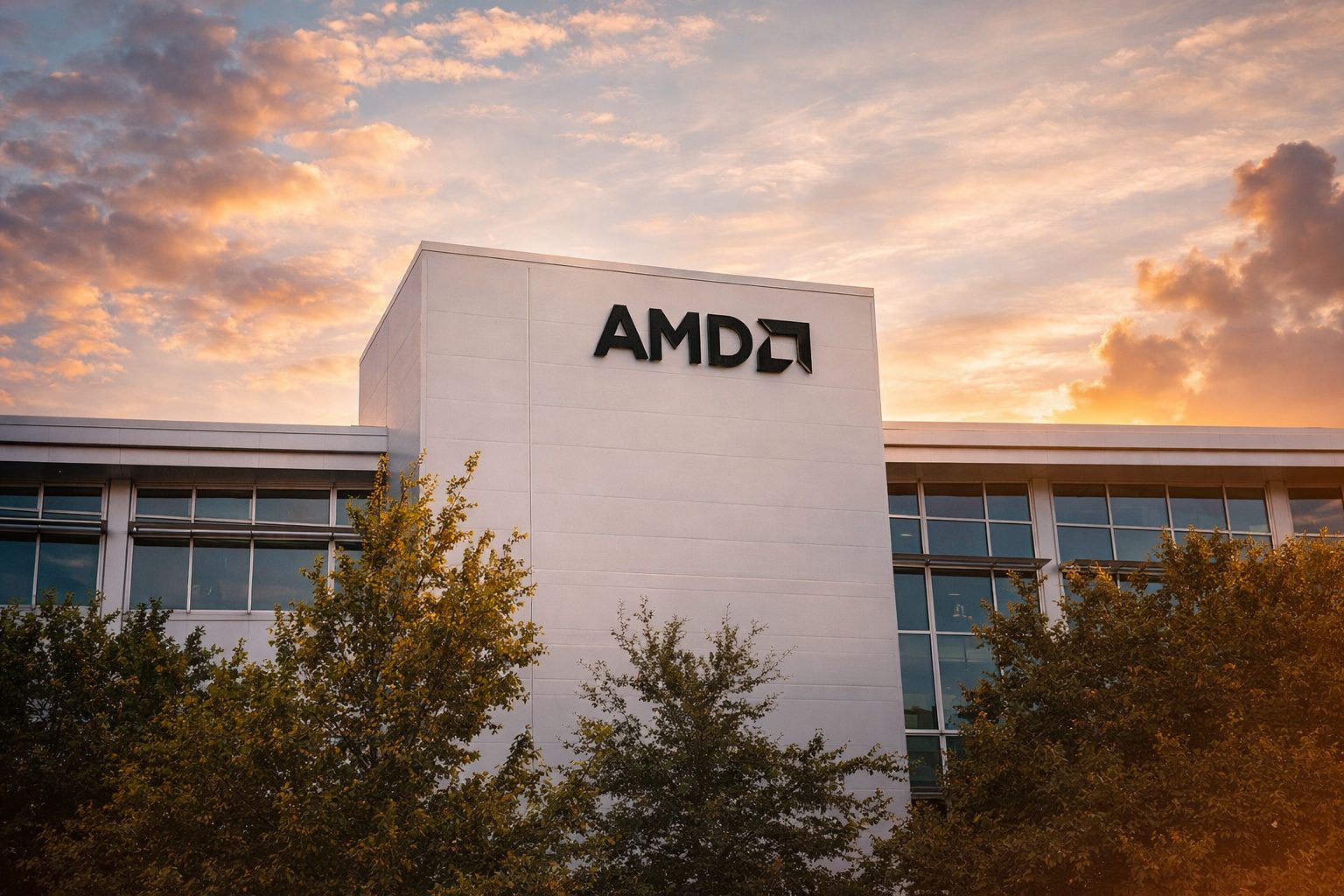
Advanced Micro Devices, Inc. (NASDAQ: AMD) is entering the final week of 2025 amid diverging narratives that are capturing investor interest: a surge in demand for AI infrastructure beyond major tech firms, coupled with tightening regulations concerning the export of high-end computing chips to China. On a subdued Christmas Day for financial markets, AMD’s story continues to unfold; new export licensing frameworks are evolving, with large buyers in China reportedly assessing substantial orders, while AMD’s roadmap emphasizes rack-scale systems and multi-year AI collaborations with prominent partners.
As of December 24, 2025, AMD shares were last traded at $215.04, with an intraday range of approximately $214.00–$216.48 and trading volume nearing 8.0 million shares. Recent trading activity indicates why AMD remains a focal point for traders: the stock experienced a notable increase late last week, particularly on December 19, before stabilizing within a narrower band as the holiday approached. This sets the stage for investors’ assessments entering 2026, particularly regarding how much of AMD’s AI potential can translate into sustainable revenue and margins, and how much will be impacted by geopolitical factors.
A critical development for AMD’s near-term AI accelerator business is the conditional reopening of channels for shipping certain AI chips to China. According to reports, AMD CEO Lisa Su indicated that the company possesses licenses to export some MI308 chips to China and is prepared to pay a 15% fee to the U.S. government upon shipment. The MI308 chip is described as a downgraded variant compliant with U.S. export controls and was included in restrictions with Nvidia’s H200 earlier in 2025. This unusual arrangement, which also involves Nvidia, raises questions among lawmakers regarding the legal and practical longevity of the structure.
Even a limited channel to China could significantly influence the supply-demand balance and inventory strategies for AMD, which has been scaling its Instinct shipments and striving to diversify its AI customer base beyond a few major buyers. However, challenges remain, as Chinese policy is reportedly pushing for state-funded data center projects to utilize domestically produced AI chips, potentially limiting the market size for U.S. manufacturers even with existing licenses.
In this context, market attention has turned to reports that Alibaba is contemplating a substantial order of AMD’s AI accelerators. TechNode has reported that Alibaba is evaluating a purchase of 40,000 to 50,000 MI308 accelerators, which have received U.S. export approval but require AMD to pay the aforementioned licensing fee. If confirmed, this order would not only represent a significant unit volume, especially during a period of expansive AI buildouts but would also signal that major Chinese AI entities still see value in importing U.S. accelerators when allowed.
AMD’s engagements in China have also been noteworthy, with Lisa Su meeting with China’s Commerce Minister Wang Wentao in Beijing to discuss AMD’s business growth and the potential for “strengthening cooperation.” In the current regulatory climate, such meetings are closely monitored for insights into regulatory trends and customer access.
While export policy remains a central topic in trading discussions, AMD’s operational narrative is also about the sources of demand, particularly from cloud providers seeking to establish themselves as viable alternatives to the hyperscalers. Recently, Vultr, a cloud infrastructure company, announced plans to invest over $1 billion in a 50-megawatt, 24,000-chip AI cluster in Springfield, Ohio, using AMD Instinct MI355X GPUs. The CEO stated that Vultr’s offerings are typically priced below those of the hyperscalers, making such deals strategically significant for AMD as they help validate AMD’s scalability in cloud deployments.
Amid these developments, AMD’s ongoing partnership with OpenAI remains a focal point of its AI strategy. AMD has committed to deploying 6 gigawatts of AMD GPUs over multiple generations, with the initial 1 gigawatt rollout of the AMD Instinct MI450 Series GPUs expected to commence in the latter half of 2026. Notably, AMD issued a warrant for up to 160 million shares of common stock to OpenAI, structured to vest as milestones are achieved, starting with the initial deployment and progressing as total purchases reach 6 gigawatts.
AMD is strategically framing its AI future around rack-scale infrastructure. A recent collaboration with HPE seeks to expand open rack-scale AI infrastructures, with HPE among the first OEMs to adopt AMD’s “Helios” architecture. The partnership references a supercomputer built on an HPE Cray platform utilizing AMD Instinct MI430X GPUs and next-generation AMD EPYC “Venice” CPUs. In its latest financial disclosures, AMD indicated that customer momentum for its AI platforms is accelerating, including a publicly available AI supercluster planned by Oracle based on the Helios design.
AMD’s third-quarter 2025 revenue reached $9.246 billion, reflecting a 36% year-over-year increase. The Data Center segment contributed $4.3 billion, up 22% year-over-year, driven by demand for 5th Gen EPYC processors and Instinct MI350 Series GPUs. Crucially, AMD noted that its third-quarter results did not include revenue from MI308 shipments to China, and its fourth-quarter guidance projects revenue of approximately $9.6 billion ± $300 million, with a non-GAAP gross margin around 54.5%—again excluding MI308 revenue.
The tightening landscape around chip exports is intensifying, with proposed legislation like the SAFE Chips Act aiming to solidify current export rules for roughly 30 months, effectively restricting AMD and Nvidia to MI308/H200 products for China. Meanwhile, shifting U.S. policy regarding Nvidia suggests that the export control landscape remains dynamic and uncertain. For AMD investors, the implications are clear: policy changes could dramatically influence revenue forecasts, margin structures, and inventory management.
Looking ahead, AMD has several significant events that could influence market sentiment. CEO Dr. Lisa Su is set to deliver the opening keynote at the CES 2026 on January 5, 2026, where updates on AI PCs, client CPUs, and graphics will be anticipated. Additionally, the next earnings report is estimated for February 3, 2026, and any developments regarding MI308 orders or clarity on the 15% fee framework could materially impact AMD’s near-term performance. With these factors at play, AMD must navigate a complex landscape as it seeks to convert its 2025 momentum into a successful 2026.
See also AI Disrupts U.S. Labor Market, Automating 12% of Jobs; $1.2 Trillion Wage Impact Looms
 DeepSeek R1 Achieves Elite AI Reasoning with $5.58M Budget, Disrupts Industry Norms
 AppLovin’s Axon AI Fuels Q3 Growth Surge; Analysts Eye $945 Target for 2026 Expansion
 Mercor and Surge AI Surge as Profitable Leaders in Specialized AI Training Data Market
 Cloud Computing Surpasses $1 Trillion in 2026 as Agentic AI Transforms Industry