






















































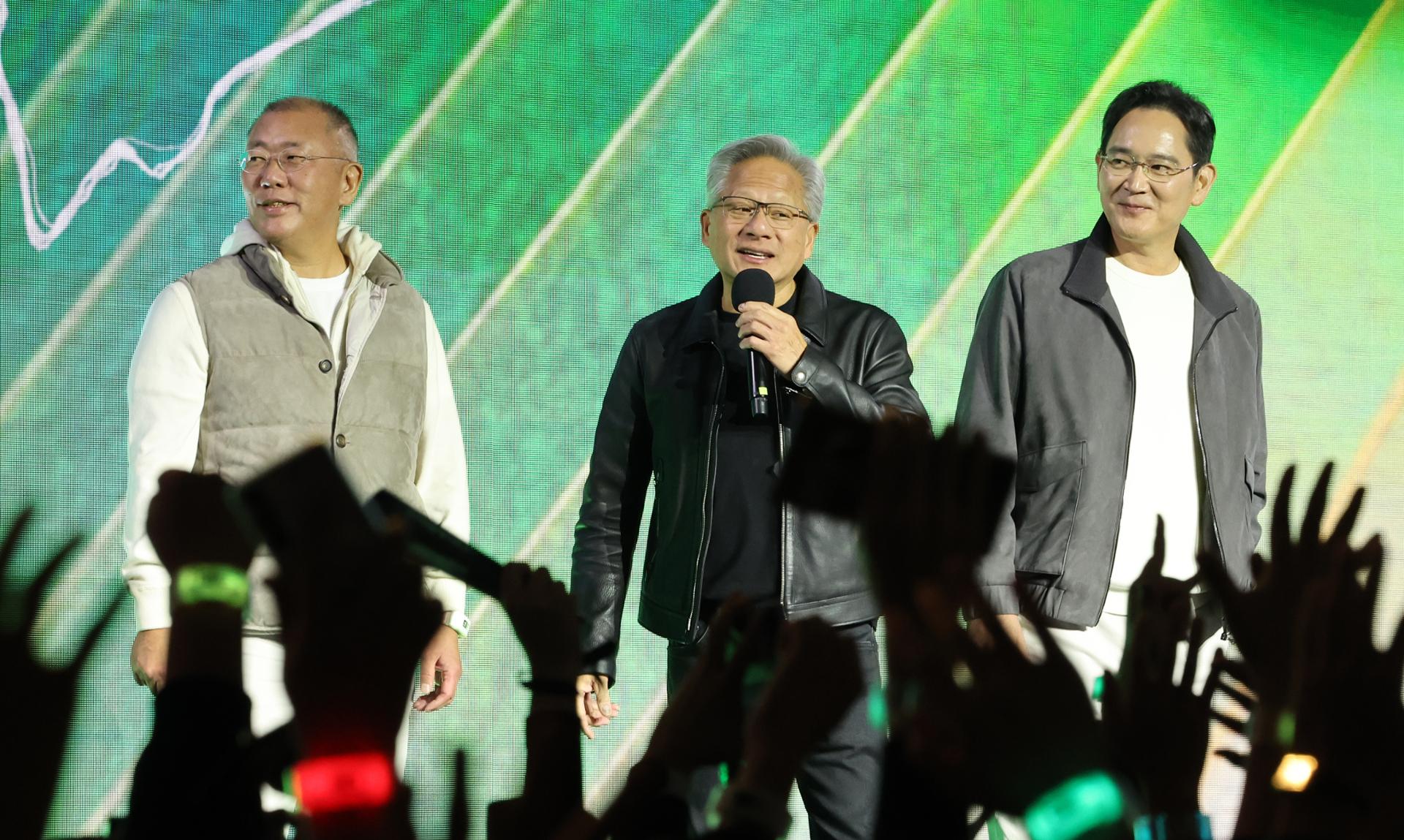
Nvidia CEO Jensen Huang announced a significant collaboration with South Korea during the GeForce Gamer Festival in Seoul on October 30. The partnership aims to enhance Korea’s artificial intelligence (AI) infrastructure, supported by the government and local conglomerates, as the nation pivots toward a more aggressive AI strategy. This initiative coincides with the South Korean government’s elevation of sovereign AI to a core national strategy, marked by a notable budget increase and the passage of a comprehensive AI framework law, set to take effect next year.
As global alliances solidify, companies in Korea are expanding their focus beyond language models to real-world AI applications, while the hardware sector experiences a memory supercycle driven by surging demand in data centers. This has resulted in supply bottlenecks not only for AI-specific high-bandwidth memory (HBM) but also for conventional memory semiconductors.
Nvidia is positioned at the forefront of this transformation. Huang’s recent visit coincided with the 2025 Asia-Pacific Economic Cooperation meetings, during which he unveiled plans to supply 260,000 Nvidia Blackwell graphics processing units (GPUs) to key players such as Samsung Electronics, SK Group, Hyundai Motor Group, and Naver. The GPUs will empower these companies to integrate AI technologies into their manufacturing capabilities while also enhancing Naver’s hyperscale data centers.
OpenAI CEO Sam Altman has also played a critical role in this AI push, visiting Korea multiple times and facilitating partnerships that led to Samsung and SK joining the $500 billion Stargate project for AI infrastructure in the United States. Each company will supply memory chips to meet OpenAI’s demands, contributing approximately 900,000 wafers of high-performance dynamic random-access memory (DRAM) monthly.
This collaboration with Nvidia and OpenAI signals a pivotal shift in Korea’s AI strategy, underscoring the government’s commitment to securing competitive AI infrastructure amidst escalating global competition. In January, the Framework Act on the Development of AI and the Creation of a Foundation for Trust was enacted, set to take effect on January 22, 2025, making Korea the first country to implement such a comprehensive AI policy.
The AI Basic Law aims to regulate the domestic AI industry by defining high-risk AI systems, introducing obligations related to safety and transparency, and establishing a governance framework that addresses data use and liability. This regulatory clarity is expected to build trust in AI technologies and accelerate their adoption across various sectors. However, concerns have been raised regarding the definitions of high-risk AI and potential compliance burdens on smaller businesses.
In response, the government is working to clarify standards through enforcement decrees while considering grace periods for penalties, allowing companies time to adapt to the new legislation. With the Lee Jae Myung administration prioritizing AI, the national budget for AI has been significantly increased to 10.1 trillion won ($6.94 billion), reflecting a threefold rise from the previous year.
The establishment of the Presidential Council on National AI Strategy further underscores the government’s commitment to building a robust AI ecosystem, focusing on creating national computing centers and related infrastructure. This initiative aims to foster growth in businesses centered on neural processing units and non-GPU AI accelerators, positioning AI as a strategic national asset.
The domestic AI industry is rapidly evolving, shifting its focus from developing language models to implementing real-world applications. Leading conglomerates have initiated AI chatbots for internal management and customer interactions, while automating various operational functions. In manufacturing, AI is increasingly utilized for real-time anomaly detection, automated quality inspections, and enhanced operational efficiencies through robotics.
This surge in AI applications has led to an exponential growth in demand for data centers powered by AI accelerators and memory chips, triggering a memory supercycle. Companies like Samsung and SK hynix have reported difficulties in meeting the soaring demand, even with full-capacity production. The supply bottleneck has resulted in price increases for HBM, with HBM3E chip prices rising by approximately 20 percent.
Market analysts are optimistic about the continued financial performance of Samsung and SK hynix, amid rising contract prices for DRAM. According to market tracker TrendForce, contract prices for DRAM surged 420 percent this year, climbing from $3.75 in January to $19.50 in November. This increase in memory prices is anticipated to affect the costs of computing devices, including smartphones, as the market turns its attention to how the AI trend may benefit other chip categories.
See also Kazakhstan Achieves 60th in Global AI Readiness Index, Leading Central Asia in Adoption
 Japan Boosts AI and Semiconductor Investment to $7.9 Billion in 2024 Budget
 Palantir and BigBear.ai Stocks Surge 156.7% and 35.5% in 2025, Outlook Strong for 2026
 Abacus News Launches $1M AI Fund to Capture 2026 Deployment Wave














