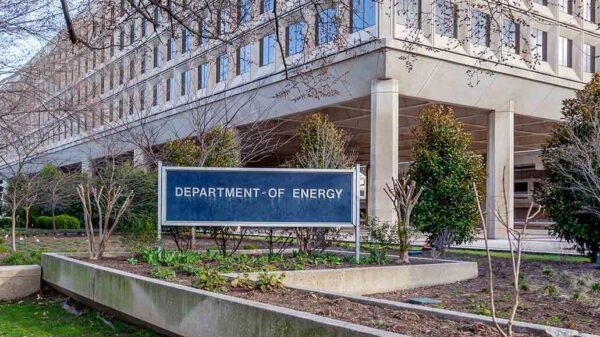
A Texas power developer, HGP Intelligent Energy LLC, is proposing a novel approach to meet the burgeoning energy demands of large-scale artificial intelligence data centers. The company aims to repurpose retired U.S. Navy nuclear reactors from decommissioned aircraft carriers and submarines to provide a continuous power supply. HGP has filed for a loan guarantee with the U.S. Department of Energy under federal energy financing programs for what it terms the “CoreHeld Project.”
The project involves deploying two naval pressurized water reactors at a dedicated data center campus located near the Oak Ridge National Laboratory in Tennessee. This site, historically significant as the birthplace of the Manhattan Project, is now home to the largest multi-program science and technology lab in the United States. The reactors in question are designed for long operational lifetimes and have a proven record of safe usage within the Navy, having been built by established firms such as Westinghouse Electric Co. and General Electric Co.
These reactors are expected to generate between 450 and 520 megawatts of baseload power, sufficient to support the intense AI training and inference workloads that require consistent electricity availability. The estimated cost for the CoreHeld Project ranges from $1.8 billion to $2.1 billion, translating to approximately $1 million to $4 million per megawatt. This pricing is significantly lower than the costs associated with constructing new nuclear plants or small modular reactors.
However, several regulatory hurdles complicate the transition of these naval reactors for civilian use. The reactors typically utilize highly enriched fuel and are designed as sealed systems, which do not fit neatly within the existing licensing frameworks established by the Nuclear Regulatory Commission for commercial power plants. HGP is aware of these challenges but remains optimistic about the project’s viability. “We already know how to do this safely and at scale, and we’re fortunate to have a solid base of investors and partners who share that vision,” stated HGP Chief Executive Gregory Forero in a communication to Bloomberg.
The proposal underscores a growing urgency to address the mounting pressure on the U.S. power grid as demand for AI workloads drives a rapid expansion of hyperscale data centers. With cloud providers and infrastructure operators increasingly exploring nuclear energy as a sustainable source of carbon-free, reliable power, interest has surged in various nuclear solutions, including traditional reactors, small modular reactors, and long-term power purchase agreements with nuclear facilities.
Moreover, the venture capital community is taking note of the potential for nuclear power to underpin AI data centers. For instance, X-energy Reactor Co., a startup focused on developing miniature nuclear reactors, secured $700 million in funding last November. Similarly, Radiant Industries Inc., known for portable, mass-produced nuclear microreactors, raised over $300 million in December.
As the energy landscape evolves, HGP Intelligent Energy’s proposal reflects an innovative approach to meet the increasing energy demands of AI while also addressing regulatory and safety concerns associated with repurposing naval reactors. The broader implications of this project could reshape discussions around energy sustainability in the tech sector, leading to new opportunities for nuclear power in civilian applications.
See also MindMap AI Launches Chat-Driven Mind Mapping with 50% Off Annual Plans and 30,000 AI Credits
 Local AI PCs Surge as Intel, AMD, and Qualcomm Achieve 180+ TOPS Performance
 NSLLM Framework Enhances LLMs’ Efficiency and Interpretability with Neuromorphic Design
 Oracle Faces 30% Stock Drop Amid AI Execution Doubts and $50B Capex Commitment
 Dell Achieves $12.3B in AI Server Orders, Expecting 150% Growth in FY2026