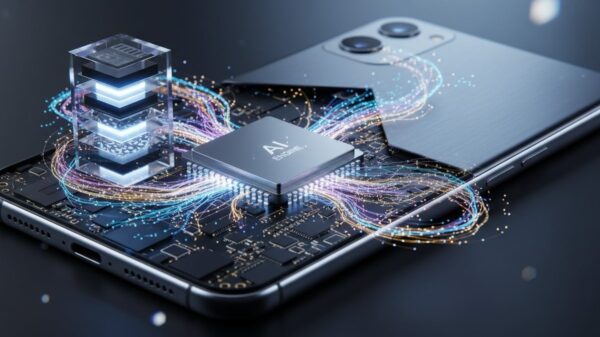
As the year 2025 concludes, the technology landscape has experienced a rapid transformation that few anticipated. The concept of the “AI PC,” once merely a marketing term for the initial wave of neural-enabled laptops introduced in late 2024, has evolved into an essential architectural standard. In this year, the industry transitioned from a cloud-dependent model of artificial intelligence to a “local-first” paradigm, wherein the silicon within laptops now possesses the capability to perform complex reasoning, generate media, and manage autonomous agents without relying on remote servers.
The implications of this shift are profound. By December 2025, the introduction of next-generation processors from major players like Intel, AMD, and Qualcomm—each delivering over 40 Trillion Operations Per Second (TOPS) via dedicated Neural Processing Units (NPUs)—has effectively rendered the traditional PC obsolete. This evolution means that for consumers and enterprises, the focus has shifted from considerations of clock speeds and core counts to “AI throughput.” This revolution has fundamentally altered software development, privacy management, and the competitive dynamics among the world’s largest tech companies.
The Silicon Arms Race
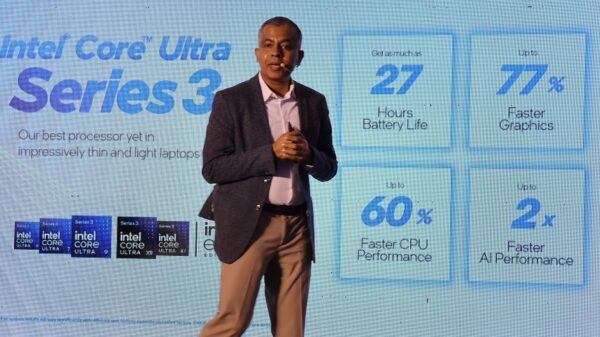
At the heart of this revolution are three breakthrough architectures introduced in 2025. Leading this charge is Intel (NASDAQ: INTC) with its Panther Lake architecture, specifically the Core Ultra Series 3. Utilizing the advanced Intel 18A process node, Panther Lake notably integrates the “NPU 5” engine, delivering a dedicated 50 TOPS of AI performance. When paired with the new Xe3-LPG “Celestial” integrated graphics, the platform achieves an impressive total compute power exceeding 180 TOPS, facilitating real-time video generation and intricate language model inference entirely on-device.
Meanwhile, AMD (NASDAQ: AMD) filled the mainstream gap with its Kraken Point processors throughout 2025. While the high-end Strix Halo chips targeted workstations earlier in the year, Kraken Point brought 50 TOPS of XDNA 2 performance to the $799 price segment, democratizing access to Microsoft’s “Copilot+” standards. Late in 2025, Qualcomm (NASDAQ: QCOM) raised the bar with the launch of the Snapdragon X2 Elite, featuring the 3rd Gen Oryon CPU alongside an impressive 80 TOPS Hexagon NPU, reinforcing its lead in “AI-per-watt” and compelling x86 competitors to innovate rapidly.
This new wave of silicon distinguishes itself by going beyond basic “background tasks” such as noise cancellation. The chips from 2025 are engineered for Agentic AI, enabling local models to interact with on-screen content, navigate file structures, and execute multi-step workflows across applications. The research community has responded with cautious optimism, acknowledging the hardware advancements while noting that the software ecosystem is still striving to keep pace. At the 2025 AI Hardware Summit, experts highlighted the critical shift to 3nm and 18A process nodes as pivotal in preventing these high-TOPS chips from overheating, a feat that seemed improbable just two years prior.
This shift to local AI has had significant repercussions for major firms, particularly Microsoft (NASDAQ: MSFT) and NVIDIA (NASDAQ: NVDA). Microsoft has effectively leveraged its “Copilot+” branding to instigate a hardware refresh cycle that has benefited OEMs such as Dell, HP, and Lenovo. Notably, the unexpected collaboration between NVIDIA and MediaTek culminated in the late-2025 launch of the “N1” series of Arm-based consumer chips. This initiative has introduced NVIDIA’s Blackwell GPU architecture into the integrated SoC market, achieving integrated AI performance nearing 200 TOPS and transitioning NVIDIA from a component supplier to a significant platform competitor against Intel and AMD.
For cloud giants including Amazon (NASDAQ: AMZN), Google (NASDAQ: GOOGL), and Microsoft’s Azure, the rise of the AI PC has necessitated a strategic pivot. While smaller inference tasks like text summarization have migrated to devices, there is an increasing demand for cloud-based training and “Confidential AI” offloading. We have entered an era of Hybrid AI, where devices manage immediate tasks while leveraging cloud resources for extensive reasoning operations that surpass 100 billion parameters, safeguarding hyperscaler revenues while simultaneously reducing operational costs.
Startups have also begun to carve a niche in “Local-First” software, as those previously burdened by high cloud-inference costs are now launching “NPU-native” versions of their applications. Innovations range from local video editors capable of real-time rotoscoping to personal assistants designed with privacy in mind, shifting the competitive advantage to entities that can optimize their models for the specific NPU architectures of Intel, AMD, and Qualcomm.
The broader implications of the 2025 AI PC revolution are most evident in privacy and data sovereignty. For the first time, users can access advanced generative AI without incurring a “privacy tax.” Features like Windows Recall and Apple Intelligence—operating on the Apple (NASDAQ: AAPL) M5 chip’s 133 TOPS architecture—function within secure device enclaves. This development has substantially mitigated criticisms from privacy advocates that plagued early AI integrations in 2024, as local data management empowers corporations to deploy AI at scale securely.
This pivotal moment is frequently compared to the transition from dial-up to broadband. Just as the latter enabled a new class of always-on applications, the 40+ TOPS standard has ushered in “always-on” intelligence. However, it has also raised concerns about a new “Digital Divide.” As of December 2025, a significant segment of the global PC install base—those utilizing chips from 2023 or earlier—finds themselves locked out of the next generation of software. This “AI legacy” issue is compelling IT departments to hasten upgrade cycles, thereby contributing to increased e-waste and supply chain pressures.
Looking forward to 2026, discussions are already surfacing about the “Autonomous OS.” With hardware bottlenecks largely resolved by the 2025 chip generation, the focus is anticipated to shift toward software capable of functioning as true digital twins. Expectations are set for the introduction of “Zero-Shot” automation, where users can issue high-level verbal commands such as “Organize my taxes based on my emails and spreadsheets,” with local NPUs orchestrating entire processes independently.
The next significant hurdle will be memory bandwidth. While NPUs have dramatically increased in speed, the “memory wall” continues to pose challenges for running the largest Large Language Models (LLMs) locally. Analysts predict that 2026 will see major advancements in LPCAMM2 and high-bandwidth memory (HBM) integration in premium consumer laptops. By 2027, it is projected that the concept of an “NPU” may fade, as AI acceleration becomes intrinsically integrated into every transistor within CPUs and GPUs, making it indistinguishable from conventional processing architecture.
The AI PC revolution of 2025 will likely be recognized as the moment that redefined what it means to own a “Personal” Computer. The transition from a cloud-centric framework to an edge-computing reality marks one of the swiftest architectural shifts in silicon history, transforming AI from a service-oriented model into an intrinsic feature of personal hardware. As we approach 2026, the focus will transition from “How many TOPS do you have?” to “What can your AI actually accomplish?” With hardware readiness and shrinking models, the cloud is no longer the sole domain of intelligence. Anticipation builds for the debut of the first “NPU-exclusive” software titles at CES 2026, signaling the definitive end of the traditional computing era.
See also NSLLM Framework Enhances LLMs’ Efficiency and Interpretability with Neuromorphic Design
 Oracle Faces 30% Stock Drop Amid AI Execution Doubts and $50B Capex Commitment
 Dell Achieves $12.3B in AI Server Orders, Expecting 150% Growth in FY2026
 Coforge Acquires Encora for $2.35B to Enhance AI Engineering and Cloud Services